








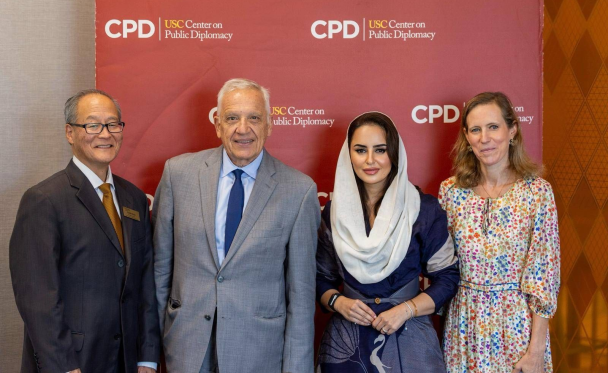
Technology Diplomacy: A Conversation With Her Excellency Deemah Al Yahya
The USC Center on Public Diplomacy (CPD), in partnership with March Capital, hosted “Technology Diplomacy: A Conversation With Her Excellency Deemah Al Yahya,” bringing together diplomacy, technology and public policy to examine how governments can navigate a rapidly changing digital landscape.
H.E. Deemah Al Yahya, Secretary-General of the Digital Cooperation Organization (DCO), joined Yannis C. Yortsos, Chester Dolley Professor of Chemical and Petroleum Engineering at USC Viterbi, for a wide-ranging discussion on the growing geopolitical significance of technology and the skills diplomats will need to address it. Al Yahya framed the central challenge around a fundamental distinction: digital diplomacy uses technology as a tool for conducting diplomacy, while tech diplomacy is diplomacy for technology—the negotiation of the norms, treaties and frameworks that will govern emerging technologies.

Al Yahya described a global order in which technology companies, digital infrastructure and artificial intelligence increasingly wield influence once associated primarily with states. Her presentation explored the strategic competition surrounding semiconductors, AI and cloud infrastructure, as well as the emergence of a more fragmented digital environment shaped by different regulatory approaches in the United States, China and Europe. She argued that these developments have created a governance challenge: technologies can be developed and deployed globally within months, while international agreements may take years or even decades to negotiate. Tech diplomacy, she explained, therefore requires governments to integrate digital issues into foreign policy, negotiate rules for emerging technologies and build bridges among governments, companies and civil society.

The conversation also emphasized that the stakes extend far beyond competition among major powers. Al Yahya highlighted inequalities in access to investment, infrastructure and technological expertise, warning that the countries and communities that help establish the rules and build emerging technologies will also shape the values embedded within them.

Al Yahya identified five interconnected pillars of tech diplomacy—norms and governance; the digital economy and trade; infrastructure and sovereignty; cybersecurity and trust; and inclusion and capacity-building—and pointed to challenges ranging from submarine cable security and ransomware to data-center energy consumption and electronic waste. Diplomacy, in this context, serves as a bridge between technology’s promise and its potential risks by translating shared values into rules, incentives and international cooperation.

Al Yahya also discussed the DCO’s role in developing a more inclusive approach to digital governance, bringing governments together with industry and civil society to develop practical tools, encourage investment and strengthen cross-border partnerships. The organization itself was founded through virtual negotiations during the COVID-19 pandemic—an example, she noted, of technology not merely facilitating diplomacy but making new forms of diplomacy possible.

She concluded with a call to the next generation of diplomats and policymakers at USC: learn the technology, engage directly with those building it, keep people at the center of policy, collaborate across sectors and be willing to reinvent diplomatic practice. As her closing message underscored, the decisions being made about technology today will help determine not only how digital systems operate, but how power, opportunity and international cooperation take shape in the decades ahead.
Visit CPD's Online Library
Explore CPD's vast online database featuring the latest books, articles, speeches and information on international organizations dedicated to public diplomacy.