








The Paralympic Movement and Building an Inclusive Legacy for LA28
Paralympic athletes and advocates joined the USC community on October 12, 2026, to explore how the Los Angeles 2028 Olympic and Paralympic Games can advance accessibility, challenge perceptions of disability and create a lasting legacy of inclusion.
The event, held at USC’s John McKay Center, featured Hellenic Paralympic Committee President and Paralympic gold medalist Georgios Kapellakis, alongside American Paralympians and adaptive sports advocates. Co-hosted by the USC Center on Public Diplomacy and the Consulate General of Greece in Los Angeles, in partnership with USC Athletics, the discussion was part of the Olympic Ideals Series, which examines the values, diplomacy and cultural connections surrounding the Olympic and Paralympic movements.
In his keynote address, Kapellakis reflected on the transformation of the Paralympic movement since the Athens 2004 Games, which he described as a cultural awakening for Greece. Beyond showcasing elite athletes, the Games prompted investments in accessible transportation, public spaces and sporting facilities while inspiring a generation of volunteers.

Georgios Kapellakis
“An accessible city is a better city for everyone,” Kapellakis said, emphasizing that the most enduring achievements of the Games extend far beyond athletic competition.
Drawing on his own journey from a life-changing injury on the Greek island of Crete to Paralympic gold, Kapellakis described the obstacles he faced entering competitive swimming, including facilities without accessible showers or changing rooms. Sport, he explained, restored his sense of purpose and opened possibilities he had never imagined.
Turning to Los Angeles, Kapellakis urged USC students to volunteer, attend competitions and become advocates for inclusion. “The most important legacy of the Los Angeles 2028 Paralympic Games will not be the stadiums built or the medals won,” he said. “It will be the change in the minds of your fellow citizens.”
Following his remarks, Clayton Frech, founder of Angel City Sports and father of two-time Paralympic gold medalist Ezra Frech, moderated a panel featuring Kapellakis; Robert Tanaka, a USC alumnus who represented Team USA in judo at the Tokyo Paralympics; and Damon Whittaker, a para archer and adaptive sports athlete preparing to compete at LA28.

Clayton Frech
Frech recounted how his son's birth with limb differences inspired him to establish Angel City Sports, which provides opportunities for people with physical disabilities to participate in athletics. He identified three priorities for the Paralympic movement: greater public awareness, broader access to adaptive sports and increased participation at every level.
“It's actually about just living in your body, having fun, playing, finding community and then dreaming about what your life could look like,” Frech said.
Tanaka, who was born with albinism and has limited vision, recalled discovering judo at age five and eventually competing internationally. He emphasized the importance of making adaptive sports opportunities more visible to young people with disabilities. “The more that people are informed,” he said, the easier it becomes for future athletes to get involved.

Robert Tanaka
Whittaker, an Inglewood native who sustained a spinal cord injury as a teenager, described how discovering adaptive sports transformed his outlook. He encouraged attendees to experience adaptive athletics firsthand and consider the everyday accessibility challenges facing people with disabilities. “Just come out and try and change the perspective,” he said.

Damon Whittaker
The program also highlighted USC's contributions to the cultural legacy of LA28. Brent Blair, founder of the USC Institute for Theater and Social Change, introduced PLY: An Odyssey, a multimedia performance project developed with artists with disabilities and informed by interviews with Paralympians. Combining music, puppetry, mythology and personal narratives, the production is envisioned as part of the cultural programming surrounding the 2028 Games.

Brent Blair
During an audience discussion, speakers addressed the shortage of funding and collegiate athletic opportunities for Paralympians, highlighting the role universities could play in expanding access. Representatives from the Australian Consulate also discussed the importance of sports diplomacy and inclusion as Brisbane prepares to host the 2032 Games.

Throughout the event, speakers returned to a common message: the true measure of LA28's success will be not only what happens inside stadiums, but how the Games transform opportunities, attitudes and everyday life long after the closing ceremonies.
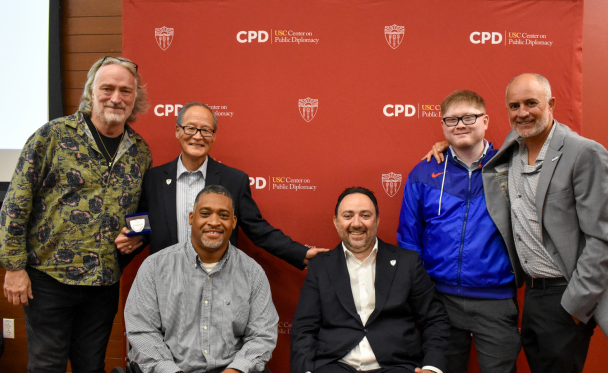
Featured Photo: L-R: Brent Blair, Glenn Osaki, Damon Whittaker, Georgios Kapellakis, Robert Tanaka, Clayton Frech
Visit CPD's Online Library
Explore CPD's vast online database featuring the latest books, articles, speeches and information on international organizations dedicated to public diplomacy.