









The CPD Blog is intended to stimulate dialog among scholars and practitioners from around the world in the public diplomacy sphere. The opinions represented here are the authors' own and do not necessarily reflect CPD's views. For blogger guidelines, click here.
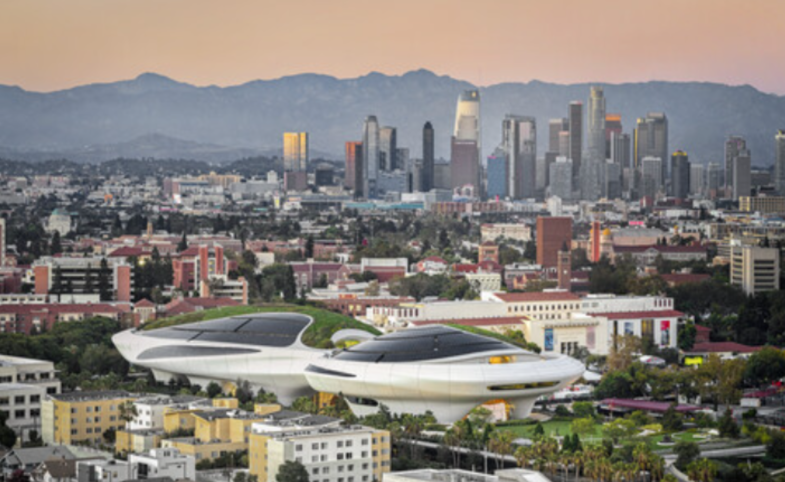
Inside the Lucas Museum, Where Stories and Pictures Meet
George Lucas cried.
Yoji Yamada, director of the film Tokyo Family, worked with composer Joe Hisaishi for the first time on that project. At a panel event commemorating the film's release, Yamada shared an anecdote about how the late director Akira Kurosawa once made George Lucas cry.
My attitude of not wanting to support stereotypical Hollywood movies changed after I heard about this.
I grew up in a very traditional Japanese cultural environment, with a grandfather who dedicated his life to traditional stonework and a grandmother who practiced and taught koto. In these cultural practices and arts, the relationship between teacher and student, mentor and mentee, and among comrades striving to master the same craft, forms the foundation of everything. I saw this for as long as I can remember, in how my grandparents took responsibility for the people who came to them.
After hearing the story of why George Lucas cried, I started watching his movies as a comrade in the filmmaking world.
At the panel event commemorating the release of Tokyo Family, Yamada and Hisaishi engaged in a lively discussion about film music. Hisaishi sharply criticized the current state of the field: "In film music, there is too much music that merely traces what is shown on the screen. When someone runs, there is fast music. When someone cries, there is sad music. It's just an extension of sound effects."
Yamada then recalled an anecdote about Lucas that Kurosawa had told him. Lucas had invited Kurosawa to a preview screening of Star Wars, not a film Kurosawa was particularly interested in. Afterward, riding in a limousine, Kurosawa was repeatedly pressed for his opinion, so he finally said, “There's just too much music.” Lucas began explaining the score, and Kurosawa cut in: “That’s exactly the problem, too much!” Lucas started crying, and Kurosawa later regretted having pushed a little too far.
That unexpected exchange between two legendary directors was heartwarming and memorable, and it gave me a chance to look past the Hollywood movie status quo. They are simply people who love art.
This week, on September 22, 2026, the Lucas Museum of Narrative Art officially opens to the public in Exposition Park, Los Angeles, near his alma mater, the University of Southern California. It’s the culmination of his life’s work, co-founded with his wife Mellody Hobson. Its galleries are filled almost entirely with narrative art Lucas has been collecting for fifty years.

Courtesy Lucas Museum of Narrative Art. Photo by Paul Salveson
Lucas has called the museum a “temple to the people’s art,” a project that took seventeen years to complete after it was first envisioned. It was originally conceived for San Francisco and later Chicago, reaching the initial design phase in both cities before landing in Los Angeles.
“But part of the problem is I'm a contrarian,” Lucas said, shrugging and laughing. “I don't like doing things that people think can be done. I'm fascinated by doing things that people say can't be done. And even when you do it, they say, well, that's not any good, you can't do that, and all that sort of thing. So I'm used to doing the impossible. This one almost broke my will.”
He continued: “Artists who illustrate stories that are already written, and most of those stories are myths, not real, make them real through the illustration. And as a result, in the beginning, especially for a few thousand years, that was the only way you could tell a story: with pictures. It's still that way because a picture is powerful, and the stories are powerful, and you combine them, those two elements create a society. That's why I wanted to build this, because narrative art creates a group of people with a common belief system.”
Many, Lucas included, say that each frame in a Kurosawa film is like a perfect picture, and that all of these elements come together to form a single film. Early in his career, Lucas saw this power of picture and story in the work of directors like Kurosawa, whom he deeply respects.
"The Lucas Museum is a place where a powerful story and a powerful picture meet, narrative art that invites people to seek a common belief system, to create, to work together."
When Star Wars was first released in Japan in 1978, it set off a boom of science-fiction films at home and abroad: King Kong, Close Encounters of the Third Kind, Superman, Alien, Mad Max, Farewell to Space Battleship Yamato, Galaxy Express 999.
Like many people born in the 1960s and 1970s, I too belong to the Star Wars generation. The Star Wars generation has always made it to the theater for the sequels, no matter how much the actors have aged, how much Mark Hamill's movements have lost their sharpness, or how Yoda has taken up acrobatics with his 3D maneuvering gear. It begins with "A long time ago, in a galaxy far, far away," the music alone is exciting, and then comes the unforgettable line, "May the Force be with you."
I was an elementary school student when I saw the first film, following the subtitles word by word, absorbing the world of Star Wars. When Obi-Wan Kenobi explains Darth Vader's betrayal and his seduction by the dark side of the Force, Luke Skywalker asks in confusion, "The Force?" I was confused too, and asked myself, “Riryoku (理力)?” Later, during the climactic Death Star trench run at the end of the film, Obi-Wan’s spirit whispers to Luke, "Use the Force," which I read as “Riryoku wo tsukae (理力を使え).”

Starfighter. Courtesy Lucas Museum of Narrative Art. Photo by Iwan Baan
A few years later, as a middle or high school student, I went to see the later episodes. It was quite a shock to find that riryoku (理力) was gone. It had been replaced by fōsu (フォース), “Force” itself had simply become a Japanese word. I am not sure whether that counts as a success, as a film or as a piece of culture, but I was disappointed, and my special connection to that word disappeared.
When a film crosses a border, I hope it crosses to a place where story and picture truly meet, because Obi-Wan whispering "Use the Force/Riryoku wo tsukae” to Luke, took me there.
Where is that place? How do we create it?
Lucas built the museum the way he’s built countless productions before it. “That common belief system allows people to work together, not kill each other, and do things no one person could do alone,” he said. “There are very few things in this world you can do entirely by yourself. You really need help. You need somebody. At the very least, your mother and your father, your family, and then other people who think the way you do, who share the same belief system.”
The Lucas Museum is a place where a powerful story and a powerful picture meet, narrative art that invites people to seek a common belief system, to create, to work together.
At eighty-two, Lucas carries forward the legacy he has built, and he is now sending a message to the world about the power of stories.
“When you have somebody with talent, somebody who's creative, who thinks outside the box, you get stuff that you've never seen before. And it's very powerful in telling the story, the narrative, of who you are and where you are.”
Featured photo: Courtesy Lucas Museum of Narrative Art. Photo by Hufton Crow

Visit CPD's Online Library
Explore CPD's vast online database featuring the latest books, articles, speeches and information on international organizations dedicated to public diplomacy.
POPULAR ARTICLES
-
September 22
-
October 5
-
October 5
-
September 9
-
September 22
MORE FROM THIS AUTHOR
Join the Conversation
Interested in contributing to the CPD Blog? We welcome your posts. Read our guidelines and find out how you can submit blogs and photo essays >.