









The CPD Blog is intended to stimulate dialog among scholars and practitioners from around the world in the public diplomacy sphere. The opinions represented here are the authors' own and do not necessarily reflect CPD's views. For blogger guidelines, click here.
From the Gallery to the General Assembly: Art as Public Diplomacy
Before I worked at the United Nations, I spent years around artists, curators, photographers and other creative practitioners. They taught me to approach complex questions differently: to look for the unexpected connection, to pay attention to what is missing and to ask not only what people need to know, but what might make them care.
When I later moved into international development, I found myself surrounded by brilliant policy minds. I also saw how easily important ideas could become abstract once translated into institutional language. That tension made me increasingly interested in the role creativity could play in public diplomacy: not simply as cultural programming or a communications layer added after the policy work is finished, but as a way of helping institutions connect ideas, people and lived experience.
That question eventually shaped Hope in Action, an advocacy art exhibition I helped develop for the UN SDG Action Campaign around different global policy priorities. The exhibition traveled through major UN moments in New York, Rome, Baku and Riyadh, adapting its curatorial focus to issues including youth participation, climate action and sustainable development.

Hope in Action at a UN climate conference, featuring photography rooted in lived experience of climate impacts. Credit: Mohammed Mostafa
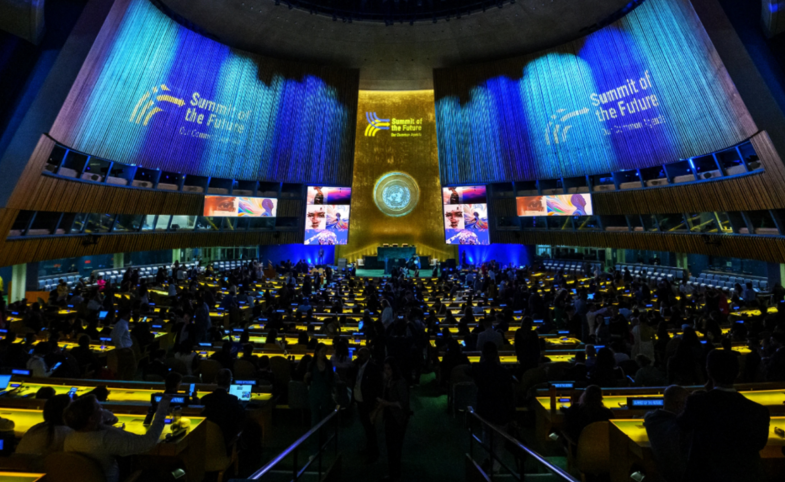
One of the most meaningful editions was created with support from the UN Youth Office for the Summit of the Future Action Days. Artworks were unveiled inside the UN General Assembly Hall, placing young creative voices in a room more often associated with heads of state, diplomats and senior decision-makers.
Among the artists was Richard Zheng, then sixteen, a photographer whose work explored identity, nature and the experience of solitude. For me, the importance of his presence was not simply that a young artist had been given a prestigious platform. It was what the image represented: a different form of knowledge entering an institutional space. A photograph could not replace a policy paper, but it could introduce a perspective, feeling or question that the policy paper might never contain.
The same idea became even clearer when Hope in Action traveled to COP29 in Baku. Climate negotiations necessarily operate through targets, finance, technical language and evidence. Yet behind those abstractions are individual lives.
One photograph we displayed showed a girl standing before the remains of her cyclone-damaged home in the Sundarbans. The image did not explain climate finance, adaptation or loss and damage. Nor was it meant to. Its role was different: it returned one human experience to a conversation conducted at global scale.
This is where I believe art can contribute something distinctive to public diplomacy. It can move between the institutional and the personal. It can make room for voices that do not usually enter formal negotiations. It can create a shared reference point across language, geography and professional background. Most importantly, it can invite people to encounter an issue before asking them to absorb a message about it.
"Policy practitioners bring evidence, institutional knowledge and the ability to act at scale. Artists bring interpretation, imagination and ways of seeing that can challenge assumptions."
Public diplomacy is often discussed in terms of informing or influencing audiences. But the strongest cultural engagement can also create space for participation and dialogue. USC's Center on Public Diplomacy has described public diplomacy in terms of communication across borders, how societies receive messages and new methods of international collaboration and dialogue. Art is particularly well suited to that last part because it does not always arrive with a single prescribed interpretation.
That openness can be uncomfortable for institutions accustomed to controlling language and outcomes. It also requires responsibility. Creative work should not simplify people into symbols, use lived experience as decoration or substitute emotion for evidence. Artists need context and institutions need to give them enough freedom to contribute something more meaningful than an attractive backdrop.
The lesson I took from moving between galleries and global policy spaces is that each side has expertise the other lacks. Policy practitioners bring evidence, institutional knowledge and the ability to act at scale. Artists bring interpretation, imagination and ways of seeing that can challenge assumptions. Communities bring lived experience. Public diplomacy becomes more meaningful when those forms of knowledge are allowed to meet.
Art will not solve the climate crisis, deliver a peace agreement or implement the Sustainable Development Goals. But public diplomacy is not only about the final policy outcome. It is also about relationships: who is invited into a conversation, whose experiences are visible and whether institutions can connect with people beyond their own professional language.
That is why I increasingly see art not as decoration at the edge of diplomacy, but as one of the ways diplomacy can become more public. The gallery and the General Assembly may appear to belong to different worlds. Bringing them together can remind us that policy is ultimately about people, and that sometimes changing the way an issue is seen is the first step toward changing the way people engage with it.
Featured image: Hope in Action at the United Nations General Assembly Hall, New York. Credit: Krisha Sia

Visit CPD's Online Library
Explore CPD's vast online database featuring the latest books, articles, speeches and information on international organizations dedicated to public diplomacy.
POPULAR ARTICLES
-
September 22
-
October 5
-
September 9
-
September 22
-
September 3
MORE FROM THIS AUTHOR
Join the Conversation
Interested in contributing to the CPD Blog? We welcome your posts. Read our guidelines and find out how you can submit blogs and photo essays >.