









The CPD Blog is intended to stimulate dialog among scholars and practitioners from around the world in the public diplomacy sphere. The opinions represented here are the authors' own and do not necessarily reflect CPD's views. For blogger guidelines, click here.
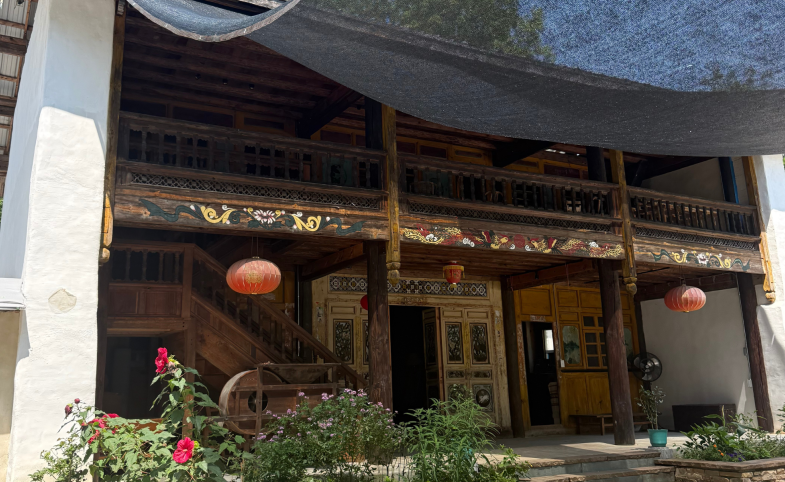
Building Cultural Exchange: People-to-People Diplomacy at the China Folk House
On Aug. 8, 2026, I visited the China Folk House in Harpers Ferry, West Virginia, where co-founder Pamela Leonard welcomed me for tea and a tour of a house that had once stood thousands of miles away in China’s Yunnan province.
It is no traditional museum. Visitors are encouraged to grab a book from shelves filled with Chinese history and literature, participate in woodworking or gardening, and simply stay awhile. Leonard told me that people are welcome to sit in the rooms, play the instruments, try on the clothing upstairs, and even pet her dog. She wants visitors to do more than observe Chinese culture from a distance. The house is meant to be experienced, and in doing so, become a place where people can learn something about a country they might never have visited.
That philosophy has roots in the way the house was first discovered.
Leonard and her husband, John Flower, ran the Sidwell Friends School China Fieldwork Semester from 2014 to 2018. Based at the Linden Centre in Xizhou, Yunnan province, the program took students outside the classroom to study Chinese history, culture, and local communities through fieldwork.

During a trip through the Three Parallel Rivers region in northwest Yunnan, the group visited Cizhong along the upper Mekong River before traveling to nearby Ximalaza. Around thirty homes there were expected to be submerged by the reservoir of the Wunonglong hydropower dam.
There, one of the homeowners, Zhang Jianhua, opened the gate of his house and invited the group inside. Flower admired the craftsmanship and remarked that he wished he could take the house home with him. Zhang agreed.
What began as an unlikely conversation eventually became the China Folk House project.
In the summer of 2017, Flower returned with a small group to study and document the house before dismantling it. The trip was supported in part by a Sidwell Friends grant. After two weeks of documentation, Flower and Leonard used personal funds to purchase the house and its furnishings, take it apart, and ship it to Baltimore. At the time, they still had no permanent location in mind.
"So much of what we hear about China has to do with its government, its policies, or its relationship with the United States. Those conversations leave much less room for the lives of ordinary people."
Eventually, they found one at the Friends Wilderness Center, a Quaker-rooted retreat within the Rolling Ridge Conservancy near the Shenandoah River and Harpers Ferry. Families of former China Fieldwork Semester students helped establish a nonprofit and raise funds, and reconstruction began in 2019 with the help of builders, local craftspeople and student volunteers.
Much of that work is still visible today.
On one exterior wall, six brightly colored paintings sit beneath a metal roof. Leonard told me that students who had visited the house painted them directly on the wall. Students have also taken part in projects ranging from timber framing and masonry to gardening and traditional crafts. The house continues to host educational programs, including summer camps and school visits that introduce students to Chinese art, gardening, building traditions, and other forms of hands-on learning.
The result is a house that keeps changing with the people who pass through it.
I saw that openness during my own visit. Partway through our tour, a woman walked onto the property and explained that she had first noticed the house while hiking in the area several years earlier. She had always wanted to return but didn't know whether she could simply come inside.
Leonard immediately invited her to join us.
For the rest of the afternoon, she joined us. After the tour, Leonard invited both of us to garden with her. The three of us worked together among the plants, and I eventually left with a beautiful bouquet of flowers I had picked there.

I kept thinking about that interaction afterward. This woman had wandered onto the property out of curiosity and left after spending an afternoon learning about a farmhouse from China, its history, and the people who had brought it to West Virginia. Neither of us expected to spend the afternoon gardening with a stranger, but there we were.
At a time when U.S.-China relations are often discussed through political disagreements and competition, the China Folk House offers a different way to engage with the country. Leonard told me that part of its purpose is to challenge stereotypes, giving visitors the chance to encounter parts of Chinese culture they might otherwise only read about.
I find this particularly interesting from a public diplomacy perspective. So much of what we hear about China has to do with its government, its policies, or its relationship with the United States. Those conversations leave much less room for the lives of ordinary people.
The house does not attempt to explain all of China, nor could it. But a visitor can learn Zhang Jianhua's story, appreciate the home he once lived in, and understand that his is only one of many individual stories that make up a country too often discussed as a single entity.
For me, the China Folk House's value lies in these small encounters. Cultural exchange does not always begin with an organized event or a formal conversation about another country. Sometimes, it begins because someone is curious enough to walk through a gate and someone else is willing to invite them in. The China Folk House was an open gate, and I was welcomed inside. To me, that's the essence of cultural exchange.

Visit CPD's Online Library
Explore CPD's vast online database featuring the latest books, articles, speeches and information on international organizations dedicated to public diplomacy.
POPULAR ARTICLES
-
September 22
-
October 5
-
October 5
-
October 13
-
September 9
MORE FROM THIS AUTHOR
Join the Conversation
Interested in contributing to the CPD Blog? We welcome your posts. Read our guidelines and find out how you can submit blogs and photo essays >.