








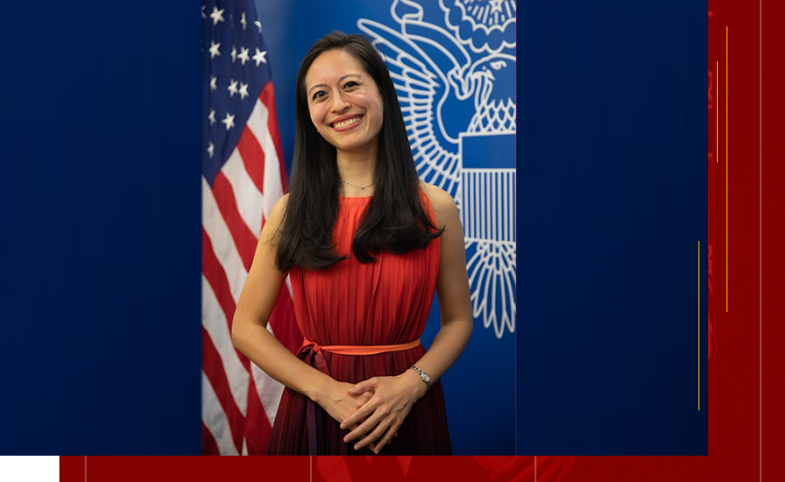
Q&A with CPD: Pauline Yang
In this series, CPD interviews international thought-leaders and key practitioners of public diplomacy. Here, CPD's Christina Fomunyoh speaks with U.S. Arts Envoy and pianist, Pauline Yang.
Piano has been a part of your life for so long. When did you first begin to see music as a bridge for public diplomacy, and what drew you to becoming a U.S. Arts Envoy?
Ever since my concert travels started taking me around the world from the age of eleven, it quickly became apparent to me that music is a superpower that brings people together since I was experiencing this firsthand in concert halls and beyond. Later on, at thirteen, one of my piano teachers impressed upon me that musicians are sometimes sent abroad to help represent their countries in public diplomacy efforts, which fascinated me. During my undergraduate years at USC, that fascination deepened as I watched Michelle Kwan - my lifelong role model and hero - work on sports diplomacy as the first U.S. Public Diplomacy Envoy for the State Department. I dreamed of getting to do something similar through music. Fast forward a few years and I now continue to feel so fortunate every day that my dream of serving as a U.S. Arts Envoy came true, partially since it is an honor and a privilege to serve my country and partially since I have the chance to hopefully help inspire others, just like Michelle (or, more formally, Ambassador Kwan!) did for me, for which I am forever grateful.

Through your work as a U.S. Arts Envoy, you have traveled and performed in a number of countries. Can you recall a particular moment or exchange when you saw music create a connection across cultures? What did you take away from that experience?
There have indeed been so many examples of this, but one particular moment that I especially like to share is from the Taitung stop on my Taiwan tour for the American Institute in Taiwan (AIT). As an encore for a concert for indigenous students at the Wonderland Performing Arts Center, I played a solo piano transcription of "Kipahpah Ima" (which translates into "Clapping Song" in the indigenous Bunun language) which is one of the most well-known traditional songs from that region. There was an especially heartwarming moment right after the intro when the students realized that I was actually playing "their" song, and the entire auditorium spontaneously erupted into the antiphonal clapping rhythm of this song and many also started singing along. That experience perfectly encapsulated for me the proof that music has the extraordinary ability and power to connect people(s) across cultures without even a single word being spoken, as they felt seen (or heard) since I had acknowledged their culture and I felt their excitement, enthusiasm, and warmth in return. It was quite impossible for me to stop smiling on stage since the response was so special and unexpected. Here is a link to that performance for those who may be interested!
(The inspiration to play this transcription came from having seen this beautiful video of Bunun children singing "Kipahpah Ima" on Yushan - Jade Mountain - the tallest mountain peak in Taiwan and Northeast Asia, filmed by the late Chi Po-lin who was best known for his aerial photography.)
Your master’s thesis at The Fletcher School at Tufts University, “Musical Magic: The Roles of Music at the White House and at State Dinners,” explores another intersection of music and diplomacy. What role does music play in spaces where the United States is representing itself to the world?
As one of my professors, former U.S. Ambassador to Austria Swanee Hunt, said, "Music has a way of reaching people that words cannot." And as Leonard Bernstein said, "There are no warmer feelings than those engendered by music" and "[p]eople often think that we come together to play music, but in fact, we play music to come together." In addition to literally bringing people together in a shared physical space for a shared experience, music also helps us form unspoken bonds with one another, based on the universality of human emotions. It is quite remarkable that nearly the entire human population has the same emotional response when listening to Beethoven's "Ode to Joy" movement from his Ninth Symphony, for instance. People typically do not tend to remember what was said in speeches and remarks, but people often do remember how they felt when listening to a particular piece or song. Music can help build bridges, express goodwill, diffuse tensions, and open doors. I often think of when former U.S. Secretary of Defense William Perry's powerful statement that "[y]ou cannot demonize people when you're sitting there listening to their music. You don't go to war with people unless you demonize them first."

Visit CPD's Online Library
Explore CPD's vast online database featuring the latest books, articles, speeches and information on international organizations dedicated to public diplomacy.
Popular Blogs
-
September 22
-
October 13
-
October 5
-
October 5
-
October 26