









The CPD Blog is intended to stimulate dialog among scholars and practitioners from around the world in the public diplomacy sphere. The opinions represented here are the authors' own and do not necessarily reflect CPD's views. For blogger guidelines, click here.
What APEC Can Learn from Iowa
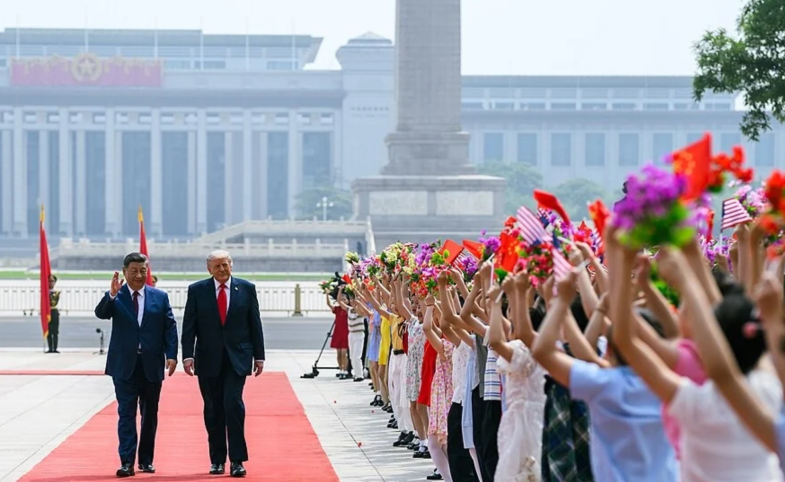
Against a backdrop of mounting tensions and global uncertainty, the September meeting between Presidents Donald Trump and Xi Jinping drew criticism for offering more symbolism than substance. It left the central disputes in U.S.–China relations unresolved and produced few immediate results. Yet their continued engagement offers an important opening to rebuild the people-to-people ties that help sustain the relationship. Both governments should use it to support a lasting network of exchanges grounded in respect, reciprocity and a relentless search for common ground.
Xi’s September 24 invitation for 100,000 young Americans to visit China during the next five years is a significant initiative. Its lasting value will depend on what participants can do after their first visit. Will they establish enduring relationships?
Representatives of The Bridge Cultural Exchange Academy, Tting Dai and Huiqin Chia, interviewed participants about their exchange experience. One of them, Samuel Jacob Griffith, an 18-year-old Iowan, participated in a March 2026 visit to China. He originally chose to study Chinese because he wanted to try something different from his classmates. By his second visit, his fascination with China had blossomed. After visiting Peking University, he was considering applying to spend a semester there during college. A short exchange had prompted him to consider a longer commitment. Whether he can pursue it is the next test.
During that March trip, Iowa students spent three days with Chinese peers in Shijiazhuang, Hebei province. Del Christensen, executive director of Iowa Sister States, explained the longer view to China Daily: “they may become leaders in the future, and the understanding they gain now will help them then.”
Iowa has reason to take that possibility seriously. People who welcomed Xi when he led a corn processing delegation in 1985 and enjoyed a homestay in Muscatine have since helped a new generation make the journey in the other direction. Their experience shows how an encounter can develop into a relationship when someone takes responsibility for continuing it.
It was my privilege to interview Ambassador Kenneth Quinn, who has participated in building ties between China and the United States for decades. He joined the governors’ exchanges of 1979 and 1980, including Iowa Governor Robert Ray’s visit to China and Xi Zhongxun’s subsequent visit to Iowa. Later, as president of the World Food Prize, he helped connect young people through this institution devoted to agriculture and food security.
"Exchanges can help participants question assumptions and assess where cooperation is possible, without requiring them to return home with favorable opinions."
Those exchanges were part of a broader effort to give this diplomatic opening a public foundation of human connections. After the American table tennis team visited China in 1971, the National Committee on U.S.–China Relations co-hosted the Chinese team’s return visit in 1972. It subsequently organized exchanges involving public officials, including Chinese provincial governors in 1980. Organizations gave people opportunities to develop relationships and provided a context for the meetings between national leaders.
Today’s rivalry differs substantially from the circumstances of rapprochement. Critics argue that engagement underestimated security risks or relied on unrealistic expectations of political convergence. An argument for renewed exchanges must take those concerns seriously.
It must also define its purpose. Americans and Chinese citizens need firsthand knowledge of each other, even when their governments disagree. Exchanges can help participants question assumptions and assess where cooperation is possible, without requiring them to return home with favorable opinions.
Security concerns should be assessed according to the activity involved. A secondary-school visit and university research involving sensitive technology present different risks. Programs should disclose their funding and give participants meaningful opportunities to ask questions and experience various aspects of the host culture. Reciprocal arrangements should allow both hosts and participants to help shape the agenda.
Earlier exchanges show that these efforts need not wait for political harmony. The United States and Soviet Union established cultural, technical and educational exchanges in 1958 while remaining adversaries. France and West Germany pursued a different course after the war, creating a youth office in 1963 that supported exchanges through educational and civic organizations. Neither history promises the same outcome for U.S.–China relations, but both demonstrate the importance of sustained institutional support.
In our interview, Quinn emphasized the importance of greater stability following a period of volatility in U.S.–China relations. Continuing presidential dialogue should be encouraged, he argued. It helps make the relationship more predictable. For institutions deciding whether to commit to a partnership, that matters.
His own experience is illustrative and suggests a way forward. During his leadership of the World Food Prize leadership, he recalled, roughly over 100 students from Shijiazhuang Foreign Language School participated in its programs, while American students traveled to other locations in China through the opportunities the organization provided.
Amb. Quinn wanted those connections to lead to shared work. He suggested agricultural projects that could bring Chinese and American students together at the Iowa State Fair. The institutional partnership would continue as successive groups took part, giving program participants a purpose beyond completing the itinerary.
That offers a practical direction for the current opening. Both governments should support a multiyear, reciprocal agricultural exchange program through existing universities and exchange organizations. Participating institutions could develop projects suited to their expertise and provide routes from introductory visits into further study or research.
Agriculture supplies a reason to stay involved. A student interested in soil conservation or food production could work with peers abroad on a question that matters in both communities, then pursue it through an internship or university partnership. At the World Agrifood Innovation Conference in mid-September in Beijing, Quinn valued the opportunity for young people to engage with experienced researchers about challenges they would eventually inherit. A program’s success should therefore be assessed partly through what participants accomplish afterward. Continued study or a completed joint project would provide stronger evidence of its value than attendance totals alone.
Quinn hopes the November Asia-Pacific Economic Cooperation (APEC) gathering in Shenzhen will give Trump and Xi an opportunity to consider a more ambitious undertaking. He described an ideal sequence in which discussions there lead to a food security partnership announced at the subsequent G20 meeting, with designated representatives gathering in Iowa in early 2027 to begin work.
His proposed starting point is expanding rural infrastructure in Africa, particularly roads connecting agricultural communities to markets. It extends the argument of his May essay: the United States and China could draw on their agricultural expertise to undertake a joint long-term effort against food insecurity.
This remains Quinn’s proposal, and it would face substantial obstacles. African partners would need to determine which projects serve their priorities, while participating countries would have to settle financing and responsibility for maintenance. An initial meeting could identify a project requested by African partners and establish whether the United States and China could make useful, complementary contributions.
The proposal gives exchanges a larger purpose without assuming that personal goodwill can overcome every political disagreement. Such work would depend on people who understand their counterparts’ institutions and have experience collaborating across borders. University and professional exchanges can help develop that capacity over time.
The task for Trump and Xi is to make cooperation sufficiently predictable for institutions to commit to it. They should follow their public encouragement with practical support for reciprocal programs that last beyond a single delegation.
In 1985, a young official from Hebei travelled to Iowa to learn about its agriculture. Four decades later, Iowa students have made the journey to Hebei. What connects the two visits is the people who took responsibility for continuing what the first one began. That is how the Trump–Xi meeting could benefit from lessons learned in Iowa. An invitation is only the beginning; for a student such as Griffith, what matters is whether there is a second visit and a substantial project that encourages collaboration.

Visit CPD's Online Library
Explore CPD's vast online database featuring the latest books, articles, speeches and information on international organizations dedicated to public diplomacy.
POPULAR ARTICLES
-
October 13
-
October 26
-
October 5
-
October 5
-
October 15
MORE FROM THIS AUTHOR
Join the Conversation
Interested in contributing to the CPD Blog? We welcome your posts. Read our guidelines and find out how you can submit blogs and photo essays >.