






MPD Alumni Spotlight: Madison Jones McAleese
To commemorate the 20th anniversary of the USC Master of Public Diplomacy program, housed at the USC Annenberg School for Communication and Journalism, the USC Center on Public Diplomacy interviewed distinguished alumni for a special series reflecting on their time at USC, their professional achievements, and the paths their careers have taken since graduation. View the complete list of alumni interviews.
Could you introduce yourself, your class of MPD, and explain what you are currently doing and have done since graduating?
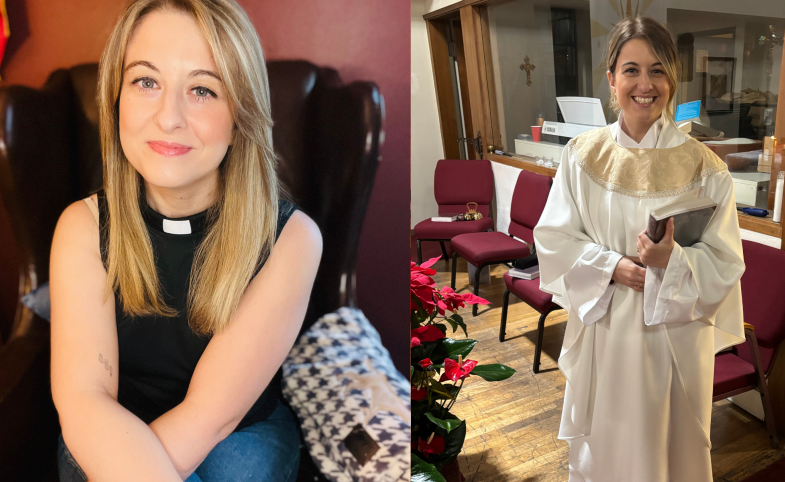
My name is Madison Jones McAleese, and I graduated with MPD’s 2018 class! I may have taken a slightly different path than others who came from MPD, but I think my work absolutely has roots in public diplomacy. I’ve spent much of my career since then in nonprofit management, first working at the Pacific Council on International Policy (a favorite of MPD-ers) before transitioning into nonprofit consulting! I’ve been a nonprofit consultant, helping civil rights, advovacy, arts, and educational organizations with their strategy and planning. But my primary work now, in addition to consulting, is actually in ministry. After USC, I got another master’s degree in Christian Studies and am now almost finished with my doctorate in social transformation. I was recently ordained a priest with the Catholic Apostolic Church in North America, and much of my focus is on intersectional feminist and liberation theology, which is, a theology and ministry that is rooted in social justice, inclusion, and activism. I preside at a local church for LGBTQ+ Catholics, and engage within the community as much as possible through vigils, protests, and local organizing work to promote a faith that is deeply connected to justice and freedom from oppression.
I also am the Executive Director of FCM, (Federation of Christian Ministries) which is an organization of spiritual seekers, chaplains, pastors, and faith leaders who are engaged in inclusive ministry work.
I’m also active in digital spaces, TikTok and YouTube, where I try to look at the intersection of tradition, ritual, and inclusion and how we can translate our ancient faith into a more expansive, inclusive one that still holds true to foundational theological truths.
How has the program, broadly helped you in your career?
It’s funny, sometimes someone will ask me how a public diplomacy degree helps me in this ministry and justice work, and I answer that it absolutely,100% helped in every way. At the end of the day, the MPD program is about impact. It’s about moving the needle toward social change, whether that’s through soft power like art, culture, food, music, or whether it’s through more intentional collaboration between publics in ways that help lead us to deeper understanding of one another.
I think this program is for more than just future foreign service officers or State Department Officials, it’s for anyone looking to work in spaces advocating for deep transformation. Widespread social change requires collaboration and an understanding of the various players in our ecosystem and what they can all bring to the table. Public diplomacy is exactly that, it requires strategy, trust, cooperation, and information-sharing. I use all these skills in my professional life.
Was there one particular class in the program which helped prepare you for the workplace? 504, hands down. It was the most terrifying class, and the most helpful, because it forced us to deal with real-world situations and approach each challenge by offering tangible, actionable solutions that could be measured and evaluated. This was so valuable to me, and frankly, to anybody who is doing work that requires any sort of project management or implementation.
What is your favorite non-academic memory of your days as an MPD Trojan?
Going to Iceland! Our second year, a few of us did an international trip to Iceland, where we not only met with diplomacy officials, but we also enjoyed the beautiful scenery – including the famous hot springs! I had such a blast.
How do you feel the world of public diplomacy and public engagement has changed during your time?
Oh, gosh. So much. I do believe our public diplomats have had to work harder to show trust with their counterparts abroad, and to prove that this country is interested in international cooperation and multilateral engagement. I think it is much bleaker than it was, which requires folks doing this work. We need more collaboration, not less. We need increased communication and engagement, not less.
But I also know that public diplomacy, even in non-official capacities like citizen diplomacy, have been integral to every social movement we’ve seen over the last century, and I do believe that is happening still.
Interestingly, in terms of faith-based diplomacy, there have been important strides as it relates to peacebuilding. There are interfaith summits happening around the world all the time, and here within the U.S., there is a new rise of faith leaders standing up for social justice and change. I actually think (and maybe I’m biased, maybe not) that faith leaders will be part of the future of public diplomacy as an antidote to the harmful rhetoric leaders have provided in the past. There is a new wave of religious collaboration resulting in peaceful activism, advocacy, and conflict resolution.
What would your advice be to today’s students?
Consider the many ways in which public diplomacy impacts our everyday lives. There are so many different career paths that are fueled by the skills we learn in this program. No longer is public diplomacy purely for those looking for government work, but for anybody seeking broad social transformation.
Tags
Visit CPD's Online Library
Explore CPD's vast online database featuring the latest books, articles, speeches and information on international organizations dedicated to public diplomacy.
Popular Blogs
-
September 22
-
October 5
-
October 5
-
September 9
-
September 22