







MPD Alumni Spotlight: Sudarshan Ramabadran
To commemorate the 20th anniversary of the USC Master of Public Diplomacy program, housed at the USC Annenberg School for Communication and Journalism, the USC Center on Public Diplomacy interviewed distinguished alumni for a special series reflecting on their time at USC, their professional achievements, and the paths their careers have taken since graduation. View the complete list of alumni interviews.
Could you introduce yourself, your class of MPD, and explain what you are currently doing and have done since graduating?
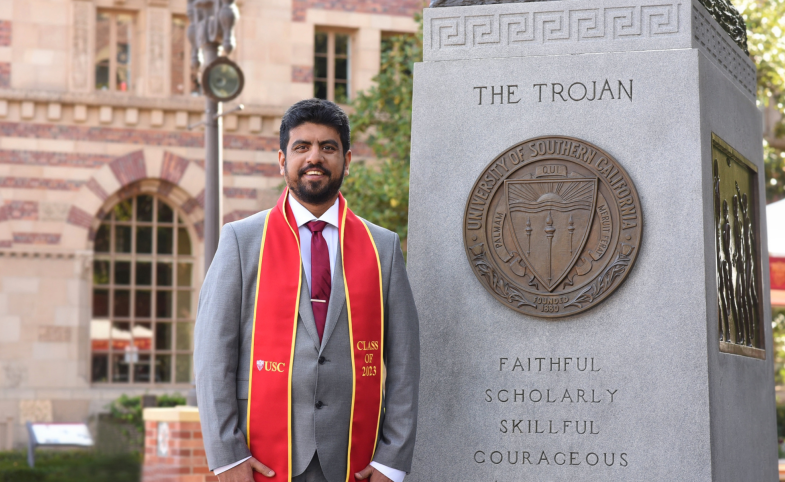
I have been humbly contributing to the field of public diplomacy since 2018. I'm extremely lucky and grateful to be part of the global Trojan community. This journey began in 2018, when the USC Center on Public Diplomacy led by Dr. Jay Wang was the academic partner for India's first global conference on soft power in Delhi. From there, I went on to study in the Public Diplomacy program for mid-career professionals, and most recently, I visited the Osaka World Expo in Japan(which was led by USC’s Prof. Nick Cull). All of these experiences have been tremendously enabling, both professionally and personally. Along the way, I've made great friends — like family — through the Public Diplomacy program at USC.
Today, I am a policy specialist, author, and international communications and public diplomacy professional. I completed the Public Diplomacy program for mid-career professionals from 2021 to 2023. Since graduating, I have been involved with India's premier stock exchange, the National Stock Exchange (NSE) in Mumbai, contributing to its government affairs, strategic communications, and public diplomacy initiatives. The NSE is the gateway to the Indian economy and the heart of India's capital markets.
A significant part of my work involves engaging with embassies and high commissions — particularly heads of mission in New Delhi, Indian embassies and high commissions abroad, and consul generals at consulates in Mumbai — on the role the exchange can play alongside them in advancing economic diplomacy. Another part of my role involves streamlining communications across mainstream and social media channels, as well as Government of India communication channels, about the Exchange. In addition, I work with state governments on financial literacy initiatives that benefit women and students and that empower small and medium enterprises to list on the exchange. Across all of these responsibilities, the skills and lessons from the Public Diplomacy program have shaped my worldview in a substantive way.
How has the program broadly helped you in your career?
An important takeaway has been staying open to possibilities — something that translates directly into today's work environment. Your field of work could be anything, but I find myself putting lessons from the program to use day in and day out. Classes in the history of public diplomacy, cultural diplomacy, evaluation of public diplomacy, branding, strategic communications, and Web 3.0 technologies have all proven useful in my present-day work.
Every professor made sure none of us stayed in our comfort zones, which humbled me in many ways. Each class challenged us individually and collectively — that, to me, is a great takeaway. Every professor pushed us to our limits, but ultimately wanted us to succeed. You come out of it refreshed. It has also given me a quality of nimbleness that's been invaluable when engaging with high-profile stakeholders at work.
Was there one particular class in the program which helped prepare you for the workplace?
Each class I chose gave me a different kind of exposure and understanding. The History of Public Diplomacy class with Prof. Nick Cull, Evaluating Public Diplomacy with Prof. Robert Banks, and courses on branding and Web 3.0 technologies across various semesters all stood out for me. There was also one on digital storytelling — I could go on. Each had a unique way of approaching its subject. The classes were detailed and gave the cohort ample room to engage with faculty in candid, informal dialogues. At no point did it feel like we were attending simply to fulfill grade requirements. There was genuine warmth and camaraderie within the cohort.
As a practitioner in the program, I presented many case studies from India that have been tried and tested that many faculty members appreciated and were forthcoming with their feedback.
I also had the advantage of a vibrant cohort from Kazakhstan, the US, the UK, China, Saudi Arabia, Uganda, Switzerland, Thailand, New Zealand, Canada, Indonesia, South Korea, and Japan, along with visiting scholars from Sweden, Denmark, and Pakistan.
The environment humbled me — I thought I knew a lot, but I didn't. There's a much bigger, brighter world out there with some incredible minds. I was the only Indian in the cohort, so I thoroughly enjoyed learning — and unlearning — alongside this vibrant group.
In fact, what was an apt conclusion to the program, I wrote a full-fledged policy paper on why and how India can have a public diplomacy policy in which I detailed key lines of effort that ought to be taken. The paper was all the lessons learned in and through the program.
What is your favorite non-academic memory of your days as an MPD Trojan?
Co-hosting From Where We Are, the weekly radio show with news and updates for the USC community, under the USC Annenberg Radio Network. We recorded every Monday, and I couldn't wait to get there — the show went live that same evening. I'd hosted podcasts before, so that experience helped. This was, if I remember correctly, during the first semester of my program. It was new: a state-of-the-art studio, a thorough production team, and professors who gave us the freedom to express ourselves and engage with the show for the benefit of students, faculty, and family. Several friends and family in India tuned in, even with the time difference. The show covered news relevant to the student community at USC and to what was happening across the US. We sometimes interviewed subject-matter experts related to a story, which was also great fun. Overall, a superb non-academic memory from USC.
How do you feel the world of public diplomacy and public engagement has changed during your time?
We studied during COVID and the onset of the Russia-Ukraine war. It was an uncertain, unpredictable time, with many divisions in the world — divisions that have only deepened since.
But despite the chaos and divisions, countries during and post-COVID severity were dispatching vaccines to one another, in recent times it was heartening to see initiatives like the Osaka World Expo in 2025, or the ongoing FIFA World Cup in the US. These initiatives bring people together. It is clearly discernible. For example at the Osaka Expo, our interactions with pavilions across the Expo embodied that spirit — that the world wants to come together and act as one. Our cultures and languages may differ, but we are all one. Indian philosophy has long expounded this idea, and the G20 that India hosted was premised on standing together as one planet.
The core of it is this: the more divisions emerge, the more we should collaborate rather than confront. That's where public diplomacy plays a strategic role — communicating what a country stands for and how we can work together. So the more divisions emerge, the more it becomes our job, as public diplomats, to bring people together.
Public diplomacy can definitely have a ‘soft and subtle’ nature, but its enigma and impact cannot be undermined. The late Professor Joseph Nye in a conversation over a podcast with me referred, ‘power with’ one another is key not ‘power over’ one another. Today’s public diplomacy ought to focus on ‘power with’ one another.
What would your advice be to today's students?
Stay eager to learn, both inside and outside the classroom. With the rapid advance of artificial intelligence and robotics, the key will be having common sense and working with purpose, armed with nimbleness — wherever you are. Stay aware of what's happening around you and in the world.
I remember interviewing Simon Anholt, the founder of the Nation Brand Index and the Good Country Equation, and asking him how he'd define a good country. He said a good country isn't one that only looks out for itself, but one that also does something for others. We saw that during COVID — despite a once-in-a-generation pandemic, people came together and thought beyond themselves.
Let's consistently strive to be good global citizens, so our countries can be good too!
Tags
Visit CPD's Online Library
Explore CPD's vast online database featuring the latest books, articles, speeches and information on international organizations dedicated to public diplomacy.
Popular Blogs
-
September 22
-
October 5
-
October 5
-
October 13
-
October 15