









The CPD Blog is intended to stimulate dialog among scholars and practitioners from around the world in the public diplomacy sphere. The opinions represented here are the authors' own and do not necessarily reflect CPD's views. For blogger guidelines, click here.
Music, Displacement and Resilience: Lessons from an Armenian-Navajo Cultural Exchange
The views expressed in this article are Jen McAndrew's own and do not necessarily represent the views of the U.S. Department of State or the U.S. government.
When mass displacement happens, emergency aid arrives first: food, shelter, medical care. But what comes next? When everything familiar has been stripped away, how do displaced communities preserve identity, dignity and hope?
In September 2023, over 100,000 Armenians fled Nagorno-Karabakh (NK) after Azerbaijan launched a military offensive to reclaim the disputed region, a territory marked by decades of conflict and two wars. As I watched these events unfold as Director of Public Diplomacy for the U.S. Embassy in Armenia, I found myself asking difficult questions about what comes next. While the United States had pledged $11.5 million in humanitarian aid, my task was to think beyond emergency relief. How could public diplomacy help these communities heal? And who could speak with authenticity to people who felt the world had abandoned them?
The answer came from the Navajo Nation. Their own history of forced removal in the Long Walk of 1864 left scars that still shape their identity. I reached out to Berta Benally, manager of the band Sihasin, which means hope in the Diné language, to share what was happening—and explore a collaboration to unite Indigenous voices in the face of tragedy. Within days, Sihasin’s Jeneda and Clayson Benally said yes.

Sihasin gives a workshop with Karin Dance Ensemble at the Armenian General Benevolent Union in Yerevan, June 7, 2024. (Credit: U.S. Embassy Yerevan)
In June 2024, Sihasin arrived in Armenia for a week of workshops and performances as arts envoys, forging creative bonds through jam sessions, dance exchanges, and storytelling. The Embassy and local partners—Ordinary Wonder Society, Armenia Vibes, and the Armenian General Benevolent Union—hosted discussions and workshops on cultural preservation, rooted in Sihasin’s expertise in preserving the Diné language and Navajo heritage. Sihasin shared Navajo hoop dance traditions and learned Armenian folk dances with the Karin folk dance ensemble, visited Armenia’s UNESCO heritage sites, and led a TUMO Center workshop on storytelling and identity. Music became the bridge connecting two worlds separated by geography, but bound by shared experience.

Sihasin records the remix of “Shine” with collaborating artists at Meeting Point Studios, Yerevan. (Credit: U.S. Embassy Yerevan)
Creating Together: An Armenian-Navajo Fusion
At the heart of the exchange was a collaboration with Armenian artists on a remix of Sihasin’s anthem “Shine.” Produced by Narek Barseghyan of Armenian rock band The Bambir, the remix wove Armenian lyrics and traditional instruments into the original, featuring the vocals of Lily Aleksanyan, Gohar Qeshishoghlyan on qanon, and Qristine Hovsepyan on the kopal dhol. Filmed at the ancient Zvartnots Cathedral—a UNESCO world heritage site—and produced by Armenian TV, the “Shine” music video reached hundreds of thousands, amplifying the power of collaboration. The Embassy’s social media campaign featuring the band’s tour, music video, and personal reflections, increased platform engagement by 250%, with audiences responding with appreciation for the message of hope and respect for Armenia’s heritage.

Sihasin films the music video for “Shine” at Zvartnots Cathedral in Yerevan, produced by Armenia TV. (Credit: U.S. Embassy Yerevan, June 2024)
Solidarity Takes Center Stage
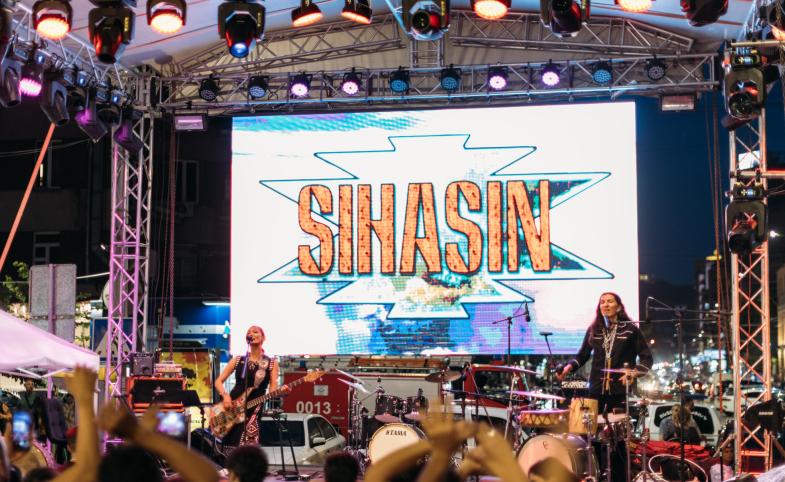
The live performances were also unforgettable. Sihasin debuted in Gyumri before 300 young listeners at the TUMO Center rooftop, sharing the stage with Voices of Artsakh—displaced musicians from Nagorno-Karabakh. Local media (Public TV, Aravot) lauded the Embassy for giving the displaced artists a platform, signaling solidarity with communities uprooted by conflict. Two days later, Sihasin headlined the Yerevan Wine Days cultural festival, performing for 25,000. Dream Beats, an all-female dhol drum band opened the celebration, and the “Shine” remix closed the show, uniting the collaborating artists and audience in an electrifying moment of cultural unity and resilience. These weren’t just concerts—they were a vivid example of how the arts can heal where policy cannot.
The Power of Music Diplomacy in Crisis
Sihasin’s visit offers a blueprint for how music can bring public diplomacy to life, showing how art heals, preserves and connects communities in crisis:
Music validates trauma and restores dignity. When communities experience mass displacement, they often feel invisible. Sihasin’s visit sent an important message: your story matters, your culture matters. Music became a shared language for acknowledging pain when words fell short.

Clayson Benally performs a traditional Navajo hoop dance during Sihasin’s concert at the TUMO Center rooftop in Gyumri, June 5, 2024. (Credit: U.S. Embassy Yerevan)
Music preserves identity under threat. Displacement threatens not only homes but cultural memory. The collaboration between Sihasin and Armenian artists honored both traditions while creating something new—proof that culture can adapt and survive even in exile. The Armenian verse and traditional instruments in “Shine” were not just artistic touches; they were acts of preservation.
Music builds solidarity across borders and generations. The exchange united two peoples separated by distance but united by experience. There was mutual recognition between indigenous cultures that understood trauma. That authenticity resonated with the Nagorno-Karabakh refugees in ways traditional diplomacy could not.
Music reaches where aid cannot. Food and shelter sustain the body; art sustains the spirit. Nine months after the exodus, with the NK refugees facing the grim reality of rebuilding their lives, Sihasin arrived—when resilience mattered most. The resulting remix, music video, and shared performances now stand as lasting symbols of connection and hope.

Sihasin performs at Yerevan Wine Days Festival, June 7, 2024. (Credit: U.S. Embassy Armenia.)
What Made This Work: A Model for Practitioners
Cultural diplomacy thrives on authenticity, not performance. This exchange succeeded because it was grounded in solidarity between communities who shared the experience of loss and renewal. The Navajo artists didn’t arrive to “fix” anything. They came to share, to create, and to listen. From this experience, four guiding principles emerge for public diplomacy in crises:
- Identify authentic cultural parallels that resonate across communities.
- Facilitate artist-to-artist collaboration to ensure true exchange.
- Document and amplify the work to extend impact beyond the immediate audience.
- Center the voices of those directly affected, letting lived experience guide the process.
As I watched Sihasin and Armenian musicians improvise and learn from one another, I saw music doing what no policy statement could: building connection, honoring pain, and affirming that culture is not a luxury—it is essential. For displaced communities in Armenia, the message was clear and enduring: your heritage matters, your stories deserve to be heard, and you are not forgotten.

Sihasin performs with Armenian artists Lily Aleksanyan, Gohar Qeshishoghlyan and Qristine Hovsepyan at the U.S. Embassy in Yerevan, June 8, 2024. (Credit: U.S. Embassy Armenia.)

Visit CPD's Online Library
Explore CPD's vast online database featuring the latest books, articles, speeches and information on international organizations dedicated to public diplomacy.
POPULAR ARTICLES
-
September 22
-
October 5
-
October 5
-
October 13
-
September 9
MORE FROM THIS AUTHOR
Join the Conversation
Interested in contributing to the CPD Blog? We welcome your posts. Read our guidelines and find out how you can submit blogs and photo essays >.