









The CPD Blog is intended to stimulate dialog among scholars and practitioners from around the world in the public diplomacy sphere. The opinions represented here are the authors' own and do not necessarily reflect CPD's views. For blogger guidelines, click here.
At 499, Jakarta Needs Trees, Not Just Towers
As the world’s most populous city, Jakarta should be defining what a livable megacity looks like. As it approaches its 499th anniversary, the question is no longer just how Jakarta has grown, but whether it can remain livable. On June 22, at 499, Jakarta should not be gasping for air.
Nearly five centuries after its founding as Jayakarta (meaning “complete victory”), this city has won the big fights: colonialism, wars, and socio-economic crises. Its name tells a story of reinvention: Sunda Kelapa, Batavia, Djakarta (ジャカルタ) under Japanese rule, and finally Jakarta. Reinvention is in the DNA. Yet this anniversary raises a more urgent question: what exactly has Jakarta won if it is becoming harder to live in each year?
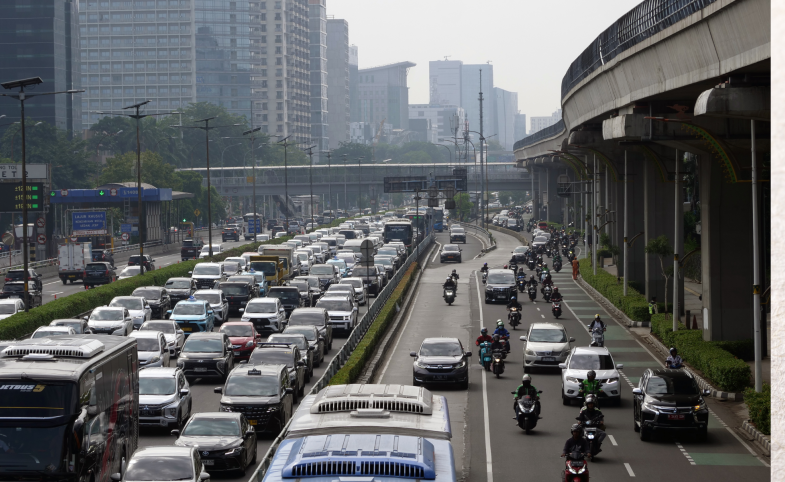
Walk down Jalan Jenderal Sudirman at noon. The heat hits you first, then the glare, then the absence of shade. This is Jakarta’s front porch—its global calling card—and it feels engineered for cars, not people. In a tropical city, that is not just bad design. It reflects a deeper policy failure. Where are the rain trees? Where is the basic dignity of walking five minutes without baking under the sun? Because this is not just about comfort. It is about the air we are breathing.
Jakarta’s air pollution routinely exceeds safe limits. The World Health Organization recommends an annual PM2.5 level of no more than 5 micrograms per cubic meter. Jakarta surpasses that many times over in a typical year, placing it among the more polluted major cities globally. Even temporary improvements often stem not from policy interventions, but from reduced economic activity. During holidays, when traffic and industry slow, pollution can drop dramatically—sometimes 40 to 70 percent. In effect, Jakarta’s cleanest air appears when the city partially shuts down—an unsustainable and revealing pattern.
This is not how a 499-year-old capital should function.
Look at what happens when cities get serious. In Seoul, leaders did something that, on paper, looked unthinkable: they tore down a highway running through the heart of the city. Beneath that concrete was the Cheonggyecheon stream, long buried and forgotten. They restored it, not just as a decorative feature, but as a functioning urban ecosystem. Air quality improved. Biodiversity returned. Foot traffic surged. Office workers, families, and students reclaimed the space. The lesson is clear: environmental restoration can also drive economic and social revitalization.
London made that decision generations ago and never reversed it. Hyde Park and Regent’s Park are not decorative green patches squeezed between developments. They are vast, central, and protected as essential infrastructure. Hyde Park alone spans more than 140 hectares. People don’t just visit; they rely on and live around it. This is the benchmark Jakarta should measure itself against: green space treated as critical infrastructure rather than optional amenity.
"If the capital cannot guarantee shade, cleaner air, and accessible green space, what exactly are we saying about our priorities as a nation?"
Jakarta, so far, has chosen concrete. Gelora Bung Karno, Monumen Nasional, and Lapangan Banteng are iconic reminders of Jakarta’s past. But built for ceremony in the 1960s, they are not green spaces for a bustling modern city. They serve symbolic and civic purposes, but fall short of meeting everyday environmental and public health needs. No megacity can call itself livable relying on a handful of plazas. Jakarta needs parks its people can live in, not just plazas to admire.
Taman Bendera Pusaka is a thoughtful addition. But at 5.6 hectares it is tiny, roughly 25 times smaller than Hyde Park, even though Jakarta’s population is more than four times London’s. One park, no matter how well designed, cannot offset a city that is overheating and overbuilt. Incremental additions, while welcome, are insufficient without a broader systemic strategy.
This is no longer about aesthetics. It is about survival for one of the world’s largest urban populations.
Without trees, Jakarta traps heat. Without clean streams and green ground, it floods. Without neighborhood parks, its people—children, workers, the elderly—lose something fundamental: the ability to step outside and breathe without planning a trip. A park should not require a car ride. It should be within walking distance. It should be part of daily life, not a weekend escape. These are not luxuries; they are baseline conditions for urban resilience.
This is where the national stakes come in. Jakarta is not just another city. It is Indonesia’s front yard. What we tolerate here becomes the template elsewhere. If the capital cannot guarantee shade, cleaner air, and accessible green space, what exactly are we saying about our priorities as a nation?
At 499, this is the moment to get serious. Policy direction must shift from short-term urban expansion to long-term environmental sustainability. Plant rain trees along Sudirman and far beyond. Treat shade as infrastructure, not decoration. Reclaim space from asphalt and return it to people. Restore urban streams. Build not one grand park, but hundreds of neighborhood parks, so that every resident can reach one within walking distance.
Because the data is already telling us what the streets are feeling. This city is overheating. This city is polluted. This city is running out of room to breathe.
“Jayakarta” promised a complete victory. Today, that victory should be measured differently: whether a child can find a tree within five minutes of home; whether a worker can walk in the shade; whether a megacity remembers it was built for human beings.
If Jakarta is to remain a credible global capital, livability must become as much a priority as growth. At 499, Jakarta still has a chance to get this right. At 500, it will have no excuse.

Visit CPD's Online Library
Explore CPD's vast online database featuring the latest books, articles, speeches and information on international organizations dedicated to public diplomacy.
POPULAR ARTICLES
-
September 22
-
October 5
-
October 5
-
September 9
-
September 22
MORE FROM THIS AUTHOR
Join the Conversation
Interested in contributing to the CPD Blog? We welcome your posts. Read our guidelines and find out how you can submit blogs and photo essays >.