









The CPD Blog is intended to stimulate dialog among scholars and practitioners from around the world in the public diplomacy sphere. The opinions represented here are the authors' own and do not necessarily reflect CPD's views. For blogger guidelines, click here.
Fashion as Diplomacy: Nation Branding and the Case for South African Soft Power
"I will wear costumes, after this war will finish." — Volodymyr Zelenskyy
Power, in the conventional understanding of international relations, announces itself through force: guns, sanctions, military coalitions. But there is a second register that operates differently: not through what a state can compel, but through what it can make others want. Joseph Nye called this soft power — the ability to shape the preferences of others through attraction rather than coercion. And it is in this second register that fashion becomes not a trivial subject but a revealing one.
Consider Zelenskyy. When Russia's invasion of Ukraine began in 2022, his response was not to hold a press conference — it was to appear, repeatedly and deliberately, in a military-green tracksuit. That tracksuit became the story. It refocused global media attention and repositioned him not as a politician seeking sympathy but as a commander refusing to surrender. No gun was fired. The instrument was cloth.
Fashion is simultaneously symbolic and economic — a cultural artifact capable of communicating identity while operating within global markets of production, consumption, and exchange. Fashion is diplomacy. Yet scholarship on it remains largely Eurocentric, fixated on historically dominant capitals. This narrows the field and ignores emerging industries — particularly in the Global South — that are already shaping national reputations. Fashion can function as a substantive mechanism of competitive identity and soft power: not inherently, but when cultural authenticity, institutional coordination, and economic strategy are deliberately aligned. That mechanism is generalizable. France establishes it. Japan extends it. South Africa is the case for its future.
France: The Mechanism
If fashion diplomacy needed proof of concept, it would be France. No other nation has so deliberately embedded its fashion industry within the architecture of national prestige. But French fashion isn't "great" as a matter of local talent — luxury was institutionalized at the national level. Beginning with the aid-to-couture plan of 1952, the government subsidized couture houses, and the proportion of subsidies allocated to international promotion rose from 12.5% in 1952 to 36.2% by 1960. What Dubé-Senécal calls "prestige-based commercial diplomacy" used cultural prestige to open commercial doors and advance national economic interests abroad.
By 1969, of an approximate $4 billion global couture market, only $35.4 million came from actual garment sales — the overwhelming balance came from goods carrying couture house names. "Made in France" was the tradeable asset. As a 1955 letter from the French ambassador in Panama captured it, Dior's Latin American tour reminded the world that France remained the country of elegance and good taste. The clothes were never really the product. The idea of France was.
But France is a mechanism, not a blueprint. A Global South nation attempting to replicate haute couture would not build its own competitive identity — it would only reaffirm the dominance of European ideas of fashion, inversely diminishing its own. What transfers is the structural logic. The cultural content is specific to France.
Japan: The Organic, Institutionalized
Where France engineered its fashion diplomacy from the top down, the Japanese state discovered fashion's soft power accidentally, and chose to harness it. It did not come from institutions. It came from the streets — the youth expression of Harajuku, Shibuya, and Shinjuku, where in a rigid social system fashion became a domain for visibility against structural gatekeeping. These were not trend cycles directed by designers. They were acts of visibility, impossible to replicate anywhere else — precisely what Anholt would recognize as authentic competitive identity.
"Fashion is simultaneously symbolic and economic — a cultural artifact capable of communicating identity while operating within global markets of production, consumption, and exchange."
In 2010, Japan's Ministry of Economy, Trade and Industry established the Office of Cool Japan, explicitly linking cultural exports to national economic revitalization. Crucially, the state's role remained that of patron rather than creative director — it could only curate and amplify what already existed. And when the Cool Japan Fund moved from amplifying authentic production to managing and standardizing it for export, it began working against the very conditions that had generated the appeal. The fund's losses aren't evidence that fashion diplomacy failed. They demonstrate what happens when a state mistakes the instrument for the source. Cultural credibility was always in the streets.
South Africa: The Case
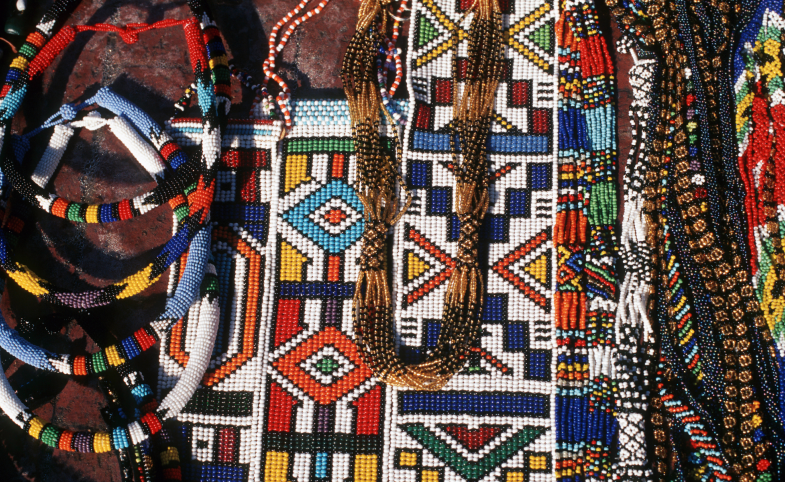
South Africa's fashion identity is embedded in something transgenerational — a heritage in which dress is a form of language. As Van Wyk shows, Xhosa and Zulu beadwork functioned as a fully realized semiotic system, mapping gender, age, marital status, rank, and spiritual state, structured "like language itself." Fashion for South Africa isn't a reflection of culture; it constitutes it.
Its competitive edge isn't luxury — it's sustainability, understood not as a Western marketing buzzword but as a structural condition: people-centered, heritage-rooted, and economically embedded. Laduma Ngxokolo's MaXhosa Africa embodies the full mechanism: Xhosa symbolism, locally sourced materials, and international legibility — shown at Rakuten Fashion Week in Tokyo, producing what one writer called "a Japaneseness that was intrinsically Afrikan." Yet Ngxokolo names the limit himself: "we are coming up with beautiful ideas, but we cannot back them up with reliable infrastructure."
That is the gap. The cultural raw material exists. What's missing is the third element France and Japan both prove is necessary — coordinated institutional support. Fashion diplomacy is already happening in South Africa, at the non-state level: in concept stores curating an image of what African fashion means, and in designers who understand themselves as diplomatic actors without a diplomatic brief in sight. The diplomatic function is being performed; it just isn't amplified, resourced, or strategically aligned. The international market is ready. The barriers are infrastructural, not creative.
Toward a Strategy
A credible South African fashion diplomacy strategy rests on three principles. Institutional recognition — treating fashion as a strategic cultural industry rather than a peripheral creative sector. Strategic promotion — backing fashion weeks and international showcases with substantive institutional commitment rather than one-off spectacle. And authentic partnership — resisting the extractive model and building the long-term relationships that generate genuine economic benefit for the local industry.
South Africa possesses the symbolism, the sustainability narrative, and the creative talent. What it requires is the political will to treat these assets with the same strategic seriousness that France brought to haute couture and Japan brought to street fashion — and to build the institutional infrastructure through which a genuinely South African competitive identity can be projected onto the world stage.

Visit CPD's Online Library
Explore CPD's vast online database featuring the latest books, articles, speeches and information on international organizations dedicated to public diplomacy.
POPULAR ARTICLES
-
September 22
-
October 5
-
October 13
-
October 5
-
October 15
MORE FROM THIS AUTHOR
Join the Conversation
Interested in contributing to the CPD Blog? We welcome your posts. Read our guidelines and find out how you can submit blogs and photo essays >.