









The CPD Blog is intended to stimulate dialog among scholars and practitioners from around the world in the public diplomacy sphere. The opinions represented here are the authors' own and do not necessarily reflect CPD's views. For blogger guidelines, click here.
Falling in Love With a Country is Not Serendipity, It is Good Public Diplomacy
This summer I attended a public diplomacy panel where I finally felt seen as a professional thanks to a colleague’s comment: “Everybody thinks they can do the job of a public diplomacy officer because they know how to post on social media, but nobody in the office questions the work of the HVAC technician nor pretends to be capable of doing the work themselves.”
Generally, the knowledge and experience of public diplomacy and strategic communication professionals, alongside other communication-related professions, is undermined on a constant basis. As a public diplomacy practitioner with an academic background, I feel compelled to stress that the international reputation, attractiveness, and popularity of a country are not the product of the stars aligning. Conversely, its lack of presence and visibility in the international arena is not the result of Mercury being in retrograde. Good public diplomacy work will make people fall in love with a country—not simply by chance, but as a result of a targeted, well-crafted, and culturally sensitive strategy.
Countries use public diplomacy to show their own personalities, their own experience, their own traditions, and their own moral values. They share their own perspective and have a particular voice and narrative. As I have argued in my research, countries that promote their image in coherence with their moral stances and the values of their people are successful in elevating their international reputation. Going back to the comparison of falling in love, this is what people look for in a partner: someone who defends, projects, and reflects their moral values in their behavior, communication, and overall presentation of themselves to the world.
A good example could be Sweden’s increased visibility in the international arena during the late 2010s as a leader in the fight against climate change – even Forbes called Sweden the world’s most reputable country in 2019 – partially through environmental activist Greta Thunberg, who represented the countries’ progressive environmental policies and values.
"Good public diplomacy work will make people fall in love with a country—not simply by chance, but as a result of a targeted, well-crafted, and culturally sensitive strategy."
Additionally, countries also use public diplomacy to listen to different audiences, to understand them, and to adapt their communication strategy to the cultural context in which they find themselves. People love to be listened to and to feel understood. People fall in love when their counterpart makes an effort not only to understand their culture, but to engage and integrate within it, regardless of external criticism.
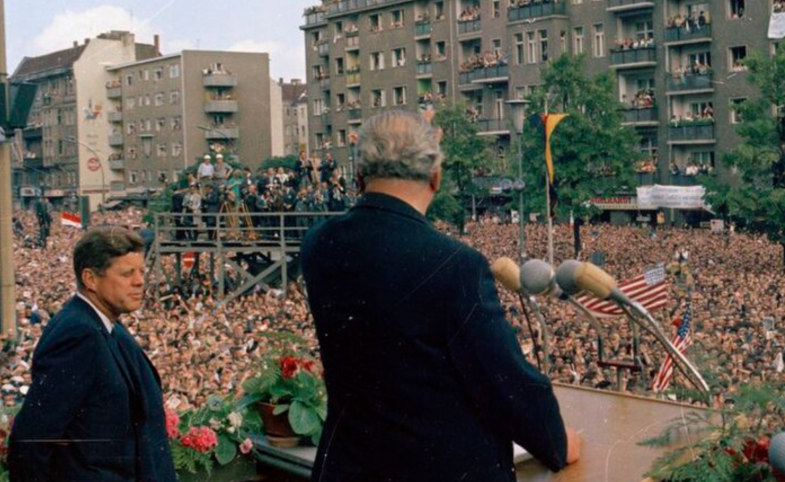
When John F. Kennedy gave his speech in Rudolph Wilde Platz in 1963 (pictured above), he understood that saying those words in their native language “Ich bin ein Berliner” was a culturally savvy way of showing solidarity and respect for West Berliners, regardless of criticism from outsider sources – who clearly weren’t the target audience – claiming the President called himself a “jelly donut.”
It is easy to fall in love with someone that shares your values, that has charisma (soft power), that is coherent with their actions, that is empathetic, and that is culturally appropriate. However, it is easy to fall out of love with a foreign country when they make a mistake, when their actions don’t reflect their values, or when they don’t follow through with what they said they were going to do. A country that has suffered this first-hand is the United States. Although the values of freedom and democracy have always been the banner and identity of the country, the torture and abuses that took place at Abu Ghraib in the early 2000s led to an international perception of hypocrisy and to a rise in anti-Americanism.
But good public diplomacy will make you fall in love again. Because, as public diplomacy professionals, our work is to listen to you, to understand you, to connect with you. Our work is to show you what our country is like deep inside, sharing our most treasured memories and proudest achievements but also our struggles through the toughest challenges and the lessons learned. Our work is to be honest, to acknowledge our own mistakes but also to help you put yourself in our shoes and understand why our leaders and our people do what they do. Our work is to be cultural translators and bridge the gap between your traditions and our customs, which can be miles apart even if we speak the same language. Our work is to build relationships—to nurture and strengthen the partnership not just between our countries but between our peoples.
As it is commonly referred to in public diplomacy circles, our work is to “win your hearts and minds.” All we want is to make you fall in love with our country, to celebrate our achievements together, and to support each other during the lowest moments. But love is also imperfect, and that is why we ask you to treat our relationship as such—an imperfect but rewarding partnership that encounters bumps on the road but emerges stronger with every single challenge.
Because when somebody falls in love with a country, it is not serendipity, it is the result of good public diplomacy.

Visit CPD's Online Library
Explore CPD's vast online database featuring the latest books, articles, speeches and information on international organizations dedicated to public diplomacy.
POPULAR ARTICLES
-
September 22
-
October 5
-
October 13
-
October 5
-
September 9
MORE FROM THIS AUTHOR
Join the Conversation
Interested in contributing to the CPD Blog? We welcome your posts. Read our guidelines and find out how you can submit blogs and photo essays >.