









The CPD Blog is intended to stimulate dialog among scholars and practitioners from around the world in the public diplomacy sphere. The opinions represented here are the authors' own and do not necessarily reflect CPD's views. For blogger guidelines, click here.
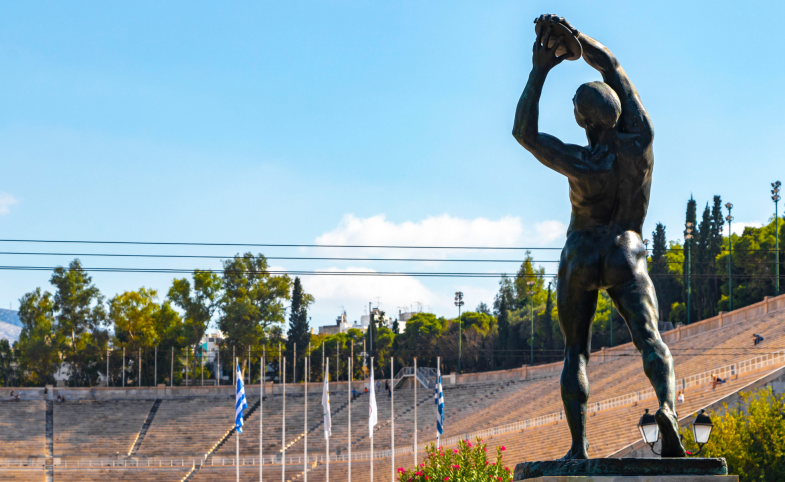
Olympia or the Arena: The Choice Before LA28
Why should the world care about the Los Angeles Olympic Games in 2028?
Athletes from nearly every nation will gather in one city and compete under common rules, even as some of their countries remain at war. Their presence raises a question that reaches far beyond sport: What kind of competition, under what rules, do we want in our world?
The Games' centerpiece, the Los Angeles Memorial Coliseum, was built to recall the arenas of ancient Rome. The Olympic Games were born somewhere very different.
At Olympia, athletes competed fiercely under agreed rules. Heralds proclaimed the ekecheiria, the sacred Truce, which protected athletes and pilgrims traveling to and from the Games, even across the territory of cities at war. Victors were honored, but defeat did not mean destruction. The defeated went home, trained, and returned to compete again.
In the Roman arena, many combatants were captives or slaves. Their suffering and death were public entertainment, a display of the power of those who staged it. An emperor decided life or death with a gesture of his hand.
One tradition is governed by rules and mutual recognition, the other by domination and the spectacle of power. The difference is not competition itself. It is whether competition disciplines power or celebrates it.
That distinction is urgently relevant today. We see the logic of the arena when military force replaces negotiation and political opponents become enemies to be eliminated. We see it when digital platforms reward outrage and humiliation, and when artificial intelligence is turned into a weapon. Victory then means not prevailing within shared rules, but destroying the adversary.
Democracy does not abolish conflict. It builds institutions through which differences can be resolved without violence or exclusion, and it requires even the strongest to accept limits on their power. The same principle must govern relations among nations.
Any political system can be judged by the Olympic test: Does the loser survive to compete again?
What Is the Olympic Truce For Today?
Before LA28, the United Nations General Assembly is expected to adopt another Olympic Truce resolution, continuing a tradition renewed in 1993. Yet the flame may be lit while governments that endorsed the resolution remain at war.
If the Olympic Truce cannot bring a truce during the Olympics, what is it for?
That question has shaped much of my public life. As Greece's foreign minister in the years before Athens 2004, I worked with the International Olympic Committee to give the Truce new life. I helped found the International Olympic Truce Centre, which I now lead.
I know the power of the symbol. I also know its limits. A UN resolution cannot compel governments to stop fighting, and the Truce must keep calling for restraint, humanitarian access and the peaceful settlement of disputes. But peace is not only an agreement between governments. It is a capacity that people and institutions must learn, cultivate and practice.
That is where LA28 comes in.
From Rivalry to Recognition
Sport can humanize an adversary in ways political rhetoric rarely can.
At the 1996 Atlanta Olympics, Greece's Valerios Leonidis and Turkey's Naim Süleymanoğlu met on the weightlifting platform in one of the greatest duels the sport has seen. Lift after lift, each answered the other. World records fell as two men from two estranged nations drove each other beyond what either could have reached alone. Süleymanoğlu took gold by the narrowest of margins, and Leonidis embraced him. Two decades later, when Süleymanoğlu died, Leonidis traveled to Istanbul to stand at his rival's grave.
Three years after Atlanta, I saw the same truth at a national scale. In 1999, earthquakes struck Turkey and then Greece. Rescue teams from each country pulled the other's citizens from the rubble. That opened a door that diplomacy alone had not. My Turkish counterpart, İsmail Cem, and I walked through it.
Neither the duel nor the earthquakes erased the differences between Greece and Turkey. But they revealed something those differences could not erase. An adversary can become someone we respect, admire and even call a friend, without ceasing to be a competitor.
"Sport can humanize an adversary in ways political rhetoric rarely can."
That is where genuine people's diplomacy begins. Public diplomacy is usually understood as governments projecting a national image abroad. The Olympic Truce points to something deeper and reciprocal: people from different societies recognizing one another's humanity, especially when they disagree.
As Christopher Nolan brings Homer's Odyssey to a new generation, an ancient Greek ideal returns with it. That ideal is xenia, the sacred duty to receive the stranger as a fellow human being owed dignity and hospitality, not as a threat. It is, above all, the duty of the host.
Yet recognition cannot remain a sentiment. It must become a skill. Listening, negotiating, mediating, accepting fair rules and disagreeing without dehumanizing can all be learned, practiced and strengthened.
Like sport, peace takes practice.
A Practical Proposal
The foundations already exist. The International Olympic Academy has devoted sessions to the Truce as an educational tool for peace. Since 2014, the International Olympic Truce Centre has brought young people from conflict-affected countries to Olympia through its Imagine Peace Youth Camp. Host cities have taken up the cause too. London 2012 brought the Truce into the great majority of Britain's schools, and PyeongChang and Beijing built it into their Games education.
But each program ended with its Games. What is needed now is continuity and scale. That means tying this work to every Games and its host community, and turning peace from a theme into a curriculum of practical skills.
It begins in Olympia. I propose that, before every Summer and Winter Games, the International Olympic Truce Centre, the International Olympic Academy and the worldwide network of National Olympic Academies convene an Olympic Truce Forum. Educators, young leaders and athletes from the coming host communities would leave not with declarations, but with skills, action plans, and partners to carry them out.
Olympia would be the source, not the boundary. Like the flame, the Forum would travel. Each National Olympic Academy can become a home for the Truce in its own country, making permanent what each host has so far had to begin anew. The work would reach into schools. During the Games it would reach into the venues themselves: the Olympic Village, where athletes already sign the Truce Wall, and the fan zones where millions gather.
Yet the Truce cannot belong to the Olympics alone. My hope is for international federations, National Olympic Committees, national sports associations and local clubs to make Truce education part of how sport is coached, organized and played, all year round. Every coach can teach it, every referee can model it, and every competition can practice it. A Saturday game in a city park can teach respect and peaceful conflict resolution as powerfully as a world championship final.
Linked together, these efforts can grow into something the Olympic Movement has never had: a worldwide movement for peace education, carried by sport into classrooms and communities everywhere.
Los Angeles: The First Model
Los Angeles knows how long an Olympic legacy can live. The surplus of the 1984 Games created the LA84 Foundation, which has brought sport to millions of children. LA28 is extending that inheritance through PlayLA, which commits up to $160 million to affordable youth sport.
1984 gave Los Angeles places to play. 2028 can teach Angelenos how to play, and live, with those who differ from them. Los Angeles will be a host in the ancient sense: the city that receives the stranger.
A pilot program would begin before the Games and culminate in a Truce Education Week across Southern California. It would be built with schools, libraries, recreation centers, youth-sport organizations and community groups. Young people would not simply be taught about peace. They would apply the Truce to real disagreements in their own schools and neighborhoods, help design the program, and judge its results. Olympic and Paralympic athletes would show what sport teaches best: respect for opponents, dignity in defeat, and responsibility in victory.
Picture a coach from Boyle Heights, a teacher from the San Fernando Valley, a Paralympian and a student from Koreatown standing together in the ancient stadium at Olympia, where athletes once gathered under the protection of the ekecheiria. There they shape what Los Angeles will teach, then carry it home.
What they build will be evaluated and passed on to the French Alps in 2030, Brisbane in 2032 and beyond, with each host adapting it and enriching it for the next. The Truce will become an Olympic relay that never ends.
The Choice Before Us
International cooperation is under strain, democratic institutions are under challenge, and domination increasingly displaces negotiation. At such a moment, this vision matters far beyond sport.
Peace education is no substitute for the political courage needed to negotiate an end to war. But the Games, again and again, bring together people from societies divided by history, ideology, religion and conflict. Few institutions hold so powerful and recurring an opportunity to turn rivalry into recognition, and recognition into cooperation. That opportunity should not end when the Games do.
In 2028, the Olympic flame will burn in a stadium built to recall Rome's arena. Which tradition it honors is up to us.
The choice is between the spirit of Olympia and the logic of the arena. It is a choice between competition governed by respect and competition driven by domination, and between a world in which the adversary must be destroyed and one in which the adversary must be respected.
For the deepest lesson of Olympia is not that we must stop competing. It is that we must learn to compete without destroying one another, so that, after even the fiercest contest, we can meet again.

Visit CPD's Online Library
Explore CPD's vast online database featuring the latest books, articles, speeches and information on international organizations dedicated to public diplomacy.
POPULAR ARTICLES
-
September 22
-
October 5
-
October 13
-
October 5
-
September 9
MORE FROM THIS AUTHOR
Join the Conversation
Interested in contributing to the CPD Blog? We welcome your posts. Read our guidelines and find out how you can submit blogs and photo essays >.