








MPD Alumni Spotlight: Mark Naylor
To commemorate the 20th anniversary of the USC Master of Public Diplomacy program, housed at the USC Annenberg School for Communication and Journalism, the USC Center on Public Diplomacy interviewed distinguished alumni for a special series reflecting on their time at USC, their professional achievements, and the paths their careers have taken since graduation. View the complete list of alumni interviews.
Could you introduce yourself, your class of MPD, and explain what you are currently doing and have done since graduating?
I am a 2009 graduate of the MPD program, originally from Iowa, but did my undergrad in Virginia. About two months after graduation, I joined the U.S. Department of State as a Foreign Service Officer. After my first tour as a consular officer in Liberia, the rest of my career has been in public diplomacy positions. I have served in Argentina, Kosovo, Washington (twice), and Estonia, working in both cultural affairs and press positions. I am currently in language training for my next position in Czechia.
How has the program, broadly helped you in your career?
The MPD program has been a huge help to me in my career. It exposed me to both the theory and the practice of public diplomacy (PD) from so many different perspectives. In my work, we manage a number of well-established, flagship PD programs such as the Fulbright Program and the International Visitor Leadership Program, but we also have a mandate to create new programs that advance our foreign policy priorities. Creativity and innovation come through in our ability to leverage partnerships and resources to ensure those programs are effective. I often find myself thinking back to MPD conversations about public diplomacy from the business and NGO perspectives when looking for inspiration.
Was there one particular class in the program which helped prepare you for the workplace?
The foundational courses (PD 502 and 504) provided the most important base — one from the historical perspective and the other from the practitioners’ perspective. Those courses were absolutely the best preparation for my work at the State Department.
What is your favorite non-academic memory of your days as an MPD Trojan?
Training with the USC Marathon Club for my first marathon definitely taught me the literal meaning of “Fight On!” It was a great group of students (both grad and undergrad) and gave me a chance to briefly call myself a Trojan student-athlete — what an honor! It also helped prepare me for the rest of my running life. Since USC, I’ve run 22 marathons and two ultramarathons around the world — including races in each of the countries where I have been posted. I like to consider it my own personal version of sports diplomacy!
How do you feel the world of public diplomacy and public engagement has changed during your time?
In many respects, I think public diplomacy has moved back to basics. We’ve realized the limits of meaningful engagement through social media and moved beyond the idea that we need to be everywhere for all audiences. PD programs have become even more laser-focused on policy objectives — especially as budgets have tightened. The question is no longer “who is your audience”, but rather “why this audience?” Likewise, it’s not “what do you want to accomplish”, but “why is this the priority?” We have buy-in that public diplomacy programs are useful and important tools to advance policy. Our job is to ensure that our programs remain effective and relevant.
What would your advice be to today’s students?
One is obvious— consider work at the State Department! Whether as a Foreign Service Officer or a member of the Civil Service, there are incredible opportunities to put your education into practice. Truly, I can’t imagine a more direct application of what I learned in the MPD program than my work at State.
But second, be sure you take full advantage of what an interdisciplinary program like MPD has to offer. Whether you consider yourself an international relations student who dabbles in communication or a communications student who dabbles in international relations, the value of the MPD is that you will have a truly unique perspective and set of skills that bring value to any job. I may “do” public diplomacy for my career, but it’s very much grounded in the skills of strategic communications, public relations, and international relations I learned at USC.
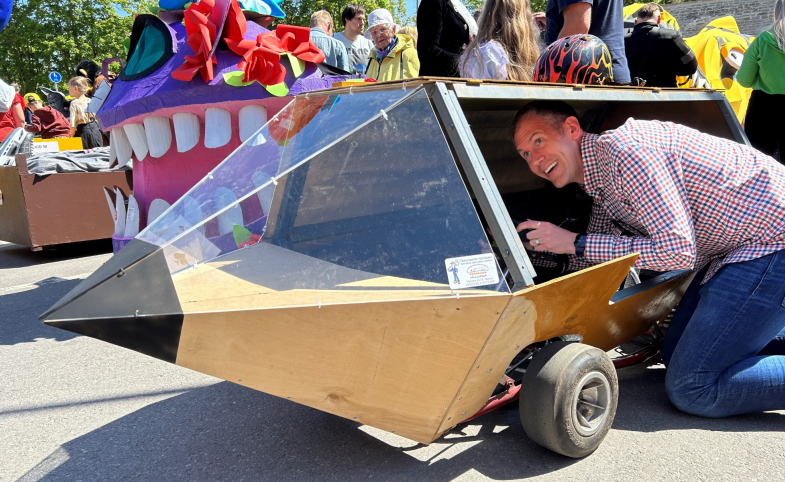
Featured Photo: Mark Naylor explores a soapbox derby car designed and built by students at the Narva American Space for the city’s annual soapbox derby, June 11, 2023, Narva, Estonia.
Tags
Visit CPD's Online Library
Explore CPD's vast online database featuring the latest books, articles, speeches and information on international organizations dedicated to public diplomacy.
Popular Blogs
-
September 22
-
October 5
-
October 5
-
October 13
-
October 15