









The CPD Blog is intended to stimulate dialog among scholars and practitioners from around the world in the public diplomacy sphere. The opinions represented here are the authors' own and do not necessarily reflect CPD's views. For blogger guidelines, click here.
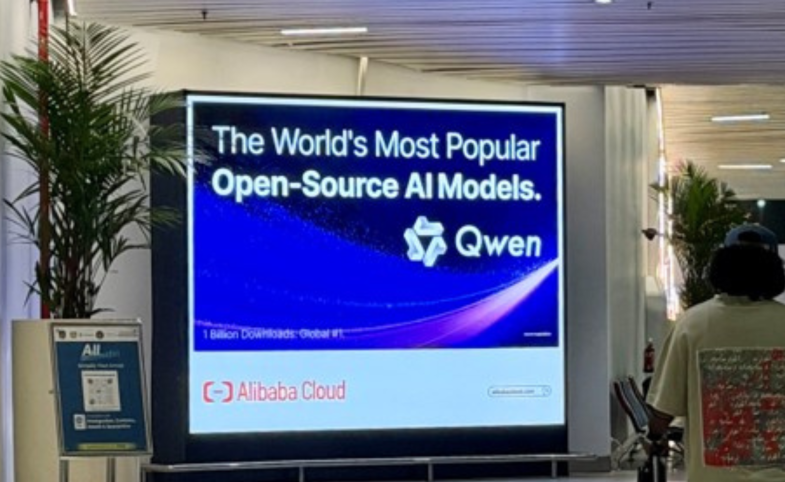
The Battle for Trust: America’s Strategic Challenge in Indonesia
China’s expanding influence in Indonesia revealed itself before I had even entered the country. The first thing I saw after stepping off the jet bridge at Jakarta’s international airport (pictured above) was a prominent advertisement for Qwen, Alibaba’s large language model, billed as the world’s most popular open-source AI. It occupied the kind of prime airport real estate that, a decade ago, might have belonged to a global bank, an airline, or a Western technology company. It was a small detail, but a revealing one. The advertisement raised a larger question: If twenty-first-century influence is increasingly built through infrastructure, algorithms, platforms, and capital rather than military presence alone, are we looking in the right places when we measure geopolitical power? And an equally important question follows: Is Indonesia merely becoming an arena in which major powers compete for influence, or is this rising economic power strategically using that competition to build a technological future on its own terms?
China’s influence in Indonesia is not difficult to measure; in many ways, it hardly needs measuring. It is something you encounter soon you step outside the airport. Hard power or soft, economic, technological, cultural, or social, its presence surfaces in nearly every. Outside the airport terminal, that abstract idea of “influence” quickly became tangible. Chinese-built electric vehicles move through Jakarta’s streets; major infrastructure projects carry Chinese financing and technology; Chinese smartphones and digital platforms are woven into everyday life; and Chinese capital stretches from Indonesia’s Whoosh high-speed railway to nickel processing and industrial development. What struck me was not simply the scale of China’s footprint, but how deeply it has entered the landscape of ordinary life. Great-power competition in Southeast Asia is no longer visible only through naval patrols in the South China Sea, diplomatic communiqués, or negotiations among governments. It is increasingly embedded in the roads people travel, the restaurants where they eat, the malls where they shop, and even in a rose latte inspired by Chinese tea-making traditions. It is in the phones they carry, the platforms they use, and the infrastructure powering the country’s economic growth. In Indonesia, geopolitics is not an abstraction. It is lived, encountered, and increasingly woven into the architecture of everyday life.
In my recent conversation with Dr. Ristian Atriandi, a faculty member in the Department of International Relations at Universitas Indonesia’s Faculty of Social and Political Sciences, this asymmetry came through less as a complaint about American absence than as a diagnosis of why China wins on the ground even when the United States remains the partner Indonesia trusts more on strategic matters. Understanding that distinction and the reasoning behind it, is essential for any U.S. policy toward Jakarta that wants to be more than rhetorical.
During my conversation with Dr. Atriandi, I learned that China’s economic influence in Indonesia is not just about money; it’s about speed and timing. He described Chinese investment as following the “path of least resistance.” Because much of it is backed by the Chinese state, projects can move quickly, deals are often packaged attractively, and the results are easy to see. High-speed rail, nickel-processing plants, and new ports become visible achievements that Indonesian leaders can showcase before the next election. American investment works differently, usually comes with higher standards, more conditions, and a longer investment timeline. While that approach may offer long-term benefits, Indonesian policymakers, who often work within short political cycles, do not always have the luxury of waiting years for those results.
This is not, in his framing, a story of American decline so much as one of mismatched tempo. Indonesia “doesn’t want to make the extra mile” to meet U.S. conditions when a Chinese alternative asks less of it up front even though officials in Jakarta are well aware that Chinese financing carries its own long-term costs, including what he described as China’s “unwritten expectations” of political deference in return for economic largesse.
That could be precisely an opportunity for Washington. Chinese investment often comes with strings attached. Jakarta is expected to stay quiet on the South China Sea. Indonesian institutions are expected to speak carefully about Beijing and its influence. U.S. capital carries no such leash. Its advantage is not speed. Its advantage is freedom from that kind of political price. The sectors most likely to welcome American investment and technology transfer are the ones where Indonesia is actively trying to diversify away from single-supplier dependency: defense procurement, digital and telecommunications infrastructure, and high-value manufacturing tied to critical minerals processing, where Jakarta has signaled interest in moving up the value chain rather than remaining a raw-materials exporter for Chinese industry.
Defense is an instructive case. Indonesia’s experience with an earlier Chinese anti-ship missile system, which reportedly failed to perform as promised more than a decade ago, left a lasting institutional memory. More recently, Jakarta’s continued interest in French Rafale fighters and its adoption of U.S.-linked satellite connectivity systems suggest a deliberate hedge: acquiring capability that is not simply interoperable with Chinese platforms, in a domain where, unlike consumer technology, systems are far less fungible between suppliers. For Washington, this is a sector where credibility, not price, is the currency that matters most.
Asked where Indonesia’s highest-priority areas of collaboration lie, Dr. Atriandi pointed to a Chinese focus on extractive industries and, increasingly, digital infrastructure with the openness to American alternatives becoming most apparent precisely where Chinese offerings are seen as “less attractive” or where dependence would be strategically uncomfortable. Indonesia’s adoption of Starlink alongside continued Chinese 5G infrastructure was cited as an example of intentional non-exclusivity, not indecision: Jakarta wants functioning alternatives in reserve, even in domains where it has already made significant commitments to Chinese suppliers.
"Indonesia has made clear it is not choosing China. It is choosing whoever shows up."
This is the through line of Indonesian strategy, as Dr. Atriandi described it. Depending on one power is a risk. That is true even with China. “Because that undermines our independence,” he said. The lesson for Washington follows from this. The United States does not need to replace China everywhere. That is a contest America would likely lose on cost and speed alone. Instead, the goal is simpler. Stay credible. Stay present. Do it in enough sectors that Jakarta actually has a choice. That is what keeps Indonesia's independence real, not just a talking point.
The clearest thread running through my conversation with this IR professor was Indonesia’s insistence on bebas dan akti, the “free and active” foreign policy first articulated in 1948, as a genuine operating principle rather than a rhetorical hedge. Dr. Atriandi’s own formulation for judging alignment was notably economic in logic: engagement should be measured by “the cost of disengagement.” A partnership that becomes so costly to exit that Indonesia cannot credibly walk away with China or with the United States, has crossed from partnership into dependency, and dependency is the outcome Indonesian policymakers are actively trying to avoid on both sides of the ledger.
This should reassure Washington, not worry it. Indonesian policymakers do welcome deeper U.S. engagement. They are not doing it despite the risk of great-power entanglement. They are doing it to guard against that risk. What they resist is different: engagement that acts like a loyalty test. The recommendation that follows is specific: Washington should design cooperation — in defense, technology, and trade, so that Indonesia can participate without it functioning as a bloc commitment and should avoid rhetoric that frames the relationship as a step toward alignment against China. Indonesia's insistence on maintaining military and diplomatic engagement with Washington even as Chinese economic and cultural influence deepens should be read as evidence that Jakarta already treats the relationship as complementary to its hedging strategy, not a fallback from it.
Perhaps the most sobering finding for American policymakers is the current balance in Indonesian threat and opportunity perception: The United States is seen predominantly as a strategic and security partner, and only secondarily as an economic one. That is a serviceable but incomplete position. Public and elite assessments of Indonesia’s international relationships, Dr. Atriandi noted, are frequently, and admittedly superficially, measured by the dollar value of investment commitments announced during presidential visits. When Chinese pledges dwarf American ones in the headline numbers, the public narrative tilts toward Beijing even when the qualitative terms, sustainability, or strategic value of American engagement are more favorable. This is not a call for Washington to compete dollar-for-dollar with Belt and Road-style headline figures, a contest it need not fight on those terms. It is a call to recognize that failing to contest the narrative of economic engagement, not just its substance, cedes ground unnecessarily. A defense partnership and a handful of high-profile technology deals will not, on their own, shift Indonesian public perception if the prevailing comparison remains a simple tally of investment commitments. Asked to project the relationship a decade or more forward, Dr. Atriandi sketched two scenarios. The more favorable, but least likely, is a broad U.S.-China accommodation on technology and trade that lets the status quo of Indonesian hedging persist comfortably. The more probable scenario is a steady deepening of Chinese economic, technological, and even military weight across Southeast Asia, not through conquest, but through the accumulation of dependencies that produce, in his words, a regional habit of self-censorship out of fear of offending Beijing.
If that second scenario is the more realistic baseline, the urgency for U.S. policy is not to force a binary choice Indonesia will resist, but to ensure that credible, competitive alternatives continue to exist in enough strategic sectors, defense, digital infrastructure, critical minerals processing, technology transfer that Indonesian non-alignment remains a real option rather than a diminishing one. Dr. Atriandi’s closing critique of U.S. policy was pointed: deterrence and defense cooperation, however well established, are “not enough.” Genuine cooperation, he argued, requires Washington to move beyond its most comfortable arena, defense into the economic, people-topeople engagement, and technological terms that actually shape Indonesian decision-making day to day.
For Washington, the strategic logic is straightforward even if the execution is not: the United States does not need to outspend China in Indonesia. It needs to remain present, credible, and nonexclusive in the sectors that keep Indonesian independence real and to tell that story as persistently as it delivers on it. The real question confronting U.S. policymakers is not how much influence China has amassed in Southeast Asia that much is visible from an airport arrivals hall. The real question is why Washington has been content to let it happen: why a superpower with deeper capital markets, more advanced technology, and a security relationship Jakarta itself values more highly than Beijing’s has allowed itself to be outcompeted in the arenas that shape Indonesian daily life, one advertisement, one toll road, one smartphone at a time. Indonesia has made clear it is not choosing China. It is choosing whoever shows up. The unanswered question is why, for two decades, Washington has let that be an easy choice.

Visit CPD's Online Library
Explore CPD's vast online database featuring the latest books, articles, speeches and information on international organizations dedicated to public diplomacy.
POPULAR ARTICLES
-
September 22
-
October 5
-
October 5
-
September 9
-
September 22
MORE FROM THIS AUTHOR
Join the Conversation
Interested in contributing to the CPD Blog? We welcome your posts. Read our guidelines and find out how you can submit blogs and photo essays >.