









The CPD Blog is intended to stimulate dialog among scholars and practitioners from around the world in the public diplomacy sphere. The opinions represented here are the authors' own and do not necessarily reflect CPD's views. For blogger guidelines, click here.
The Power of the Expo and Pavilion Design at World’s Fairs
Matthew Asada was CPD's U.S. Public Diplomat in Residence from 2022 to 2024. He is a career diplomat and a World’s Fair enthusiast. Asada has visited seven World’s Fairs, including the last six World Expos, and led the five-year effort to realize a USA Pavilion at Expo 2020 Dubai. He served as the Deputy Commissioner General of the USA Pavilion in Dubai during the Trump and Biden Administrations. For more of his work, visit his author page.
Whenever I’m asked about a visit to a World’s Fair, I’m asked about my favorite pavilions and why. In answering, I’ll subconsciously draw on memory and recall one aspect, attribute or artifact. If I can remember one thing, about one pavilion, I’ll consider the pavilion a success.
For the USA Pavilion at Expo 2020 Dubai, it might have been the moving walkway, or Thomas Jefferson’s Koran, or the replica SpaceX Falcon 9 rocket that stayed with visitors after they left. However, what really struck me was how many people remembered the USA Pavilion for its moon rock and the ability to “touch the moon,” but more on that later.

Commissioner General Bob Clark with His Excellency Sheikh Mohammed bin Rashid Al Maktoum, the Vice President and Prime Minister of the UAE and the Ruler of Dubai on Opening Day in front of Thomas Jefferson’s Qur’an at the USA Pavilion at Expo 2020 Dubai (October 1, 2021)
Within the field of public diplomacy, we are often asked about impact. How can we measure impact and assess the value of a proposed public diplomacy intervention? What sounds a bit challenging, might actually be quite simple: Was something indelible and memorable, and in its afterglow, did it prompt a behavior or action?
For instance, Saudi Arabia’s pavilion at Expo 2020 Dubai had challenged me to see that country, and its people, in a new light. Inspired by my visits to their pavilion, I recently traveled to Riyadh for the first time to learn more about what is happening in the country as it prepares to welcome the world for Expo 2030. Architect, filmmaker and USC adjunct professor Mina Chow would tell me later that intentional pavilion design through the combining of artifacts, sequencing of the shared journey, and “closing the circle,” can result in transformative, immersive experiences.

Author at the Kingdom of Saudi Arabia’s Pavilion at Expo 2025 Osaka with a model of the upcoming Expo 2030 Riyadh (August 29, 2025)
One year after Expo 2025 Osaka closed its doors, it’s worth looking back at that World’s Fair to see what it has to teach us about pavilion design. In September 2025, I traveled with my dad and sister to see what the Expo-enthused nation of Japan had put together for the country’s fifth World’s Fair. This was my seventh visit to a World’s Fair, and first since my time at USC, where I had written several articles about global mega events (See CPD’s Perspective An Inter-Event Comparison of Two Historic Global Mega Events: FIFA 2022 and Expo 2020 and The Journey to Expo 2020 Dubai and its Legacy in the May 2023 Foreign Service Journal.)

The sun setting on Expo 2025 Osaka with the Grand Ring in the background (August 28, 2025)
Expo 2020 was a tough act to follow, as Dubai had orchestrated a spectacular gathering for the Middle East’s first World’s Fair and that ,too, amidst a global COVID-19 pandemic. However, while Osaka may not have had Dubai’s resources or its international visitors and residents, it could summon the history, legacy and memories of hosting the 1970 World’s Fair from a time before the modern-day state of the United Arab Emirates was born.
Expo 1970 Osaka
64 million people visited Japan’s first World’s Fair to experience for themselves the "Japanese Miracle" and the country’s emergence from WWII destruction. For the Japanese people, the 1970 Expo, and the 1964 Summer Olympics that preceded it, was an opportunity to take stock of a quarter-century of rebuilding and re-introduce their new country to the world. It was also a moment of competition and global change, with the Vietnam War raging, the People’s Republic of China about to replace the Republic of China (Taiwan) as the Chinese voice at the United Nations and the Bureau of International Expositions (the international organization that regulates World’s Fairs), and the Cold War competition extending into space.

Expo 1970 memorabilia on display at the University of Osaka’s Nakanoshima Center (September 5, 2025)
In fact, it was a fascination with space that had informed the U.S. pavilion’s exhibition in Osaka – designed by the legendary USIA exhibits lead Jack Masey – with millions lining up to catch a glimpse of the moon rock that had returned on Apollo 12.

Apollo 12 Moon Rock displayed at USA Pavilion at Expo 1970 Osaka
Touching the Moon at Expo 2020 Dubai
We forget how extraordinary and unfathomable it once was to go to the moon. In 2020, I wasn’t sure how much of a hit our lunar sample would be, but what I had failed to appreciate was the sample’s own energy. Architect Mina Chow reminded me “that the 'human-connected artifact' possesses a distinct energy that religious traditions have long recognized.”
Perhaps it was the idea of suspending COVID-19-era caution and having more than a million people touch the same stone that lessened my excitement, but there was something about that rock that brought everyone and everything together. Whether it was the first Emirati astronaut exploring new frontiers for his country, or the American astronaut now representing his constituents in the U.S. Congress, or the French astronaut recalling his voyage on board a SpaceX Falcon 9 rocket, the stone started the conversation. And nowhere was the power of the rock more evident than amongst Japanese visitors, particularly of a certain generation.

Youth Ambassador Othman Alawy, Nora Al Matrooshi, UAE Astronaut Hazza Al Mansouri, Commissioner General Bob Clark and author in front of the lunar sample at the USA Pavilion at Expo 2020 Dubai (November 29, 2021)

Commissioner General of the French Pavilion, Erik Linquier, Commissioner General Bob Clark, ESA Astronaut Thomas Pesquet and author in front of the replica SpaceX Falcon 9 rocket at the USA Pavilion at Expo 2020 Dubai (March 18, 2022)
Half a century earlier, halfway around the world, these Japanese visitors had queued for hours to see a moon rock at the U.S. pavilion in Osaka, Japan. Now, at Expo 2020, they would have a chance to touch the moon at the U.S. pavilion in Dubai. The few Japanese visitors that were able to travel to Dubai – Japan was still under a strict travel curfew – were ecstatic to touch the stone and complete the circle. Nowhere was the anticipation, and the resultant disappointment, more evident than with the Japanese guests that visited the U.S. pavilion in Dubai on the last days before closing, as the lunar sample had already been packed up and returned to the United States a couple of days before.
Fifty years later, these visitors could still recall the experience of waiting in line at the U.S. pavilion in Osaka in 1970 to see the moon rock, and that experience had moved them to visit the U.S. pavilion in Dubai and had prompted visible disappointment when the anticipated event did not materialize. Here was the designer Jack Masey’s intention in proof: recall prompting action triggering an emotion.
Expo 2025 Osaka
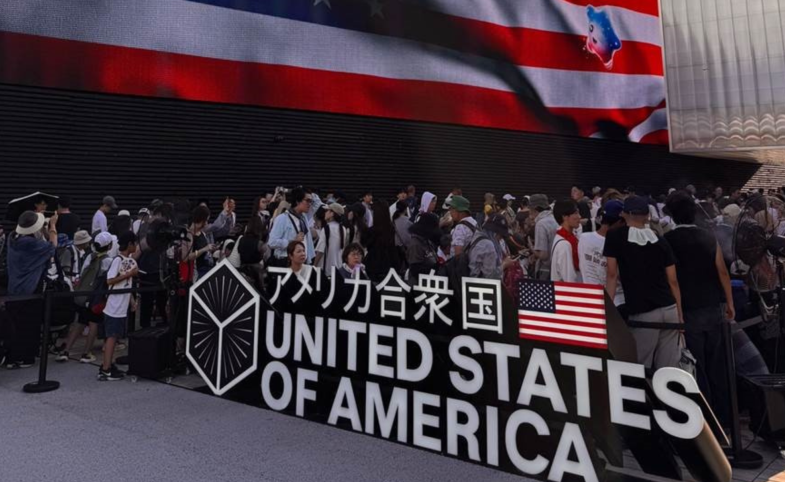
So fast forward to Osaka, and perhaps it is no surprise that the U.S. pavilion leaned in to the moon rock nostalgia – and space exploration for its big show – and this time with a sample from Apollo 17. In its review of Expo 2025 Osaka, the New York Times described the feeling of Expo nostalgia, compared and contrasted Japan’s political and economic standing in 2025 and 1970, and discussed the U.S. continuing interest in space exploration. Per the USA Pavilion Expo 2025 exhibit overview “The inclusion of this lunar sample serves as a symbol of American gratitude to the people of Japan for the continued U.S.-Japan partnership in space exploration.”
In Osaka, nostalgia was ever present for the expo, whose official theme was “Designing Future Society for our Lives.” There were articles about Expo fans who had purchased a ticket online to the 1940 “Ghost Expo” and redeemed it for admission to Expo 2025. The story and photo of the 22-year old Japanese man who had taken a picture with a Swiss Pavilion staff member in 1970 and reunited with her 55 years later.
I caught some of that Expo 1970 nostalgia in the movie Expo’70: A Girl’s Dream that I saw on board Japan Airlines. Taiwan leaned into its 1970 participation and I.M. Pei-designed pavilion – its last as the official BIE representative – with the Tracing to Expo '70 film that it had restored for the Osaka Asian Film Festival.

Watching Expo’70: A Girl’s Dream on board Japan Airlines

Subway Advertisement for the Tracing to Expo '70 film for the Osaka Asian Film Festival
But in keeping with the theme, it was not all about the past; rather, the focus was on the future. We saw the future in the architecture and exhibitions of the pavilions of the rising Expo stars (Saudi Arabia, Qatar, Bahrain and the UAE), and the Expo blue chips (France, Germany, Scandinavia and Switzerland), and of course our Expo hosts, Japan.

Inside the Japan Pavilion at Expo 2025 Osaka with its structural algae exhibit (August 28, 2025)
The Expo 2025 organizers had commissioned eight designers to interpret the expo’s theme for eight signature pavilions. These included a dystopian AI mirrored experience (null2), and an immersive pavilion without walls or a roof (Better Co-being); however, the pavilion that left a lasting impression with me was the Future of Life. There, the designer, Professor Hiroshi Ishiguro, had integrated human robotics to tell the story of a grandmother contemplating whether to extend her life and the associated philosophical and ethical considerations. By the end of the 30-minute journey all of us were crying alongside the androids and amidst the scents that had been created for this singular experience.

Author in the final room of the Future of Life pavilion at Expo 2025 Osaka (August 29, 2025)
Serendipitous Moments and Closing the Circle
In Osaka, the world’s largest wooden architectural structure, a 2 km long Grand Ring, connected us together providing access to the far points of the Expo. As CPD Faculty Fellow Nicholas Cull remarked to me later, the Grand Ring created a space that emanated a “Spirit of Expo” that kept negative aspects at bay and allowed visitors to experience a utopian life within that wooden ring. Across the site, we were greeted by the ethereal Expo 2025 mascot Myaku-Myaku, whose pavilion had its own hour-long queues. As the sun set, the drones rose, and the fireworks exploded, we reflected on what we had seen: the nostalgia of the past, the promise of the future, the human condition, and the Grand Ring, connecting us all.

Expo 2025 mascot Myaku-Myaku in the retail pop-up at Maruzen Marunouchi Department Store in downtown Tokyo (September 6, 2025)
At a World’s Fair, serendipity loves to make an uninvited appearance. And here in Osaka, it seemed to channel the Japanese philosophy of Ichi-go ichi-e (one time, one meeting). How else can one explain the chance run-in with a former pavilion colleague from the last World’s Fair, or seeing a photograph at one pavilion that reminds you of an object you saw at another? These serendipitous encounters cut across Expos and unite us at one moment, in one time.

Author with Deputy Commissioner General of the Monaco Pavilion Kristina Djordjevic and Kevin Solon, former Pavilion Director at the USA Pavilion (Expo 2020 Dubai), in front of the Grand Ring at Expo 2025 Osaka (August 29, 2025)
In Japan, my journey came full circle as I ran into former USA Pavilion colleagues, Expo 2020 friends, and fellow global mega event academics. Over the two days we saw a dozen-plus pavilions telling their countries’ stories and visions for the future. I proudly visited the USA Pavilion – whose federal funding, the Department’s first, had been made much easier by our successful pavilion at Expo 2020 Dubai – and met the next generation of Expo afficionados.

Author with Commissioner General of the Swiss Pavilion Manuel Salchli (Expo 2025 Osaka and Expo 2020 Dubai) inside of the Swiss Pavilion at Expo 2025 Osaka (August 29, 2025)
On my last day in Osaka, I joined Nicholas Cull, with whom I had taught public diplomacy at USC for a symposium entitled “The Expo Script: The Political Economy of Nation State Management.” As I remarked then, a non-existent USA Pavilion at Expo 2000 Hannover brought me to them today. My visit to the Hannover Expo changed my life and led me to join the Foreign Service and work towards a future that ensured that when the world gathers, the United States would show up.

Participants in the Expo Symposium “The Expo Script: The Political Economy of Nation State Image Management” at Osaka University (September 5, 2025)
In looking back, it was the Expo that had brought us all together. It had brought me to the Foreign Service, and through the Foreign Service to Dubai, and from Dubai to USC, and now here to Japan with my family to follow in the grandparents’ footsteps.
On our last night in Hiroshima, we met family for a meal that my grandparents had had with these same people 42 years ago. Thanks to Google Translate, we were now speaking with my great-grandmother Tamayo’s nephew, Kouheita Mizoguchi, now 88, about his prize-winning Shine Muscat grapes. That evening, we relished his grapes, exchanged our stories and reminded ourselves about the power and promise of connecting across families, countries, and oceans.

The author with Kouheita Mizoguchi (3rd from left) and families in Hiroshima (September 3, 2025)
We left Japan having closed a circle that had opened more than one hundred years ago when my family migrated to the United States. We left reminded about the restorative and healing power of connecting – online, in real life, and at Expos – and how the technology of travel, communication, and correspondence can empower, not just destroy, and how good pavilion design can help create a better world in the process.
Disclaimer: The views expressed in this report are the author’s alone and not necessarily those of the U.S. government.

Visit CPD's Online Library
Explore CPD's vast online database featuring the latest books, articles, speeches and information on international organizations dedicated to public diplomacy.
POPULAR ARTICLES
-
September 22
-
October 5
-
October 13
-
October 5
-
October 15
MORE FROM THIS AUTHOR
Join the Conversation
Interested in contributing to the CPD Blog? We welcome your posts. Read our guidelines and find out how you can submit blogs and photo essays >.