









The CPD Blog is intended to stimulate dialog among scholars and practitioners from around the world in the public diplomacy sphere. The opinions represented here are the authors' own and do not necessarily reflect CPD's views. For blogger guidelines, click here.
Unable No More: What LA28 Can Teach the World About What is Possible
Sport has always had the power to shape perceptions throughout the world. And with millions of eyes tuning in to Los Angeles 2028, the Olympics and Paralympic games have the opportunity to spotlight what we often leave in the dark. The question is what exactly will we see and CAN it change what we believe is possible?
Unfortunately we built a society that treats people with disabilities as, well, un-able. Unable to go to class with us. Unable to come to the game, worse, unable to play the game. An unusual consensus – the inability to function along society.
Though obvious to us fans of para sports, this is the furthest thing from the truth. These are athletes who swim, sprint, and shoot at levels most able-bodied people never will. Anyone who has watched a blind sprinter, tethered to a guide, cross the 100m line in under eleven seconds knows exactly what ability looks like. Yet the miseducation encourages a reality of ignorance, the mark of the “unable.”
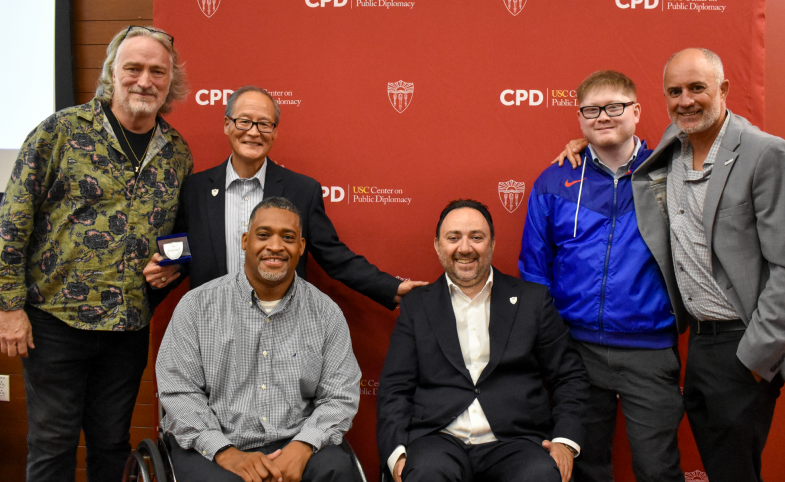
The athletes at the recent event in Los Angeles, Paralympic Movement and Building an Inclusive Legacy for LA28, are flipping the narrative. Co-hosted by the USC Center on Public Diplomacy, the Consulate General of Greece, and USC Athletics, the message was simple yet powerful – anything is possible.
Damon Whittaker is a para archer with Angel City Sports, working towards a spot on Team USA at LA28. At 14, a car crash left him a quadriplegic. He told the panel that getting into para sports brought his light back, and that he has spent his life since helping others with disabilities do the things they were told they couldn’t.

Damon Whittaker
Georgios Kapellakis, President of the Hellenic Paralympic Committee and a Paralympic gold medalist, put the stakes plainly for us. Los Angeles has a unique opportunity to shape how the public views and treats people with disabilities, simply by hosting these Games. Real cultural change, he argued, happens when we realize disability is not a limit but an important asset to our diversity. A wheelchair user, he swam in the S2 class, among the most severe physical-impairment categories in para-swimming, and won gold in the 50m freestyle at Beijing 2008.
"We keep building a society that shuts out so many of our population because we were never taught to imagine them there. That is why diversity of thought matters."
The story he told next illuminates further just why the narrative needs to change. Growing up in Greece, Kapellakis went looking for a pool to train. As you could guess, it was hard to find a pool built for him. The showers and changing rooms weren’t designed for people with disabilities, so after every session he drove all the way home in his wet swimsuit. Since then, his mission has been to strengthen the work of building a more inclusive world through Paralympic sport.

Georgios Kapellakis
Nobody designed that pool to keep Kapellakis out. Yet that’s the point. Nobody thought he would come. We keep building a society that shuts out so many of our population because we were never taught to imagine them there. That is why diversity of thought matters.
Para-sport changes the narrative from “What can’t you do?” to “WE CAN.” It’s about changing society’s perspective on what we collectively agree is possible. Whittaker said his aim is to expose information via his work in para sports. Not just for the disability community but for society as a whole. One audience member pushed it further: Maybe the word “disability” itself needs to go. The language we use can be a powerful tool for understanding. These are not people who are unable. Their abilities expand our horizons of what we think is possible for humanity.
Which brings us back to LA28. Sports diplomacy through these mega-events has huge potential to build stronger bonds between nations and human beings alike. But this cycle is special: LA28 will be Los Angeles’s first-ever Paralympic Games. And the Olympics and Paralympics are most powerful when united. Paris 2024 made that visible, becoming the first Games to share a single emblem across both.
Yet the most important investment a partnership like this can make is in human thinking. We need to show that inclusion is not a luxury. It is a basic human right.
Clayton Frech, founder of Angel City Sports, reiterated that the world is unfair to these communities. But what is beautiful about the Paralympic Games, he said, is the level of fairness inside them, even with so much diversity in bodies and abilities. Athletes are grouped into classification categories based on how their impairment affects their sport, so competitors face others with comparable function. The difference is not ignored. It is designed for. The pool, finally, is built for anyone.

Clayton Frech
The world was made for everyone. That is the power of the Games.
In the room were consuls and diplomats from Greece, Senegal and Australia, which will host in 2032, all talking about the same thing: what sport can do between nations that statements cannot. It brings nations, athletes and stakeholders to the same table to collaborate. It shapes perceptions and global understanding. And it lets us experience the most beautiful thing that sport has to offer — diversity, in cultures and in bodies.
Los Angeles gets to host that in 2028. The real legacy won’t be the venues. It will be how many people walk away with no thought of the “unable.”
Featured Photo: L-R: Brent Blair, Glenn Osaki, Damon Whittaker, Georgios Kapellakis, Robert Tanaka, Clayton Frech

Visit CPD's Online Library
Explore CPD's vast online database featuring the latest books, articles, speeches and information on international organizations dedicated to public diplomacy.
POPULAR ARTICLES
-
September 22
-
October 5
-
October 13
-
October 5
-
October 15
MORE FROM THIS AUTHOR
Join the Conversation
Interested in contributing to the CPD Blog? We welcome your posts. Read our guidelines and find out how you can submit blogs and photo essays >.