









The CPD Blog is intended to stimulate dialog among scholars and practitioners from around the world in the public diplomacy sphere. The opinions represented here are the authors' own and do not necessarily reflect CPD's views. For blogger guidelines, click here.
The BTS Paradox: Does Their Use in Public Diplomacy Strain South Korean Soft Power?
In March 2026, the K-Pop group BTS held a free public concert at Seoul’s Gwanghwamun Square. Set against the main gate of the historic Gyeongbokgung Palace, the event served as their first performance following military service.
While the performance celebrated a return to the stage, the logistics revealed a deeper story of statecraft. The concert required governmental approval and logistical support as traffic was diverted and public services like the fire department and police were mobilized. The group’s new album, Arirang, featured a track titled “No.29,” solely consisting of the recording of the sound of the "Divine Bell of King Seongdeok," officially designated as South Korea’s "National Treasure no. 29," provided by the National Museum Foundation of Korea.
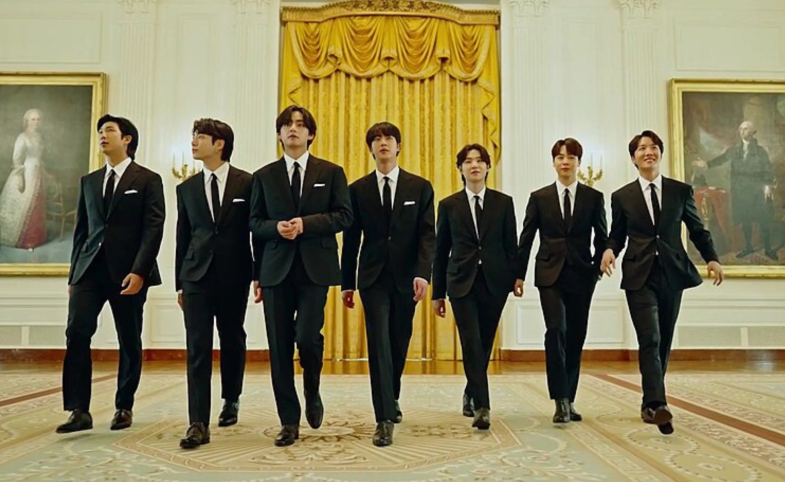
This level of government involvement is part of a pattern of deepening State investment in BTS as a managed soft power resource. From the 2021 appointment of the members as "Special Presidential Envoys for Future Generations and Culture," to high stakes deliberations over their military service exemptions, the State has increasingly institutionalized the group’s diplomatic potential.
Joseph Nye Jr. defined "Soft Power" as the "ability to attract rather than coerce." He identifies credibility as its essential precondition, arguing that public diplomacy works most effectively when the source of the message is perceived as ‘genuinely independent’ of the government whose interests it advances.
"The more conspicuously the Korean State marks BTS as its cultural property, the more it undermines the independence that generates their credibility advantage."
Each formulation of this theory points to the same evaluative criterion: The visibility of the State’s involvement in managing its messengers is inversely proportional to their diplomatic effectiveness. For BTS, the Korean government’s increasingly conspicuous conscription of the group creates a measurable tension with these foundational credibility conditions.
The South Korean Ministry of Foreign Affairs designated 2010 as the first year of public diplomacy, elevating it by 2011 to one of the three pillars of national diplomacy alongside political and economic affairs (Park, 2020). This institutionalization culminated in the 2016 Public diplomacy Act, which established a legal foundation for systematic master plans and a coordinating committee to improve the nation’s international prestige.
Much of this work operates at the level of "familiarity building." However, the emergence of BTS presented a resource capable of building genuine trust. Unlike State-manufactured exports of the early Hallyu period, BTS earned global fame through a mode of production that granted them creative autonomy and a reputation for authentic social advocacy.
The Blue House appointment ceremony of September 2021 was designated to maximize the visibility of the State-BTS relationship. President Moon Jae-In’s public statement that "other world leaders requested BTS appearances during Korean State visits" made the instrumental logic of the relationship explicit rather than tacit.
Consequently, instead of harnessing the group’s organic credibility, the apparatus of their diplomatic deployment through official ceremonies and diplomatic passports, presents the relationship as managed. The more conspicuously the Korean State marks BTS as its cultural property, the more it undermines the independence that generates their credibility advantage.
Andrew F. Cooper (2020) identifies the "conformist requirement" as a major shortcoming in celebrity diplomacy. A celebrity’s utility to an institutional sponsor depends on their operating within a defines script, amplifying existing positions without generating friction with diplomatic relationships.
BTS’s UN General Assembly participation, addressing the Sustainable Developmental Goals (SDGs) and youth empowerment, involved no position that created friction with any member State’s declared positions. The conformism converts apparent independent advocacy into a legitimating exercise for policies the State endorsed regardless. Though the celebrity may appear to speak independently, the content becomes indistinguishable from what the State would say without them.
Nye identifies consistency between stated values and observable conduct as the mechanism through which credibility is built. BTS developed an international profile based on vocal statements regarding social discrimination, including anti-Asian discrimination and support for the Black Lives Matter movement.
However, the group’s sustained silence on the conflict in Gaza since October 2023 provides evidence of structural constraints. Given South Kora’s diplomatic alignment with the United States and the commercial risks within the industry, the incentive to speak remains absent. The viral circulation of pictures of BTS merchandise left in the ruins of Gaza made visible the "credibility gap" between the values the group projects and their selective silence on issues that might lead to friction with government interests. This strain gets further complicated by private commercial choices. In 2025, member V’s appointment as a brand ambassador for Coco-Cola produced a credibility complication following the brand’s inclusion on global boycott lists. This incident highlights a structural incoherence: The Korean State has formally designated BTS as envoys for global youth values while exercising no control over the commercial contracts individual members enter.
History also sets a ceiling on soft power. In 2018, member Jimin was photographed wearing a T-Shirt depicting the atomic bombing of Japan alongside imagery of Korean liberation. Consequent controversies resulted in the cancellation of a scheduled Japanese TV appearance. As scholars Koari Hayashi and Eunjung Lee documented, cultural popularity does not easily dissolve colonia tensions or nationalist media cycles.
South Korea aspires to reach ‘Public Diplomacy 3.0’ (PD 3.0), a model characterized by intellectual leadership and active engagement with global issues. This model requires a State to maintain positions on contested issues where diplomatic risk is accepted in pursuit of global public good (Park, 2020). However, by staying within "safe" parameters, the deployment of BTS remains an instantiation of PD 2.0, aimed at image enhancement, rather than evidence of PD 3.0.
While the diplomatic adoption of BTS reflected an accurate assessment that organic credibility is valuable, the cumulative effect of institutionalization has been to transform a soft power asset into a visible instrument of State management. Until the State allows its flag-bearers the autonomy to engage with global realities, its public diplomacy will remain an exercise in managed visibility rather than a transformative global force.

Visit CPD's Online Library
Explore CPD's vast online database featuring the latest books, articles, speeches and information on international organizations dedicated to public diplomacy.
POPULAR ARTICLES
-
September 22
-
October 5
-
October 5
-
October 13
-
October 15
MORE FROM THIS AUTHOR
Join the Conversation
Interested in contributing to the CPD Blog? We welcome your posts. Read our guidelines and find out how you can submit blogs and photo essays >.