








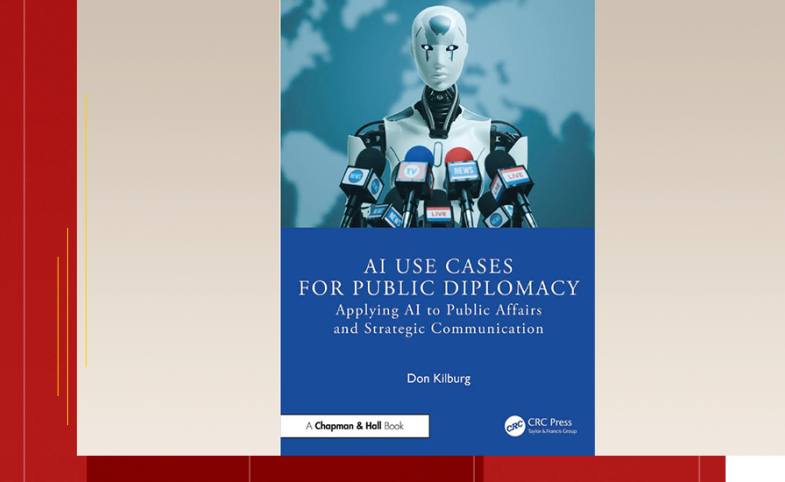
Meet the Author: Don Kilburg on AI Use Cases for Public Diplomacy
CPD’s Andrew Dubbins spoke with Don Kilburg, author of the new book, AI Use Cases for Public Diplomacy: Applying AI to Public Affairs and Strategic Communication. Kilburg, PhD, is founder and CEO of Mind Leap Institute, where he advises on the human side of artificial intelligence. A retired U.S. Foreign Service Officer, he is also an experimental psychologist and a U.S. Army infantry veteran. Kilburg helped pioneer the use of generative AI for diplomacy at the U.S. Department of State and founded an AI-in-diplomacy community that grew to thousands of professionals. He is the author of four books with Routledge, including his AI Use Cases for Diplomats trilogy and Mind Leap: How to Think, Feel, and Flourish in the Age of AI. During more than 21 years in the Foreign Service, Kilburg worked across public diplomacy, strategic communication, audience research, technology, and policy. He served as Public Affairs Officer in the Bureau of Diplomatic Technology, the Bureau of Global Public Affairs, and at the U.S. Consulate in Almaty. His other public diplomacy roles included Public Opinion Analyst in the Bureau of Intelligence and Research, Spokesperson for the Bureau of Energy Resources, and Assistant Press Attaché at the U.S. Embassy in Beijing.
You argue that AI is changing not just the tools of public diplomacy, but the conditions under which credibility is earned. What does that mean for diplomats trying to build trust with foreign publics?
I learned a lot about credibility when I was posted to the U.S. Embassy in Beijing from 2010 to 2014. I worked in the press section, and almost every day we faced some kind of credibility challenge in U.S.-China relations. I came to see credibility as something that accumulates over time. Do people see your words corresponding to your actions? Do you tell the truth when it is inconvenient? Do you listen? Do you keep your commitments? If you've been doing your homework, so to speak, it will show when you are pressed by a crisis.
The Embassy's air-quality monitor was a good example. During an extreme pollution event in 2010, the automated system famously tweeted that the air was "crazy bad." It looked like an embarrassing gaffe, but the larger story was that people had been watching the Embassy's air-quality data over time and had come to rely on it. The credibility of that little monitor didn't come from sophisticated messaging. It came from a track record.
AI doesn't change that basic principle, but it does change the environment around it. We can now manufacture many of the appearances of credibility very cheaply: polished writing, professional analysis, convincing images, voices and video, even the appearance of public support. That creates a real test of sincerity for public diplomacy professionals. What do we think public diplomacy is for? Are we trying to build a long-term relationship with foreign publics, or are we simply trying to get people to believe what we want them to believe?
As a psychologist, I also worry about an information environment in which people become exhausted trying to determine what is real. There is a relationship here to learned helplessness. If people's repeated experience is, "I can't tell what is true anymore, so why bother?" disengagement itself can become an outcome.
That's why I keep coming back to a simple rule: Advocate, don't fabricate. Public diplomacy is advocacy, and AI can make us much better at it. But there is a difference between making a better argument and manufacturing the evidence for that argument. In an environment where almost anyone can manufacture something convincing, being known as a source that does not manufacture reality may become one of a diplomat's most valuable assets.
One of the tensions running through the book is between AI’s ability to “listen at scale” and its inability to fully understand culture, humor and context. Where do you think human judgment remains most indispensable?
I think human judgment is most indispensable in the space between what the data says and what the data means. An AI system might accurately detect that sentiment has changed, a phrase is spreading, or a particular group is engaging with an issue differently. But why is that happening? Is a small but highly active group driving the apparent trend? Is humor or sarcasm being interpreted literally? Is coordinated activity making something look organic? Is the online conversation representative of the larger population? The signal may be accurate while our interpretation of it is wrong.
I learned this working in the State Department's Office of Opinion Research with surveys, focus groups, and foreign public-opinion data. That experience made me a strong believer in evidence, but it also taught me that data doesn't interpret itself. This is where locally employed colleagues become especially important. I don't think their role should simply be to "validate" what an AI system or a Washington analyst has concluded. They should be co-interpreters. Someone who understands the language, history, humor, culture, and local media environment may look at exactly the same information and see something the model missed.
I think of the process as three stages: signal, meaning, and action. AI can be extremely useful in detecting signals at a scale no embassy team could manage on its own. But moving from signal to meaning requires context and judgment. Then we still have to decide what to do. Do we respond publicly? Talk to different people? Investigate further? Or do nothing because responding would amplify something that doesn't matter very much?
So I see AI as a kind of perceptual extension for diplomats. It can greatly expand what we are able to see. But it shouldn't become a substitute for understanding what we see. The objective isn't to have AI understand the foreign public for us. It is to use AI to help us become better at understanding the foreign public ourselves.
Public diplomacy has always involved tailoring messages to particular audiences. As AI makes personalization much easier, where is the line between effective engagement and manipulation?
I don't think personalization itself is the problem. Public diplomacy has always involved understanding the people you are trying to reach and communicating in ways that are relevant to them. When I worked on public diplomacy around the Transatlantic Trade and Investment Partnership (TTIP), different groups cared about very different aspects of a complicated trade negotiation. A small business owner and an environmental organization weren't asking the same questions. Explaining the parts of a policy that matter most to each audience is not manipulation. That's knowing your audience.
AI can take this much further, however. The distinction I find useful is between relevance and vulnerability. Persuasion makes an argument relevant to someone. Manipulation begins when we identify something about a person's psychology that allows us to bypass or compromise their judgment. If I know you care about environmental protection and explain how a policy affects the environment, that's relevance. If I infer that you are frightened or emotionally vulnerable at a particular moment and deliberately exploit that vulnerability, we have crossed into something different.
My psychology background makes me particularly aware of this. Human judgment is influenced by emotion, identity, fear, social pressure, and many other factors. That isn't new. What is new is the possibility of using AI to identify those characteristics and act on them individually and at enormous scale.
One practical test is whether we would be comfortable telling someone why they received that particular version of the message. Another is whether the underlying facts remain the same for different audiences. We can change the language, examples, emphasis, or level of detail. But if we are giving different people incompatible versions of reality because each has been optimized to produce a desired response, we have a problem.
Persuasion ultimately leaves people with agency. We make our case, and they remain free to evaluate it, disagree with it, and say no. Public diplomacy should use AI to become more relevant and persuasive without treating people's psychology as something to be secretly engineered.
Deepfakes, synthetic media and AI-generated disinformation can now spread faster than diplomatic institutions traditionally respond. How should public diplomacy organizations rethink crisis communication for that environment?
Speed obviously matters. A convincing synthetic image, video, or audio recording can spread widely before a government completes a traditional clearance process. But I don't think the answer to machine-speed information is simply machine-speed government. Responding too quickly can cause us to amplify something that wasn't spreading very far, authenticate something we haven't actually verified, or make a statement we later have to correct.
That means much of the important work has to happen before the crisis. Who can verify questionable content? Who has authority to respond? Who needs to be consulted? Which journalists, local experts, civil society organizations, or other trusted people can help us understand what is happening? You don't want to invent that process while a synthetic video is going viral.
I think about crisis response as a sequence: detect, verify, assess, decide, respond, and learn. AI can be extremely useful in detection. It can track a narrative, compare versions of content, identify anomalies, and help a public affairs team understand how something is spreading. But I particularly don't want us to automate away the assessment stage.
Suppose we determine that an image is AI-generated. We still don't know what it is doing. Is it intended to deceive? Is everyone in on the joke? Is it ridicule? Is it signaling something? Is it trying to provoke a government response? Those questions are part of what I call Synthetic Statecraft, the use of synthetic and AI-mediated content as an instrument of political communication and statecraft. In that environment, asking "Is this real or fake?" is no longer sufficient. We also have to ask, "What is this trying to do?"
AI can help governments respond faster. But the objective isn't speed for its own sake. It is to build the people, procedures, relationships, and technical capabilities that allow us to exercise good judgment faster.
You describe a broader information environment in which governments are no longer the only powerful actors—technology companies, civil society organizations and other networks increasingly shape what publics see and believe. How does that change the practice of public diplomacy?
When I was serving in Almaty, Kazakhstan, I became very aware that the information environment didn't respect the boundaries on our organizational charts and portfolios. Russian-language media crossed borders. Kazakhstan had its own history, language, and identity, but it also sat at the intersection of Russian, Chinese, Western, and other influences. We were organized geographically. The narratives weren't.
AI makes that much more important. People in Kazakhstan, like people everywhere, will increasingly have to decide which AI systems they rely on to search for information, translate, learn, and make sense of the world. Some will come from China, some from the United States and other Western countries, and others may come from Russia or elsewhere. Most countries aren't going to build their own advanced AI systems, so they will be relying to some degree on technologies developed somewhere else.
One thing I think people need to understand is that these systems are not neutral. They are designed by people. Choices have been made about what information they are trained on, what they can say, what they won't say, and how they handle sensitive questions. DeepSeek gives us a very concrete example. Ask the Chinese AI system certain questions about the 1989 Tiananmen Square crackdown and it may refuse to answer or say the subject is beyond what it can discuss. So in a very practical way, some of the rules and assumptions of the environment in which an AI system was developed can travel with the technology.
But this isn't just about China. American AI systems also have guardrails, assumptions, and design choices. No AI system comes to us culturally or politically empty. And that matters because people aren't just asking AI to find information. They are asking it to explain what that information means. They may ask it to explain a war, a historical event, another country, or a political controversy. At that point, AI isn't simply another communications channel. It is becoming part of how people understand the world.
For countries like Kazakhstan, that raises what I call a question of cognitive sovereignty. By that I simply mean: How do you take advantage of these enormously useful technologies without giving up your ability to think for yourself? How does a country preserve its own language, history, culture, and point of view when many of the AI systems its people use were built somewhere else? I think a lot of countries are going to be wrestling with that question.
There is an internal lesson for diplomatic missions too. Before a mission starts adding AI to its work, people need to be reasonably clear about what they are trying to accomplish and what lines they won't cross. People working in the same mission won't always have exactly the same views about truthfulness, authenticity, transparency, or acceptable influence. AI won't fix those differences. It may amplify them by giving people more powerful tools.
That's why I don't see AI as simply another communications tool. Governments are now operating in an environment shaped by technology companies, platforms, civil society, networks, and increasingly AI systems themselves. Public diplomacy therefore has to be about more than getting our message out. We have to understand the larger information environment in which people are making sense of the world, who is shaping it, and where we can make a useful and credible contribution.
For a public diplomacy organization that agrees AI matters but is still experimenting with isolated tools, what does it actually take to move from experimentation to responsible institutional adoption?
I would start with the work, not the technology. It's easy to acquire a new AI capability and then ask, "What can we automate?" I would reverse the question. What decision are we trying to improve? Where are people overwhelmed by information? What part of the work isn't being done well enough? Where would better analysis actually change what a public diplomacy officer does? Then ask whether AI can help.
I would also look at whole workflows rather than individual tasks. Suppose AI can draft press guidance in thirty seconds. Fine. Who checks the facts? Who understands the policy well enough to recognize a subtle mistake? Who understands the local environment? Who is accountable for the final product? The important question isn't simply whether AI can perform a task. It is what happens to the larger system of work when it does.
That's why I don't think saying "human in the loop" is enough. What kind of human is in the loop? If AI has drafted, summarized, translated, and analyzed everything for someone for years, will that person still have enough expertise to recognize when the machine is wrong?
Organizations therefore need a cognitive strategy alongside their AI strategy. By that I mean a deliberate plan for the human capabilities we want to develop and preserve as machines become more capable. A junior officer traditionally learns partly by doing the work: drafting, reading, translating, comparing sources, making mistakes, and being corrected. Those aren't merely tasks that produce outputs. They are also how expertise develops.
So whenever we automate important work, I would ask four questions: What decision are we trying to improve? What can the system get wrong? Who is qualified to recognize that failure? And what human capability might weaken if we routinely give this work to AI?
My objective isn't maximum AI use. It's better public diplomacy. Responsible institutional adoption means thinking not only about what AI enables us to produce, but also about the people, judgment, and expertise we need to preserve as AI becomes part of the way we work.
What surprised you in researching and writing this book?
What surprised me most was how often a book I thought I was writing about artificial intelligence turned into a book about human beings.
I started with use cases. How can AI help with research, listening, translation, analysis, content creation, audience understanding, and crisis communication? But the deeper I got into the subject, the more interesting questions became human ones. What happens to judgment when machines become very good at producing analysis? What happens to expertise when AI performs the tasks through which people used to acquire expertise? What happens to credibility when convincing communication can be manufactured cheaply? And what happens to persuasion when we can understand and target people at a much more individual level?
My training as a psychologist probably has a lot to do with why I ended up there. I've always been interested in how people perceive things, develop expertise, make judgments, trust, and persuade one another. AI now touches all of those processes. As I put it, the AI revolution is a psychological revolution.
I also describe what is happening with the trillion dollar AI build-out as a Cognitive Industrial Revolution. The Industrial Revolution dramatically expanded our ability to mechanize physical work. AI is beginning to change how cognitive work is divided between humans and machines. I don't mean that machines are simply going to replace human thought. I mean that institutions are going to have to make choices about what we want machines to do, what we want people to remain good at doing, and how the two should work together.
So that was probably my biggest surprise. The more I studied AI, the more convinced I became that the most important questions aren't really about the technology. They're about us. The human element of diplomacy is not the legacy part of the system. It is the part we are trying to make more capable.
Visit CPD's Online Library
Explore CPD's vast online database featuring the latest books, articles, speeches and information on international organizations dedicated to public diplomacy.
Popular Blogs
-
September 22
-
October 5
-
October 5
-
September 9
-
September 22