









The CPD Blog is intended to stimulate dialog among scholars and practitioners from around the world in the public diplomacy sphere. The opinions represented here are the authors' own and do not necessarily reflect CPD's views. For blogger guidelines, click here.
When the Sky Turns Gray: Indonesia as an Opportunity for American Climate Diplomacy
China’s expanding influence in Indonesia is increasingly visible in an area that receives less attention than infrastructure, trade, or critical minerals: climate diplomacy. Beijing’s engagement is significant because it does not treat climate cooperation as an isolated environmental issue. Instead, it increasingly connects the green transition with investment, industrial policy, technological cooperation, renewable energy, electric vehicles, critical-mineral supply chains, and disaster resilience. Recent Indonesia–China discussions have included clean energy, green technology, circular-economy initiatives, forest conservation, and artificial intelligence and satellite technologies for disaster early-warning systems. This integrated approach allows China to translate environmental cooperation into economic and technological relationships that are visible well beyond diplomatic meetings.
Indonesia is particularly important to this strategy because it occupies several positions simultaneously: it is Southeast Asia’s largest economy, a major emerging power, one of the world’s most biodiverse countries, the world’s largest nickel producer, and a country highly exposed to environmental and natural hazards. Indonesia is therefore not simply a recipient of climate assistance. Its choices concerning energy, forests, minerals, urbanization, and industrial development have consequences for regional and global climate governance. This gives climate diplomacy with Jakarta a strategic significance that extends beyond emissions reduction. It is increasingly about who participates in Indonesia’s technological and economic transformation and under what terms.
China has recognized this relationship between climate policy and development particularly effectively. Its green engagement offers Indonesia access to capital, manufacturing capacity, infrastructure, and technology while supporting Jakarta’s ambition to move beyond exporting raw minerals toward higher-value industries. Yet this model also presents tensions. Indonesia’s nickel-centered industrialization, for example, illustrates how the transition to clean technologies can itself generate environmental costs through mining, energy-intensive processing, and continued dependence on coal-powered industrial facilities. Climate diplomacy should therefore not be equated automatically with sustainable development. Rather, China’s experience demonstrates that climate influence increasingly derives from the ability to connect environmental objectives to a partner country’s economic priorities.
This presents an important strategic question for the United States. Washington cannot assume that leadership in climate diplomacy will result simply from advocating stronger environmental standards or emphasizing global climate commitments. In Indonesia, diplomatic credibility is likely to depend increasingly on whether international partnerships contribute to tangible national priorities: technological development, disaster resilience, scientific capacity, economic opportunity, and energy security. The challenge for Washington is therefore not simply how to compete with China’s financial presence, but how to identify areas in which American capabilities offer Indonesia forms of cooperation that are distinctive, durable, and consistent with Indonesian strategic autonomy.
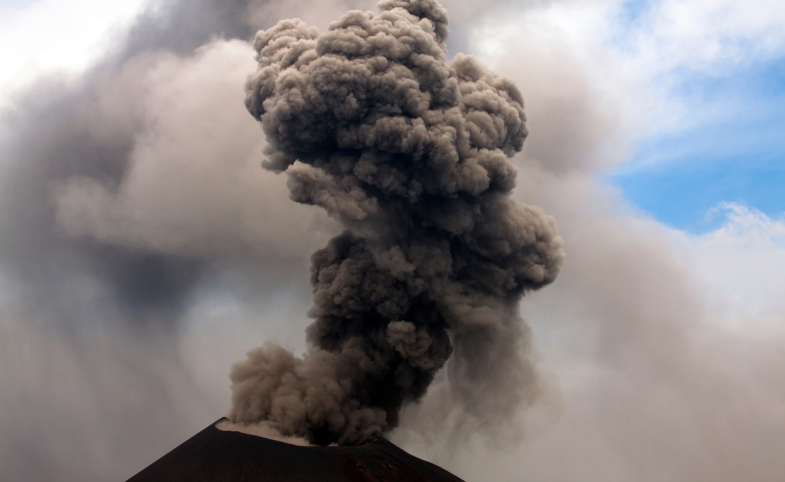
My own experience as CFR fellow in Jakarta brought this question into sharper focus. In early September, I watched the sky from my high-rise building change as volcanic ash affected parts of western Indonesia. Friends and colleagues circulated alerts and discussed precautions; masks appeared again; people cleaned ash from their cars; and conversations turned toward air quality, schools, aviation, and the direction in which the ash might travel. The eruption of Mount Anak Krakatau (pictured above) disrupted aviation and daily life across affected areas, demonstrating how quickly an environmental hazard can move from a scientific event to a social, economic, communication, and governance challenge.
Volcanic activity should not be conflated with climate change. Indonesia lies on the Pacific Ring of Fire, and eruptions are geological rather than climate-driven phenomena. Yet the diplomatic relevance of the episode lies elsewhere. Volcanic eruptions, floods, wildfires, extreme heat, sea-level rise, and other hazards require many overlapping institutional capacities: reliable scientific data, satellite monitoring, early-warning systems, risk communication, resilient infrastructure, emergency preparedness, and public trust. Environmental diplomacy can therefore extend beyond negotiations over carbon emissions to encompass the scientific and technological systems through which societies anticipate and respond to risk.
"The challenge for Washington is not simply how to compete with China’s financial presence, but how to identify areas in which American capabilities offer Indonesia forms of cooperation that are distinctive, durable, and consistent with Indonesian strategic autonomy."
This broader understanding is central to my academic colleague, Dr. Muhammad Ittefaq’s conception of climate diplomacy. Dr. Ittefaq, Assistant Professor of environmental communication at Michigan State University whose research addresses environmental and health communication, misinformation, artificial intelligence, and public understanding of science, argues that concentrating narrowly on emissions is insufficient for addressing the climate crisis. In my conversation with him, he emphasized that international cooperation should be organized around a shared responsibility toward humanity and the planet, alongside stronger scientific cooperation between the Global North and Global South. His perspective shifts climate diplomacy from a predominantly state-to-state negotiating process toward a wider ecosystem of scientists, universities, public institutions, communicators, and communities.
Dr. Ittefaq’s argument is particularly relevant to Indonesia because environmental vulnerability can also produce diplomatic agency. Countries that experience severe environmental shocks do not necessarily remain passive recipients of international assistance; they can use their experiences to influence international norms and policy agendas. He points to the Philippines’ diplomatic activism following Typhoon Haiyan and Pakistan’s advocacy for loss-and-damage financing after catastrophic flooding as examples of environmental vulnerability being translated into diplomatic influence. Indonesia has potentially even greater capacity to play such a role because its environmental significance is combined with substantial economic, demographic, maritime, and geopolitical weight.
The State of Southeast Asia: 2026 survey reinforces the importance of this environmental dimension. Climate change and intensifying extreme weather were identified as the region’s most pressing challenge by 60 percent of Southeast Asian respondents, while the figure among Indonesian respondents reached 67.4 percent. This finding matters strategically because it suggests that climate diplomacy intersects with an issue already regarded as highly consequential by influential regional stakeholders. Public diplomacy in this context is therefore not merely about communicating national values more persuasively. It is also about demonstrating whether an international partner can contribute meaningfully to challenges that regional societies themselves consider important.
The same survey illustrates why this question is particularly consequential for Washington. China was identified as Southeast Asia’s leading economic power by 55.9 percent of respondents and its leading political-strategic power by 40 percent, compared with 29.9 percent for the United States. More strikingly, when respondents were presented with a binary choice between China and the United States, 80.1 percent of Indonesian respondents selected China and 19.9 percent selected the United States. These findings should be interpreted cautiously: the survey captures the views of regional opinion-makers rather than serving as a representative national public-opinion poll, and a forced binary choice does not reflect the complexity of Indonesian foreign policy. Nevertheless, the results indicate the scale of China’s perceived influence, and the difficulty Washington faces if its engagement with Indonesia is understood primarily through great-power competition.
Indeed, another survey finding complicates any simple interpretation of Indonesia as moving into a Chinese strategic orbit. A substantial share of Indonesian respondents favored strengthening ASEAN resilience and unity rather than yielding to pressure from either major power. This preference is consistent with Indonesia’s longstanding emphasis on strategic autonomy. The implication for climate diplomacy is significant: an American strategy explicitly designed to pull Indonesia away from China could undermine its own objectives by forcing environmental cooperation into a geopolitical framework that Jakarta has strong incentives to resist.
The more productive American approach would therefore be to treat climate diplomacy as a means of strengthening Indonesian capacity rather than demanding Indonesian alignment. This is where the United States possesses important comparative capabilities. American universities, scientific institutions, technology companies, research laboratories, development organizations, and government scientific agencies constitute a knowledge infrastructure that can support partnerships in climate modeling, satellite observation, artificial intelligence, disaster prediction, environmental communication, renewable-energy innovation, coastal adaptation, and resilient urban development. The strategic value of these assets lies less in reproducing China’s infrastructure-centered model than in creating a complementary model based on scientific and technological networks.
Dr. Ittefaq’s emphasis on scientist-to-scientist relationships is particularly useful in this context. Indonesian universities and scientific institutions possess substantial expertise in geology, volcanology, tropical ecosystems, biodiversity, climate science, and disaster management, while U.S. universities and research institutions possess significant capabilities in advanced research, computational science, satellite observation, and technological innovation. Connecting these communities would make climate diplomacy less dependent on changes in government priorities because institutional and professional relationships can persist even when official political relations fluctuate. Universities, scientists, and research centers can consequently function as diplomatic actors rather than merely supporting institutions for formal diplomacy.
Such an approach would also require moving beyond the traditional donor-recipient model. Dr. Ittefaq argues that durable international partnerships should be built on mutual respect and trust rather than hierarchical assistance relationships. This principle is especially important in Indonesia, which already possesses substantial scientific capacity and extensive experience managing environmental and natural hazards. A reciprocal partnership would recognize that knowledge moves in both directions. American researchers can contribute satellite technology, computational resources, AI systems, research networks, and financing, while Indonesian partners bring expertise in tropical ecosystems, volcanology, community resilience, biodiversity, peatlands, coastal environments, and disaster management. Climate diplomacy would consequently become a process of co-production rather than technology transfer alone.
This model could be institutionalized through a U.S.–Indonesia climate and environmental science network linking universities, scientific agencies, geological institutions, meteorological organizations, disaster-management agencies, and environmental communicators. Its purpose would not be to create another broad diplomatic dialogue with limited public visibility, but to produce identifiable capabilities: shared environmental datasets, AI-assisted early-warning systems, joint research laboratories, researcher exchanges, disaster-communication training, climate fellowships, and collaborative work on flooding, forest fires, coastal vulnerability, extreme heat, air quality, and geological hazards. Dr. Ittefaq’s proposal for greater Global North–South sharing of climate resources provides an important normative foundation for such a network. The ultimate measure of cooperation would be whether knowledge and technology reach institutions and communities capable of using them.
There is, however, an important strategic risk in framing such initiatives primarily as instruments of competition with China. Securitizing climate cooperation too heavily could weaken precisely the trust that science diplomacy is intended to create. Indonesia’s strategic autonomy means that cooperation with Beijing, Washington, Tokyo, Brussels, or other partners need not be mutually exclusive. China can contribute infrastructure, industrial investment, and manufacturing; Japan can draw on long-established development relationships; European partners can contribute regulatory and environmental expertise; and the United States can deepen scientific, technological, educational, and research cooperation. From Indonesia’s perspective, maintaining multiple partnerships can itself be a source of strategic leverage and autonomy.
For Washington, the objective should therefore not be to displace China from Indonesia’s climate landscape. A more sustainable strategy would be to make the United States a consequential partner in areas where its capabilities complement Indonesian priorities. This means evaluating climate diplomacy not primarily by the number of bilateral declarations issued or the geopolitical messages communicated, but by the institutional relationships and capabilities that remain after individual programs end. A jointly developed early-warning system, a long-term university research partnership, an Indonesian scientist connected to an American laboratory, or an environmental communication network may generate less immediate visibility than a major infrastructure project, but such relationships can accumulate credibility over time.
The experience of watching Jakarta’s sky turn gray ultimately underscored this distinction for me. Foreign-policy debates often describe Southeast Asia through the language of strategic competition, multipolarity, critical minerals, supply chains, and U.S.–China rivalry. Those frameworks are important, but they can obscure the level at which diplomacy is actually experienced. When environmental hazards affect the air people breathe, whether schools remain open, whether flights operate, whether communities receive warnings, and whether institutions can protect citizens, international cooperation becomes tangible rather than abstract.
China’s growing climate engagement in Indonesia demonstrates that environmental diplomacy is already becoming intertwined with economic and technological influence. The United States therefore faces a strategic choice not over whether it should imitate China, but over what kind of partner it wants to become. Dr. Ittefaq’s emphasis on scientific cooperation, mutual respect, people-to-people relationships, and Global North–South knowledge sharing suggests one possible framework: a climate diplomacy centered less on geopolitical alignment and more on building capabilities that Indonesia itself controls.
Such an approach would not remove competition from U.S.–China relations, nor would it require Indonesia to choose between the two powers. Instead, it would recognize a central feature of Indonesian strategic autonomy: Jakarta can derive value from multiple relationships while retaining the ability to define its own priorities. For American public diplomacy, that may ultimately be the more durable form of influence. In an era of environmental uncertainty, credibility may depend less on which country communicates its leadership most forcefully than on which partnerships leave societies better equipped to confront the next crisis when the sky turns gray.

Visit CPD's Online Library
Explore CPD's vast online database featuring the latest books, articles, speeches and information on international organizations dedicated to public diplomacy.
POPULAR ARTICLES
-
September 22
-
October 5
-
October 13
-
October 5
-
October 15
MORE FROM THIS AUTHOR
Join the Conversation
Interested in contributing to the CPD Blog? We welcome your posts. Read our guidelines and find out how you can submit blogs and photo essays >.