








Meet the Author: Andrew Johnstone on the Public Relations Industry and American Foreign Relations
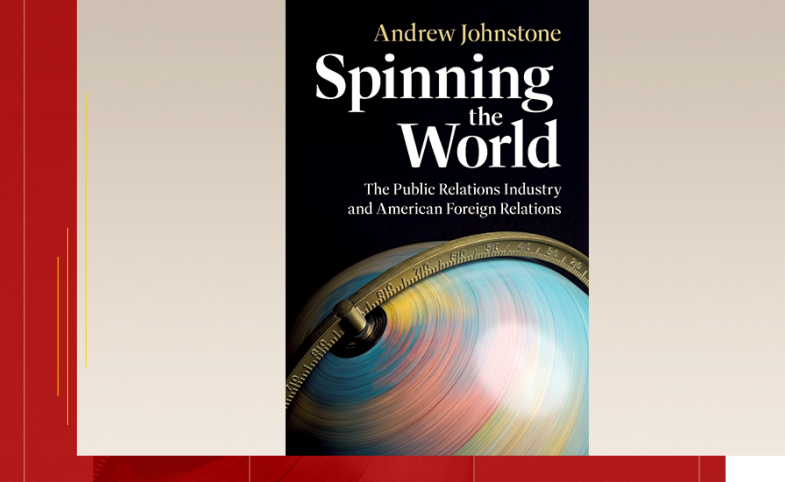
Here, CPD's Andrew Dubbins speaks with Andrew Johnstone, author of Spinning the World: The Public Relations Industry and American Foreign Relations (Cambridge University Press, 2025).
You frame public relations as a kind of “invisible hand” shaping U.S. foreign relations. How should public diplomacy practitioners think about the ethical line between informing global audiences and subtly engineering public opinion?
The first thing I would highlight is that the main actors in this book are public relations professionals. There’s obviously overlap between their work and public diplomacy, but there’s also a difference here. These are private businesses who (for the most part) profit from their contributions to governmental public diplomacy efforts, and corporate public diplomacy for businesses. It’s clear that those PR figures were aware of ethical issues relating to their work, but I’m not so sure they were concerned about a distinction between informing and engineering opinion. The latter is the point of their work, and the information they present is designed to engineer opinion. For example, Edward Bernays opened his 1925 book Propaganda by saying that “the conscious and intelligent manipulation of the organized habits and opinions of the masses is an important element in democratic society.” In his writing about public opinion, Walter Lippmann thought an independent, expert technocratic elite was necessary for making sense of a complex modern society, but he did have concerns about the potential for abuse and about PR and publicists in particular. Bernays and others had few such concerns and were happy to act as an invisible hand in a way that remains controversial. As I say in the book, persuading the American people to buy products as consumers was one thing, but persuading them to think differently about the national interest as citizens is something else altogether.
You highlight the tension between democratic ideals and expert-driven opinion shaping, drawing on figures like Walter Lippmann. How should modern democracies balance expertise with public participation in foreign policy communication?
The conduct of American foreign relations has never been especially democratic, and there have been numerous times in the last century when government policy and public opinion seem particularly far apart. I would rather see leaders do more to openly explain their positions. Attempting to persuade opinion through PR is acceptable if the source of persuasion is openly acknowledged; this was Ivy Lee’s key concern in the 1920s. But as I discuss in the book, PR leaders weren’t always interested in persuading opinion, and they were more interested in being seen to represent opinion, even if it was just a small portion of elite opinion. In the view of one PR leader, Harold Oram, an organization only needed “about 5% of the people in your country on your side to get almost any bill passed as long as there is not a great vocal opposition on the other side.” With just 5%, you could make it look “as if the whole country is behind you”, whether it was or not. The ethics of such a position went largely unexamined.
You note that PR firms sometimes worked for foreign governments whose interests conflicted with U.S. policy. What does this reveal about the limits of national loyalty in a global communications industry?
The post-Cold War years revealed that pretty much anything goes now when it comes to taking on foreign clients, and I cover this period in the book’s epilogue. There was more concern about this earlier in the twentieth century, first seen most notably with the response to Ivy Lee and Carl Byoir’s work in Germany. Even though that work was technically for companies rather the German government, it caused an enormous backlash. That backlash made some firms hesitant about engaging with foreign clients for a while, and those concerns clearly lingered through the early Cold War years. Hill and Knowlton rejected the Arab League in 1953 because of the potential political complications, for example. There were a lot of questions in the press in the early 1960s about the amount of PR work being done for foreign countries, most notably focused on the “Vietnam Lobby.” But by the 1970s, the number of foreign clients looking for PR support in the US was too big and lucrative for many firms to ignore.
The book raises recurring fears about propaganda undermining democracy, from the 1930s to Vietnam and beyond. Do you think those fears were justified, and are we facing a similar moment now with disinformation and AI-driven media?
Yes, I think fears about ethical questions and unaccountable influence were justified. And while this book did not evolve out of contemporary concerns about disinformation, an awareness of who is responsible for disseminating information is as important as ever given the proliferation of media. What I will say is that I’m not as convinced that PR actors were as influential as they thought or claimed they were. Ivy Lee was never likely to persuade Americans to support Nazi Germany, Edward Bernays was not individually responsible for the 1954 coup in Guatemala, and Harold Oram did not single-handedly drag the US into the Vietnam War. However, they were part of a broader attempt for influence alongside politicians, businessmen, and interested elite publics.
Ultimately, you argue that PR helped make the case for an “American-led century.” To what extent was that narrative constructed?
The American-led century was obviously a very real thing in terms of political, economic and military power, but the narrative that America was a positive force for good as part of a rules-based international order had to be supported by a PR narrative that tried to show American actions – and those of its allies – in the best possible light. Sometimes, as the history shows, that light was extremely selective.
What surprised you in researching and writing this book?
In terms of the research, I loved some of the insights that came from reading the private correspondence of the PR leaders who left their papers for historians to read. The brazen self-confidence of Edward Bernays. The staunch conservativism of Arthur Page. The American patriotism of John Hill. More broadly, one of the biggest surprises is how the PR industry successfully convinced others of its influence and power despite a lack of hard evidence to prove its effectiveness.
Visit CPD's Online Library
Explore CPD's vast online database featuring the latest books, articles, speeches and information on international organizations dedicated to public diplomacy.
Popular Blogs
-
September 22
-
October 5
-
October 5
-
September 9
-
September 22