








Meet the Authors: Jan Melissen, HwaJung Kim & Githma Chandrasekara on Home Engagement in Diplomacy
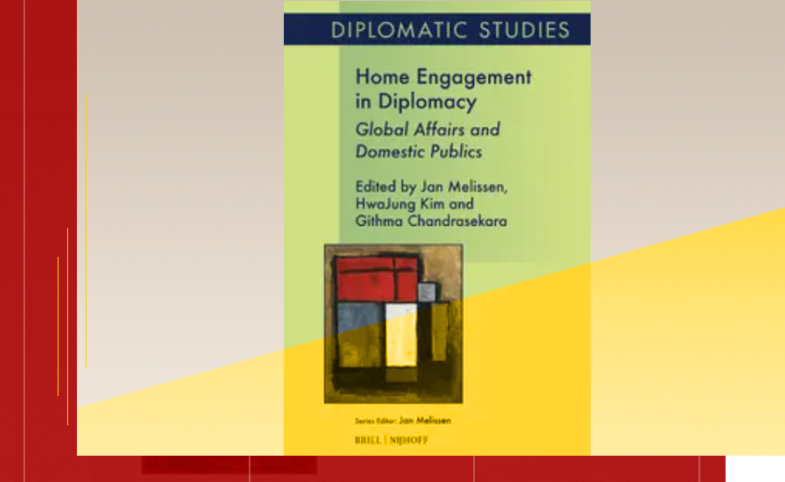
CPD’s Andrew Dubbins sat down with Jan Melissen, HwaJung Kim, and Githma Chandrasekara, volume editors of the new book Home Engagement in Diplomacy: Global Affairs and Domestic Publics (Brill, 2025).
How should today’s diplomats rethink their role if diplomacy is no longer just conducted between governments, but also with their own domestic publics?
We see diplomats reconceiving themselves as "boundary spanners" beyond their traditional roles, actively engaging with their increasingly assertive home citizens. The classical image of the diplomat facing outward is, of course, no longer adequate. Many practitioners see themselves not only as international networkers, negotiators, representatives, facilitators, and communicators, but also as governance actors at home. Diplomats navigate legitimacy, public expectations, and political contestation equally.
This does not imply turning diplomats into politicians or activists. Rather, it requires acknowledging that diplomacy is influenced by citizens’ expectations of representation and accountability, rooted in an evolving social context. In this sense, diplomacy increasingly unfolds through continuous interaction between international arenas and domestic societies, where citizens' agency, perceptions, and reactions can shape the legitimacy and sustainability of foreign policy choices.
The escalating tensions across the Middle East involving the USA, Israel, Iran, and a web of regional actors offer a striking illustration of this. Western governments have found themselves managing not just complex negotiations behind closed doors, but fierce domestic debates about military postures, sanctions regimes, energy security, economic implications, and the protection of civilian lives. These are foreign policy decisions with immediate domestic reverberations. Citizens are neither passive nor silent about them. When differences get out of hand and domestic society becomes a polarized sphere, this kind of socially damaging environment is equally a problem for diplomacy.
This calls for a genuine ontological shift: in a state-based world, savvy diplomats today recognize that individuals and societal groups co-constitute the diplomatic process itself. The book, therefore, foregrounds what we call “home engagement”—the growing interaction between diplomacy and domestic societies—and it examines how this emerging dimension of diplomacy challenges conventional approaches within diplomatic studies and international relations.
You argue that citizens are not merely audiences for foreign policy, but active agents within it. What does meaningful “home engagement” look like in practice for a foreign ministry?
The textbook answer to your question is that meaningful engagement goes well beyond opinion polling or token consultation. What we underscore, normatively speaking, is a genuine two-way dialogue between the state and society, i.e., the renegotiation of state–society relations aimed at building diplomatic constituency and fostering public trust in government. Rather than treating citizens as passive recipients of narratives, home engagement recognizes them as political actors capable of forming views, questioning priorities, and influencing legitimacy. The gap between government action and public expectation is precisely what home engagement is designed to address.
In practice, this can include participatory mechanisms such as citizen assemblies, public consultations, and deliberative mini-publics. It also means harvesting diverse knowledge from society, promoting diversity of thought, and managing the effects of public discontent or polarization on international issues. One key point we want to highlight is that not all domestic actors are organized or feel formally represented. Disintermediated individuals — ordinary citizens further removed from government — retain genuine agency, and any serious account of home engagement must include them.
Recognizing individuals as part of an expanded diplomatic ecosystem represents an important ontological shift, also for academics: rather than seeing citizens in a somewhat dated public diplomacy perspective, they play significant roles in the process of diplomacy’s societization. Several chapters by authors from the Americas, Asia, and Europe explore these deeper state-society dynamics across different regional and political contexts, examining how domestic actors and societal interests influence foreign policy debates and diplomatic practices.
The book introduces the idea of “deliberative governing” in diplomacy. How can diplomats incorporate public input into foreign policy decisions without compromising expertise or operational effectiveness?
We introduce the concept of "deliberative governing," which offers a more encompassing framework for understanding and advancing the application of deliberative democracy principles—a well-established framework in political theory—into the realm of diplomacy, applying them to issues of national decision-making in foreign policy. By grounding itself in reasoned debate, mutual respect, reciprocity, and a balanced distribution of communicative power, deliberative governing aims to create a political environment where citizens contribute to policymaking in an informed and equitable manner. Hence, this framework is not just about replicating existing democratic engagement models; it adapts and refines them to suit the distinct challenges of diplomacy.
Deliberative processes are ill-suited to urgent decisions, binary questions, or matters dominated by national security concerns where executive reliance on intelligence services necessarily limits public involvement. The fast-moving nature of the Iran conflict is a clear example of the limits of real-time public deliberation. That is precisely why we prefer the term "deliberative governing" over simply transplanting domestic deliberative democracy models into diplomacy. We are adapting those principles to the distinct conditions of foreign policy, where stakes are higher, information is often sensitive, and the interplay of domestic and international pressures is more complex.
The longer-term strategic questions surrounding the Middle East imbroglio—about diplomatic recognition, sanctions policy, and regional security architecture—are exactly the kinds of values-laden, complex, trade-off-heavy issues where structured public engagement is not only possible but essential for democratic legitimacy. Several case studies from our volume, including Canada, Germany, and South Korea, the United States, and Japan, flag the challenges of creating meaningful and democratic engagement mechanisms in complex, politicized, and polarized environments—and the domestic political repercussions for governments that have made various foreign policy choices on these questions without meaningful public deliberation.
In an age of digital media and networked communication, how has the relationship between diplomats and domestic citizens fundamentally changed?
Digitalization has narrowed the distance but not generated more trust between diplomacy and domestic society. Citizens now encounter foreign policy continuously—through media, social media platforms, and transnational networks—often outside institutional control. This has intensified the politicization of diplomacy, and while these digital tools have not yet transformed public engagement as anticipated, they have enhanced existing practices.
Senior and mid-level diplomats may feel insecure in the volatile and politicized digital sphere. When they fail to engage their domestic publics directly and credibly, though, they can find their foreign policy positions rapidly undermined by citizen-driven narratives they cannot control. Simultaneously, digital platforms have empowered diaspora communities, civil society actors, and networked individuals to challenge state-controlled narratives, generating what various academics discuss as a form of "digital nationalism" that blurs and complicates traditional borders. We also find the idea in the literature particularly useful that not every citizen has to be a co-creator of policy, but that developing an independent, critical understanding of foreign affairs is itself a meaningful form of political agency, one that deserves a place in any serious deliberative framework. In this sense, the increasing entanglement of diplomacy with domestic society reinforces one of the book's central claims: diplomacy can no longer be understood analytically without accounting for the domestic societal environment in which it operates and including citizens.
Looking ahead, what shifts are needed within foreign ministries to move from a "whole-of-government" approach to a truly "whole-of-society" model of diplomacy?
A whole-of-society diplomacy recognizes that the legitimacy of foreign policy is increasingly co-produced through state-society interaction. Rather than weakening the role of professional diplomats, this development situates diplomacy within a broader societal ecosystem in which domestic dynamics influence both the direction and the sustainability of foreign policy decisions.
Our volume shows that such engagement is not limited to the West or liberal democratic systems. Liberal and illiberal variants of domestic diplomatic practices are emerging, often shaped by societal polarization, political contestation, and strained international relationships. Moving toward such a whole-of-society approach requires both institutional innovation and conceptual adaptation. Foreign ministries aware of their existential need for home support will increasingly cultivate new professional skills among diplomats, including improved societal listening, cross-sectoral collaboration, and the ability to navigate increasingly politicized domestic environments.
In practice, this means developing mechanisms to enable meaningful and sustained dialogue with domestic publics beyond traditional stakeholders, including civil society organizations, local communities, private-sector actors, and diaspora networks. It also involves expanding conventional consultation processes and creating new participatory spaces where citizens can engage with foreign policy questions that affect their lives, their economic well-being, and their sense of safety and security. This helps diplomatic practitioners see the essence of foreign policy through the eyes of citizens as the smallest units of society.
What surprised you in researching and writing this book?
What stood out most was the extent to which diplomatic actors already engaging domestic publics—sometimes reluctantly, sometimes experimentally—are mostly lacking a clear language or conceptual understanding to describe and grasp their own efforts.
An academic surprise was the limited attention paid by diplomatic studies to theorizing the domestic foundations of diplomacy, despite historical evidence that foreign policy has long been contested within societies. This gap underscores the urgency of conceptualizing the societization of diplomacy and of going beyond diplomatic studies and international relations, drawing more explicitly on political theory, sociology, and governance studies. The book seeks to illuminate a growing trend in contemporary diplomacy—the increasing engagement of international affairs with domestic societal dynamics. Our objective in bringing together scholars from different regions and disciplines to reflect on diplomacy’s domestic dimension is to provide new conceptual and theoretical guidance for diplomatic studies.
Visit CPD's Online Library
Explore CPD's vast online database featuring the latest books, articles, speeches and information on international organizations dedicated to public diplomacy.
Popular Blogs
-
September 22
-
October 5
-
October 5
-
September 9
-
September 22