








Meet the Author: Joseph Horowitz on Music, Mythmaking, and the Cultural Cold War
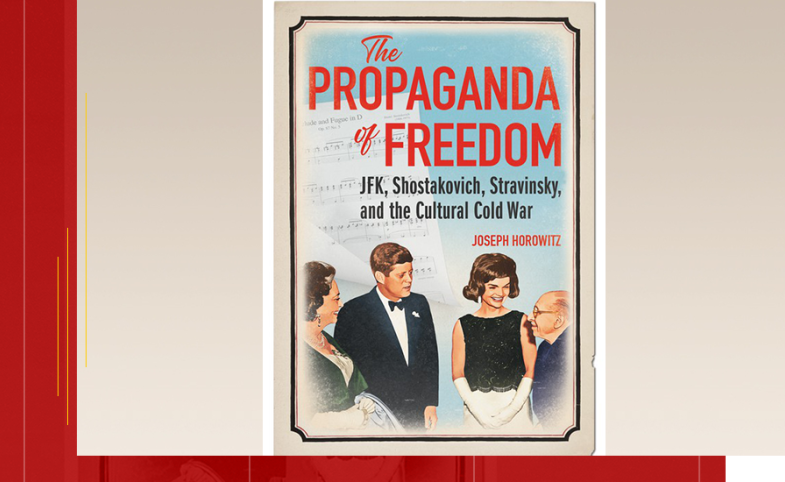
CPD's Andrew Dubbins speaks with Joseph Horowitz, author of The Propaganda of Freedom: JFK, Shostakovich, Stravinsky, and the Cultural Cold War.
Your book challenges Cold War assumptions that artistic greatness flourishes only in free societies. How do you think that mythology shaped America's cultural diplomacy strategy during the Cold War?
My book is called The Propaganda of Freedom, which is a phrase I coined to describe a morsel of Cold War ideology that I found so preposterous.
The book began one day when I attended an event at the National Archives about the Kennedy White House and Arts Policy. For the first time, I became acquainted with what Kennedy had to say about the arts. And what he said was so counter-empirical, I was just staggered. He said that only in free societies can free artists create great art.
Everybody knows that's not true. At least, you would think so. For one thing, it wasn't true in the Soviet Union, which produced any number of great filmmakers, writers, poets, composers, notwithstanding—or perhaps because of—the circumstances to which they were subjected. So I was fascinated to know what was on Kennedy's mind.
His most famous address about the arts was delivered at Amherst, not long before he died. I was able to go into the archives at the Kennedy Library and read Arthur Schlesinger's and Ted Sorensen's drafts. Sorensen wrote the speech first; Kennedy rejected it; then Schlesinger wrote the speech, and Kennedy actually strengthened it by adding to it this counter-empirical claim that artists are practitioners of social justice, which is another obviously false claim. It could be true, but it's often not true.
In the case of Kennedy, we're dealing with somebody who's absolutely not conversant with the arts. He's a reader, and he's a thinker, and he's an intellectual, but the arts, and especially music, are a closed book for him. My book is the closest examination of Kennedy in relationship to the arts. I'm sure this is a topic that Fred Logeval will address in his three-volume Kennedy biography, and I've been in close touch with him over the past few years, discussing this puzzle: How could John Kennedy have asserted that the arts can only thrive in free societies, or rather, that great art can only be created in free societies by free artists?
Its impact on American diplomacy was dramatic, and I would say very unfortunate. I mainly look at the Congress for Cultural Freedom—a propaganda instrument that's covertly funded by the CIA. The Secretary General was Nicholas Nabokov, who is a central figure in my book. Nabokov is a refugee, an exile from Russia. He's a minor composer. And he's obviously, I would say, suffering. I try to treat him with respect, but he's a man who was traumatized by exile. And his trauma takes the form of demonizing the Soviet Union for ruining the arts in his Russian homeland.
Nabokov had this idea that the Soviet Union is a cultural wasteland and he exerted enormous influence on American policy. He was so upset about the fate of Russia that he views Soviet Russian composer Dmitri Shostakovich as a Soviet stooge. And he was an opponent of cultural exchange. When Stravinsky decided to go to Russia in 1962, Limbokov was hysterically upset. He didn’t want Stravinsky to go. His ignorance of cultural exchange was so great that he showed very little awareness of something everybody else knew, which was the significance of 23-year-old pianist Van Cliburn's victory in 1958 at the Tschaikovsky Piano Competition in Moscow.
What changed the ballgame was American conductor and composer Leonard Bernstein's trip to Russia with the New York Philharmonic in 1959. Bernstein—whose parents were both Jewish immigrants who emigrated to the U.S. from Russia—delivered a message that we're all in it together; we're all the same, that the arts established a brotherhood of nations. He even delivered a lecture, which was televised internationally, claiming that Russians and Americans were fundamentally similar as manifest in their music.
So, the policy of demonizing the Soviet Union with regard to the arts was unfortunate because propaganda needs to be plausible, and this claim was implausible. Everybody could tell there was no credibility to the claim that the Soviet Union was so fundamentally inhospitable to the arts, and that the arts could only thrive in the United States.
Is that blind spot still in existence today—that Russia is a wasteland for Culture—or has it been properly updated?
It was very much a product of the Cold War—which undermined sound intellectual judgment. There are many things in my book about misperception of the Russians and Russian perception of the Americans. There were some Americans in the State Department who were reluctant to send American artists to Russia because they were afraid they would be jeered. Just the opposite happened. They were acclaimed.
So, I think this period has passed. We're now living in a period where there's no soft diplomacy, but it will pass, too. I was in South Africa with an orchestra of the University of Michigan—an excellent orchestra. And the repertoire included music by Black composers, including the most important symphony by a Black American, the Negro Folk Symphony by William Levy Dawson, as well as excerpts from Porgy and Best, etc. This tour had no support, nor did it seek any support from the U.S. government.
And yet, South Africa is a country that's geopolitically crucial right now. And there's no question in my mind, based on that experience, that once the Trump administration passes, and there's a potential for resuming this kind of cultural diplomacy, sending an American orchestra to South Africa with an appropriate repertoire could have enormous benefits for American foreign policy.
Talk about how culture can thrive in authoritarian regimes.
An authoritarian regime can paradoxically stimulate cultural expression. First of all, culture becomes more important when people's lives are so… delimited.
I knew Lazar Gossman, who was a member of the Leningrad Philharmonic during the Soviet times, and—like other members of that orchestra who were Jewish—he defected and wound up playing in the St. Louis Symphony. And he said to me, when he got to the St. Louis Symphony, he couldn't believe that when a concert was over, everybody got in their cars and drove home. “In the Soviet Union,” he said, “when a concert was over, we'd all get together, drink vodka, and talk about the concert”—because culture, music, concerts have more importance as a community. And then there's the phenomenon, also well known—look at Aleksandr Solzhenitsyn—that hardship can produce great art.
Thinking about public diplomacy professionals, how can they avoid reducing culture to these simplistic ideological narratives while still advancing national interests?
I think the ideological narrative is dead. No one today is going to say, anything as silly as “only free artists can create good art.”
I think that the issues facing cultural diplomacy the most today is that the culture, the arts, are being so rapidly eroded in the United States. We don't have a Leonard Bernstein. We could certainly send an orchestra to South Africa, but we don't have a cultural ambassador of Bernstein's caliber.
One of my most memorable conversations in writing this book was with a diplomat named Hans Tuch, who was in his 90s and is now deceased. He was an attaché in Moscow for the U.S. State Department, and he told me a great story.
When Leonard Bernstein came to Russia in 1959, there was a meeting with a Russian cultural attaché—Tuch was present—and the attaché told Bernstein not to perform “The Unanswered Question” by Charles Ives, because people wouldn't like it, or understand it.
Bernstein said, “fuck you,” got up, and left the room.
We don't have anybody today Who we can send abroad who's as intrepid and impactful as Bernstein was. Bernstein was a completely free agent. Nobody told him what to do, and he didn't need to be told. He was a natural cultural ambassador. Would that we had such people at hand today.
There's one more thing I need to say about Bernstein, which is that his relationship to Kennedy and Mrs. Kennedy was beyond anything we can imagine. It's not just that they knew one another. It's not just that they both went to Harvard. It's not that they knew one another before Kennedy Kennedy became president. It's not just that the Bernsteins were guests at the Kennedy White House.
People talk about what if Kennedy had not been assassinated? What would be the impact of Vietnam? What interests me is what would be the impact on the American arts?
I could assure you that he and Bernstein would have become comrades in arms. Things would have happened that are completely unthinkable today. The day that Kennedy was assassinated, the New York Times ran a story in the morning edition that he was about to appoint Richard Goodwin as his advisor on the arts. Goodwin, as you know, was part of the inner circle of the new frontier. This would have elevated arts policy to a White House priority. And what results would have arisen as a consequence of that? Well, one thing that impresses me is that after Kennedy died, years later, Bernstein was invited to testify at a congressional hearing about forming a council on the arts of some kind, and Bernstein had no interest in that whatsoever. And it had been done many times. So he dedicated his testimony to a priority that was never asked about, which is teaching music to young children in the public schools. And what he said was, we should make it a priority that all young Americans are musically literate—something that actually happened in communist Hungary.
What do you see as the state of music diplomacy today?
Well, it's dead right now because of the Trump administration. You know, a lot of our musical diplomacy to the Soviet Union was jazz artists. And the three most impactful visitors to the Soviet Union, sponsored by the U.S. State Department, were Leonard Bernstein, George Balanchine, and Duke Ellington—each for a different reason.
Balanchine was, of course, Russian. He was Georgian. And… For the Russians, the ballet was more impactful than the New York Philharmonic, because George Balanchine had created a new genre of classical ballet based in the New World, and was doing things not known at the Bolshoi or the Kirov. And also, he was choreographing music by Anton Webern that was completely unknown to Soviet musicians.
But it's been argued that the biggest impact was Ellington. And I write about Ellington in my book as well. You know, the Russians had a love affair with jazz. It was an iconic representation of American freedoms. And many, many stories could be told about the, the Willis Conover Jazz Hour, which was legendary.
This is a Voice of America program that presented the newest developments in jazz for the untold thousands of jazz aficionados in the Soviet Union, many of whom were classical musicians, like my late friend Alexander Toradze, who would listen clandestinely in a basement to the Jazz Hour on a shortwave radio.
So, we had a product during the Cold War, the musical product that just spread like wildfire in the Soviet Union. And we had great jazz artists, too, whom we eventually sent to the Soviet Union. Again, alas, we have nothing commensurate today to a Duke Ellington, or a George Balanchine, or a Leonard Bernstein.
What surprised you in researching and writing this book?
Hans Tuch surprised me. John Kennedy surprised me. Every step taken by Nicholas Naboko. The fact that he was so frightened by cultural exchange. For him, it was a threat. He feared going back. He feared discovering what it was really like. Because he had created a cartoon vision of the Soviet arts, and some part of him knew that this notion—that the Soviet Union was a cultural wasteland—wasn't true.
He didn't want to have to encounter that. Eventually, he did. He went back and he discovered that Dmitry Kabalevsky and Aram Khachaturian were really nice guys. He hung out with Mstislav Rostropovich.. He met Dmitri Shostakovich, who didn't bear any grievance, although he could have. And, he realized that these people were not ogres, and they were not, stooges, but they were human beings, just as he was.
The story of Bernstein in Israel is pertinent. I've just written a book about Bernstein, and cultural leadership. And it's heartbreaking to read about his concert in 1967 on Mount Scopus after the Six Days' War in 1967, and then the unification of Jerusalem.
Teddy Kollek was the mayor of Jerusalem, and he was a visionary. Bernstein and Collick were friends. So, somehow it was arranged, presumably by Kollek, that Bernstein would conduct Mahler's “Resurrection Symphony” , sung in Hebrew on Mount Scopus in Jerusalem to celebrate the reunification of the city.
And Bernstein went to Jerusalem and was intent on visiting the religious sites of Christians, Jews, and Muslims. He and Collick actually believed that this would be a landmark event, in creating future harmony between Palestinians and Israelis.
So that's a glimpse of cultural diplomacy, that, as I say, is heartbreaking today. At the end of his life, Bernstein considered moving to Israel, because he was so estranged from the United States. Estranged because of the Kennedy assassination, because of Watergate, because of Vietnam. Because of the erosion of the American arts. And in his diary, he talks about moving to Israel, because he says he feels at least as Hebraic as he does American. Which is amazing, given that this is a man who began his career as such an excited champion of the United States, the American experience, American music, Broadway. So, that's how embittered he was, and in the same breath, he worried however, that Israel is sectarian So, he's a prophetic figure.
And the dimensions of his cultural diplomacy are almost indescribable. As soon as he took over the New York Philharmonic, he was in Latin America for something like a month. Then he was in Eastern Europe and Russia. He went to Berlin when it was in crisis. This all happened in a period of a few short years. He was the music director of the New York Philharmonic, and he had been going to Israel beginning before 1948 and conducting there. This is one of the things that tutored him as a cultural ambassador.
He came to understand the power of music, the power of the Israel Philharmonic touring the country with more dates than it could manage. The hunger for music in Israel at that moment was so great, and the power of music was so great. So, Bernstein experienced all of that before he ever went to the Soviet Union.
He was the ultimate embodiment Of a cultural diplomat.
Last question: I'm curious your reaction to President Trump renaming the Kennedy Center and musicians cancelling their shows there.
I did a recent NPR show about that, and what I said is that if Bernstein had been around and the Kennedy Center was renamed, he would have been apoplectic. If Bernstein had been asked, as the National Symphony was asked, to perform the Star Spangled Banner at the beginning of every concert, he would have said, “fuck you”—exactly what he said to the Russians. If Bernstein were around when the National Endowment for the Arts and the National Endowment for the Humanities were decimated by DOGE, and two imbeciles in their 20s who canceled 1,400 NEH grants—one of which was my own Music Unwound grant—he would have been screaming, and he would have exercised a kind of leadership that we no longer see in the American arts community.
Visit CPD's Online Library
Explore CPD's vast online database featuring the latest books, articles, speeches and information on international organizations dedicated to public diplomacy.
Popular Blogs
-
September 22
-
October 5
-
October 5
-
October 13
-
September 9