









The CPD Blog is intended to stimulate dialog among scholars and practitioners from around the world in the public diplomacy sphere. The opinions represented here are the authors' own and do not necessarily reflect CPD's views. For blogger guidelines, click here.
The Smart Power of Carney’s Canada
Throughout his second term, Donald Trump has manifested an intense hostility and covetousness toward Canada. Convinced that America’s smaller northern neighbor doesn’t have the proverbial cards to stand up to a bullying apex power, Trump has sought Canada’s economic and political subjugation, to the point of scheming to engineer annexation via “economic force.”
But President Trump has fundamentally misunderstood the power levers Canada has at its disposal—soft, hard, and in combination, smart, in my late mentor Joseph Nye’s formulation—which are being deftly manipulated by Prime Minister Mark Carney against American domination, and for the middle power-driven flourishing of a values-based international order that the U.S. has abandoned and is currently working against.
Trump’s ignorance isn’t surprising. His administration has abandoned attractive, persuasive soft power, to the point of effectively denying that it exists, and has based its foreign policy exclusively on hard power’s mix of raw military might and bare-knuckled carrot-and-stick economics. Of course, without soft power, there can be no smart power, a set of “strategies that combine the tools of both hard and soft power” that can be utilized judiciously as circumstances necessitate.
To Mark Carney’s strategic benefit, on the soft-hard-smart power front Canada has an estimable toolkit. Canada’s international brand and reputation are extraordinarily strong. In 2025, Canada ranked third in the Anholt Nation Brands Index. Also in 2025, Reputation Lab ranked Canada at the apex of its scale alongside Switzerland as the world’s most admired country. As Carney himself has put it, “Canada is a pluralistic society that works. Our public square is loud, diverse and free…We are a stable and reliable partner in a world that is anything but.”
While Canada’s economy is a fraction of America’s, it nonetheless has elements to give the US pause in a trade war. Canada is America’s number-two trading partner and buys well over $400 billion in U.S. goods and services annually. Canada’s intertwined economy with U.S. is not only a point of vulnerability but a source of leverage as well: Canada is the top customer for 26 US states, including critical electoral swing states Maine, Michigan, Ohio, and Wisconsin.
As important as any other smart power attribute is Mark Carney’s remarkable oratorical skill—a gift for composing and delivering what one Canadian analyst refers to as “the consequential speech”, in which the prime minister is “conscripting words in the trade war with the United States and deploying them as foot soldiers to rally Canadians and enlist allies.”
In his now-famous presentation at the World Economic Forum in Davos in January 2026, Carney diagnosed “a rupture in the world order…where the large, main power, geopolitics, is submitted to no limits, no constraints” but where middle powers “have the capacity to build a new order that encompasses our values, such as respect for human rights, sustainable development, solidarity, sovereignty and territorial integrity of the various states.” He exhorted the gathered leaders to “build something bigger, better, stronger, more just. This is the task of the middle powers.”
"Under Mark Carney’s leadership, Canada is standing tall against America’s coercion, backed by formidable soft power attributes and more economic hard power than Donald Trump has realized. "
Over the subsequent months, the effect of the Canadian prime minister’s speech was electrifying: as a European Union diplomat stated, “I think Carney has been quite an important figure. He was threatened by the Trump administration, like Europe has been, and he said we need to change gear and think in different ways. He gave European leaders courage and inspired them.” Washington Post foreign policy columnist David Ignatius has singled out Carney as the most notable middle power leader today. “His speech at Davos, asserts Ignatius, “is a defining document of what I hope will be the post-autocrat era.”
When it came to soft power’s attraction and persuasion, Mark Carney rapidly brought Canada to the fore. But it would be Canada’s response to Trump’s blunt-force economic assault over a trade deal that would test the country’s resolve in the face of bald hard power and demonstrate whether Canada had sufficient hard power tools of its own, and thus a full smart power capacity vis-à-vis America.
The U.S. laid out onerous terms in trade negotiations over the summer of 2026. But Carney had no intention of being steamrollered in the face of threats of 50 percent tariffs on billions of dollars of Canadian goods, especially when the Americans began inserting insidious changes into what was supposed to be a completed agreement that sought “to restrict our protections of our language, our culture, and in effect, our sovereignty.” Carney withdrew Canada from negotiations and, when the U.S. followed through on the threatened tariff spike, the prime minister responded with a dollar-for-dollar counter-tariff regime.
Carney’s policy has matched hard power against hard power, coercion against coercion, on the bet that Canada can weather the negative economic effects better than the U.S. can. The Canadians are virtually certain to hang tough and likely to ultimately prevail, because the prime minister has deep public backing for a strong stand against American arm-twisting and the trolling that lately includes an attempted renaming of Lake Ontario as “Lake America”, while Trump faces a potential electoral bloodbath turning largely on an economy facing significant headwinds and the unpopular Iran conflict, as well as a U.S. public that doesn’t approve of the trade war that America is waging against Canada.
On September 17, Mark Carney spoke before the European parliament in Strasbourg to accept the offer of an unprecedented associate membership in the European Union. Carney asserted, in words that went beyond his immediate European audience to all of the beleaguered middle powers, that “the leverage of the powerful in an exploitive relationship collapses well before complete independence is achieved. Because diversity confers advantage. The objective is not self-sufficiency. It is collective resilience.” The Canadian news magazine Maclean’s grasped the full ramifications of Carney’s proffered strategic vision, entitling an article on the speech “Canada’s Anti-Trump Playbook Could Be the Blueprint for the World”.
Most recently, Mark Carney brought his ambitious vision to the United Nations. In a direct echo of Joseph Nye’s “liberal realist” conception, he declared that the “alternative that Canada and many others are pursuing is values-based realism. An approach that is both principled and pragmatic.” At the UN, Carney announced that Canada was co-sponsoring the middle power-driven Partners for Multilateralism coalition, a new group that “will help build trust, bring together those who are ready to take action, and accelerate the development of promising solutions that could eventually – and with full legitimacy – be deployed on a larger scale.”
Under Mark Carney’s leadership, Canada is standing tall against America’s coercion, backed by formidable soft power attributes and more economic hard power than Donald Trump has realized. The combined smart power at his disposal offers an inspiring vision of a path for like-minded middle powers to resist a rapacious United States, and to establish a robust values-based system in the midst of the current Hobbesian global disorder. They really have no other choice—as Carney warned fellow middle powers at Davos, “If we’re not at the table, we’re on the menu.”
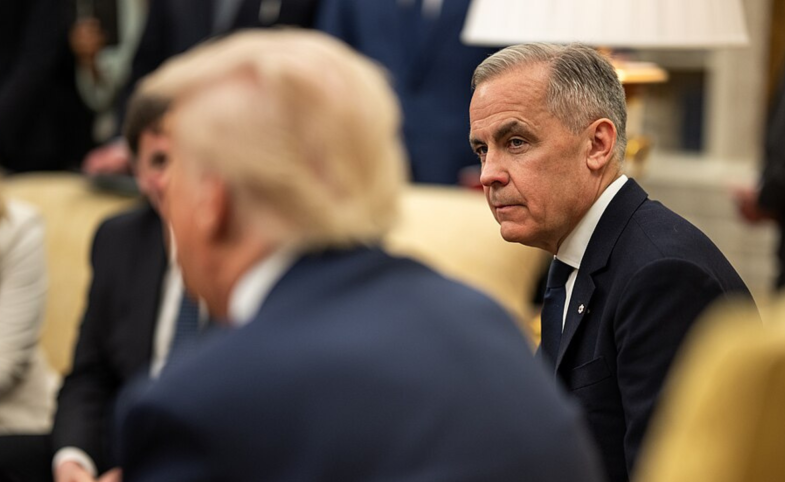
Featured image: President Donald Trump meets with Canadian Prime Minister Mark Carney, Tuesday, May 6, 2025, in the Oval Office. (Official White House Photo by Daniel Torok)

Visit CPD's Online Library
Explore CPD's vast online database featuring the latest books, articles, speeches and information on international organizations dedicated to public diplomacy.
POPULAR ARTICLES
-
September 22
-
October 5
-
October 5
-
October 13
-
September 9
MORE FROM THIS AUTHOR
Join the Conversation
Interested in contributing to the CPD Blog? We welcome your posts. Read our guidelines and find out how you can submit blogs and photo essays >.