









The CPD Blog is intended to stimulate dialog among scholars and practitioners from around the world in the public diplomacy sphere. The opinions represented here are the authors' own and do not necessarily reflect CPD's views. For blogger guidelines, click here.
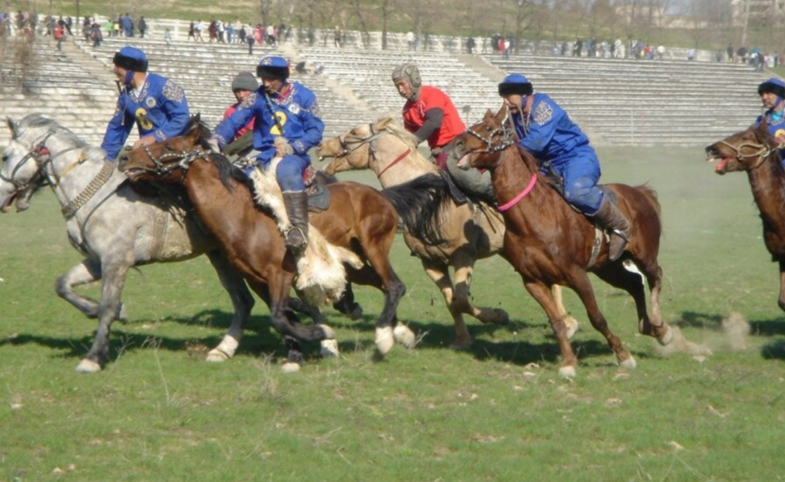
Sports Diplomacy at the World Nomad Games
What connects the American rodeo and the Kök-börü event at the World Nomad Games? The answer lies not only in the field of combat sports and horsemanship, but also in the artistic endurance of the horsemen who must skillfully ride their horse whether to herd cattle or catch prey. Kök-börü (pictured above), also known as “goat polo,” is one of the most spectacular games to have originated from ancient nomadic activities. It was recently recognized as a UNESCO cultural heritage of humanity by Kyrgyzstan. Kök-börü is a key event in the World Nomad Games, which began in 2014. Since then, they have taken place every two years, with the most recent competitions held in Bishkek, Kyrgyzstan, in September 2026.
Historically and geographically, Central Asian countries are at the heart of the Nomad Games. The Olympics of the nomadic world have expanded to include the Turkic states, where Turkic languages and cultural heritage predominate. However, the participation of a considerable number of non-Asian states from Europe, Australia, the Americas and Africa has made this initially ethnic competition truly international. The latest Nomad Games gathered more than three thousand athletes from over a hundred countries. The spectacular opening and closing ceremonies attracted millions of viewers. The high-level representation made the Nomad Games a politically significant event in the Eurasian region.
Apart from the Central Asian teams, who were the favorites of the Nomad Games thanks to their cultural traditions, practices, and above all their specifically developed physical skills, there are also American, British, Hungarian and Russian teams who also play Kök-börü. The participation of Western teams bridges cultural and civilizational divides through sport, making geopolitical tensions fade away, at least during the Games. However, geopolitics lies behind such sporting competitions. The participation of Russian athletes, who are not restricted from waving their national flag or singing their national anthem, is a sign of a new geopolitical configuration in which Western restrictions are inapplicable. Russia’s ban from the Olympic Games and other international competitions, followed by the conflict in Ukraine in 2022, demonstrated that sport and international politics go hand in hand. The World Nomad Games are different.
"The World Nomad Games reflect a consolidated stance in Eurasia, showcasing a regional gathering with global outreach."
The framework of sports diplomacy could be used to evaluate the “ethno-Olympics,” which are not directly associated with Western countries. In this case, sports diplomacy is considered a mechanism that helps develop and strengthen regional cooperation, a role in which Russia plays an important part. Moreover, the 2028 Nomad Games are scheduled to take place in Tatarstan, a predominantly Muslim region of Russia.
So, how could a connection be established between sports diplomacy and the World Nomad Games? That could be viewed as a system of regional governance that is strengthened through sports diplomacy and projected worldwide.
The World Nomad Games coincided with the annual Shanghai Cooperation Organization (SCO) summit, which also took place in Kyrgyzstan’s capital, Bishkek. The SCO has been a regional governance body for the last 25 years and now consists of 10 member states, including the original members, Russia and China. The SCO has since expanded to include 27 countries, some of which have observer or dialogue partner status. Despite the increasingly complicated regional geopolitical landscape, the situation has surprisingly stabilized. The absence of severe military conflicts between SCO members and associated states is proof of the rationale behind Eurasian cooperation, of which regional sports activities are one of the building blocks.
The SCO promotes security, economic and humanitarian affairs throughout the Eurasian region, focusing on cross-border issues. As a non-Western regional organization, the SCO does not advocate an anti-Western narrative, instead calling for a joint security architecture. However, Europe does not seem interested in this idea.
At the heart of the SCO are the Central Asian countries that have historically and geographically been connected to Russia. Russia’s “near abroad” of Central Asian countries, along with its strategic relations with other regional powers such as China, India and Iran, has been a significant factor in enabling Russia to overcome the myriad Western economic sanctions and maintain regional stability.
The presence of Russia’s Vladimir Putin, India’s Narendra Modi, Iran’s Masoud Pezeshkian and other high-level Central Asian representatives, gave the opening ceremony regional political significance. An American representative was also present: Sergio Gor, the U.S. Special Envoy for South and Central Asian Affairs. Regional powers well acknowledge the US’ interests in the region and would prefer it to adopt a cooperative approach rather than a confrontational one.
Sports competitions can pave the way for peace-building between nations and civilizations. The World Nomad Games bring sports diplomacy back to the fore while depoliticising sport. Political will and certain principles form the foundation of any type of cooperation and inter-state relations. A set of specific principles adopted by regional powers also demonstrates the possibility of cooperation, even when the national interests of different countries contradict each other. These principles include recognizing national interests and respecting sovereignty in maintaining political regimes, even those that may appear threatening.
Despite all geopolitical controversies, the Kök-börü shows the unity of people belonging to different political regimes and still remaining geopolitical rivalries, while Russian and American teams enjoy the game. The World Nomad Games reflect a consolidated stance in Eurasia, showcasing a regional gathering with global outreach. It is hoped that international sporting events will be free from political restrictions. Eurasian gatherings provide an example of how sports and politics can work together to strengthen inter-state relations and increase regional stability.

Visit CPD's Online Library
Explore CPD's vast online database featuring the latest books, articles, speeches and information on international organizations dedicated to public diplomacy.
POPULAR ARTICLES
-
September 22
-
October 13
-
October 5
-
October 5
-
October 26
MORE FROM THIS AUTHOR
Join the Conversation
Interested in contributing to the CPD Blog? We welcome your posts. Read our guidelines and find out how you can submit blogs and photo essays >.