








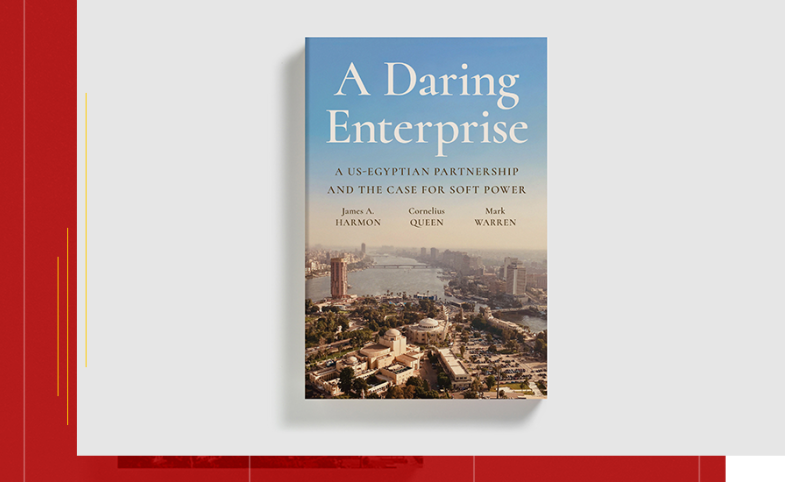
Meet the Authors: Cornelius Queen and James Harmon on US-Egyptian Partnership
CPD’s Andrew Dubbins spoke with Cornelius Queen and James A. Harmon, co-authors of the new book, A Daring Enterprise: A US-Egyptian Partnership and the Case for Soft Power.
You emphasize “partnership, not imposition” as a guiding principle. What lessons does the Enterprise Fund offer for avoiding the perception of U.S. interference while still advancing American interests abroad?
The most important decision we made early on was not to put Americans on the ground. Instead, we relied on Egyptian talent. Working with Egyptian investment professionals, who understood the market and local operating environment has been key to our success.
This is one of the most important lessons learned from our experience. Future enterprise funds should work with trusted local investors who know the market as opposed to relying on Americans. Our strategy of relying on local partners helepd reduce the perception of U.S. interference while allowing us to support Egypt’s private sector.
In 2014, we began working with our first investment advisor, Lorax Capital Partners. From 2015 to 2019, Lorax helped us make a series of investments that would generate significant financial and development returns. We later supported an additional six first-time fund managers. Today, those fund managers are an important part of Egypt’s private equity and venture capital ecosystem.
Together, we currently support close to 70,000 Egyptian jobs and have helped attract $1.8 billion in foreign investment to Egypt. This strengthens Egypt’s economy and makes it a more stable partner of the United States.
The book highlights deep Egyptian skepticism toward U.S. motives, shaped by history and recent tensions. How should public diplomats navigate environments where American engagement is viewed through a lens of distrust or conspiracy?
The Egyptian-American Enterprise Fund has always had one mission: to support the development of the Egyptian private sector. We never tried to tell the Egyptian government what they should do. Instead, we listened and worked with local partners to advance our mutual goal of strengthening the private sector.
When the fund was first created, members of the Egyptian government were skeptical of its intentions and frustrated that it had been established without their consultation. To address them, we answered their questions, acknowledged the importance of partnership, and reaffirmed that our only goal was to support Egypt’s private sector.
The lesson learned is that credibility is built through partnership. Rather than telling Egyptians what they needed, we worked with Egyptians who understood the market and were committed to building the country’s private sector. That helped demonstrate that American engagement could be practical, respectful, and mutually beneficial.
That experience offers an important lesson for public diplomacy. Public diplomats should navigate difficult environments by listening and understanding the local context.
You argue that economic opportunity—jobs, investment, entrepreneurship—can counter instability and even extremism. To what extent should economic statecraft be considered a core pillar of public diplomacy strategy?
Economic opportunity is critical to stability. The Egyptian-American Enterprise Fund was created to support Egypt’s private sector and create jobs. As the Arab world’s most populous country and a key regional actor, Egypt’s economic stability matters not only for Egyptians, but for the broader Middle East.
If economic development tools like the enterprise fund can help create jobs, local partnerships and promote stability, then these kinds of programs should be a core pillar of any public diplomacy strategy.
You describe tensions between U.S. policy goals and Egyptian sovereignty, especially around aid and NGOs. What is the right balance between advancing democratic values and respecting local political realities?
It is important to acknowledge that with democracy there is not a one size fits all model. What works in the United States may not work in other countries. Working to understand local customs and traditions should be the first step of any effort to try and advance democratic values in other places. As the United States, we should be clear about our values but also recognize that those values are most effective when they are put forth in ways that respect local history, culture, and political realities.
The enterprise fund was not designed to dictate political outcomes or tell Egyptians how to govern themselves. It was designed to support the development of Egypt’s private sector. Our strategy has always been simple: supporting private sector development isbe most effective when it is locally led.
The book ultimately makes a case for a renewed commitment to American engagement abroad through soft power. In today’s shifting geopolitical landscape, what would it take to rebuild bipartisan support for this kind of approach?
Enterprise funds have always been bipartisan. They are pro-business, investment-driven and support critical development priorities that advance U.S. strategic interests They were first created under President George H.W. Bush after the fall of the Soviet Union and later reintroduced under President Obama after the 2011 Arab Spring.
In today’s political climate, rebuilding bipartisan support for soft power will require showing that American engagement abroad is not charity. It is a strategic investment. The enterprise model demonstrates that the United States can build relationships, strengthen private sector development abroad, and compete more effectively with rival powers — all while responsibly stewarding taxpayer funding.
The Trump administration’s FY 2027 budget request seeks congressional authorization to create enterprise funds indicating that this this model is still relevant. The bipartisan nature of enterprise funds is one of the strongest reasons they can be replicated in other countries.
What surprised you in researching and writing this book?
The United States was one of the first countries to recognize Egypt’s independence after 1922. Over the years, the relationship has grown to be a strategic relationship for both. But there have been challenges. From American concerns over democratic backsliding in Egypt to Egyptian opposition of perceived U.S. interference in internal affairs, the relationship has at times been rocky. Egypt is a proud country and for good reason. It is one of the world’s oldest civilizations and is a key regional actor. Despite these challenges, which happen in any long-term relationship, the U.S.-Egypt strategic partnership remains resilient and a cornerstone of regional stability.
Visit CPD's Online Library
Explore CPD's vast online database featuring the latest books, articles, speeches and information on international organizations dedicated to public diplomacy.
Popular Blogs
-
June 24
-
July 2
-
June 29
-
July 29
-
July 20