








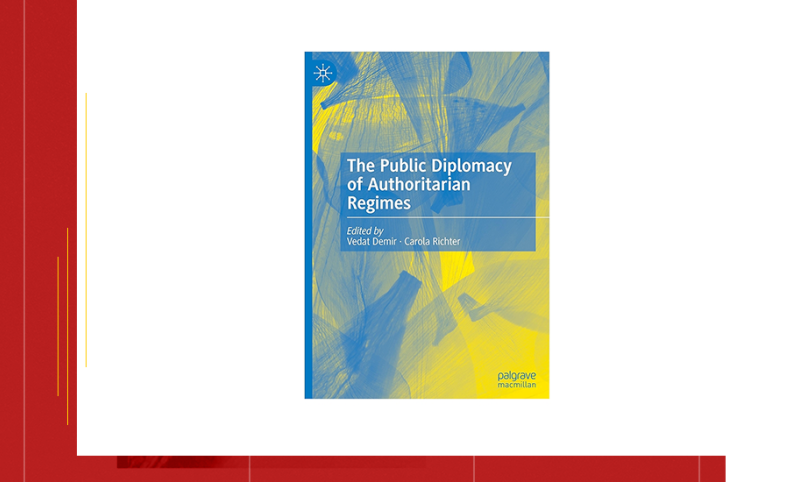
Meet the Authors: Vedat Demir and Carola Richter on the Public Diplomacy of Authoritarian Regimes
Here, CPD's Juliana Maitenaz speaks with the editors of The Public Diplomacy of Authoritarian Regimes (Palgrave Macmillan, December 2025): Vedat Demir, a visiting scholar at the Institute for Media and Communication Studies at Freie Universität Berlin, and Carola Richter, a professor for international communication at Freie Universität Berlin.
Could you tell us a bit about your background: What first drew you to public diplomacy? How did you end up researching and teaching in this field?
Vedat: I completed my education in journalism and public relations, with my graduate studies focusing on both the theoretical and applied dimensions of these fields. My interest in public diplomacy developed during my early years at Istanbul University, at the intersection of my core disciplines and my long-standing interest in international relations. I became particularly interested in how communication practices—especially those rooted in public relations and international communication—are rearticulated at the level of state actors.
Teaching a course in this area played a decisive role in transforming this interest into a more structured research agenda. Around the same time, I began working on my book Public Diplomacy and Soft Power (in Turkish), which became one of the first concrete outcomes of this shift. Since then, I have concentrated much of my academic work on public diplomacy.
Carola: At the beginning of the 2000s, I studied a combination of Middle Eastern studies, communication studies, and political science, spending significant time in countries across the Middle East and North Africa. After 9/11—and even more so following the Iraq War in 2003—the Middle East became the primary testing ground for renewed U.S. public diplomacy initiatives, and I gained firsthand insight into how these efforts were perceived. In this context, I wrote my first academic article on the largely unsuccessful U.S. public diplomacy efforts in the region. The topic of strategic outreach to foreign audiences has interested me ever since, particularly with the rise of such initiatives not only in the Western hemisphere but also within the Middle East itself. Notable examples include Qatar’s success with its international broadcaster Al Jazeera, the UAE’s efforts to brand itself as a hub for technology and innovation, and Iran’s export of a hybrid religious and anti-imperialist ideology.
How did the idea for a book on public diplomacy policies of authoritarian regimes originate?
Vedat: The idea for the book developed during a research project I conducted in Germany at Freie Universität Berlin in collaboration with Carola. The project, titled Public Diplomacy in Authoritarian Regimes and the Turkish Case, was supported by the Einstein Stiftung Berlin.
While I initially focused on the Turkish case, Carola identified compelling similarities in the approaches of Arab countries in the Middle East. Our discussions during this period pointed to a significant gap in the literature: public diplomacy has largely been examined through democratic contexts, while authoritarian regimes have either been treated in a fragmented manner or approached through normative assumptions. The focus has been almost exclusively on China and Russia, resulting in limited insight into the outreach strategies of ambitious middle and regional powers such as Turkey, Saudi Arabia, and Venezuela. At the same time, comparative perspectives have been largely absent, even though they are crucial for academic progress. Only through systematic comparison can we identify common patterns and key differences—both across political systems and within forms of authoritarian rule.
This realization led us to conceptualize an edited volume that would address the issue from a comparative and global perspective. The project, which we initiated in 2023, brought together contributions from scholars across different regions. After an intensive three-year process, the book was published by Palgrave Macmillan in December 2025.
Carola, you focus particularly on the MENA region. How do media and political systems inform these regimes' public diplomacy initiatives or programs?
Carola: One key insight from our regional comparison of MENA countries is that the logic of control through ownership has been extended to external outreach. In most Arab countries, domestic media is almost exclusively owned by ruling elites—such as royal families, the military, or those closely aligned with them. Even ostensibly private media outlets are ultimately in the hands of regime cronies. This centralized and hierarchical communication structure has been replicated in external strategies, allowing regimes to maintain tight control over their initiatives. At the same time, however, this approach tends to undermine credibility among target audiences—particularly in the West—because it limits the appearance of genuine dialogue and internal critique.
At the same time, our comparative analysis highlights the need to avoid overly homogeneous labels. The region is highly diverse, and public diplomacy strategies vary depending on internal sources of legitimacy, such as religion in Saudi Arabia or cultural heritage in Egypt, which can be leveraged for soft power, as well as on the resources available to each state.
In working on this book, were there any specific conclusions you came to that you have found to be crucial in the understanding of authoritarian politics?
Vedat: Yes, the project turned out to be not only an editorial endeavor but also a process of conceptual reflection. One of the key insights is that authoritarian regimes use public diplomacy not merely as an external communication tool, but also as an extension of domestic legitimacy-building processes.
Relatedly, these regimes tend to move beyond conventional “soft power” frameworks by adopting more hybrid, adaptive, and at times manipulative communication strategies. This shift is accompanied by a stronger emphasis on economic power as an incentive for cooperation across many of the countries we studied. It is also noteworthy that many authoritarian regimes are moving away from a primary focus on Western audiences and are instead targeting publics in the Global South. This suggests that some of the core concepts in the public diplomacy literature need to be revisited and critically reassessed.
We outline these broader implications in the book, particularly in the concluding chapter, which is largely shaped by Carola’s conceptual framing and synthesis. We are currently working on a follow-up article that will develop these insights further in a more explicitly theoretical direction.
Visit CPD's Online Library
Explore CPD's vast online database featuring the latest books, articles, speeches and information on international organizations dedicated to public diplomacy.
Popular Blogs
-
September 22
-
October 5
-
October 5
-
October 13
-
October 15