









The CPD Blog is intended to stimulate dialog among scholars and practitioners from around the world in the public diplomacy sphere. The opinions represented here are the authors' own and do not necessarily reflect CPD's views. For blogger guidelines, click here.
Endings Matter, We Need to Get Better at Them
Years ago, when Maria Shriver was speaking at a large annual California women's conference, she shared something I have never forgotten. Her mother taught her the power of a good ending. You give yourself ample time to process what you learned. You acknowledge where you fell short, and you own it. You commit to what you will do differently going forward. You let go, say goodbye with intention. And then, quietly and with purpose, you move on.
That is what a good ending should be, no? So why collectively do we suck at them? It is the lesson I have been holding up against this month.
Endings have been everywhere this month. Ted Turner, who founded CNN and gave a billion dollars to the United Nations, died at eighty-seven. An icon of media and philanthropy, gone. Foreign service officers I admire deeply are stepping out of careers, not by choice, that they spent decades building, sharing journeys on LinkedIn that should be required reading for anyone who wants to understand what diplomacy actually is. A colleague I respect deeply announced she is moving on from a company she helped build for nearly five years, leaving with the kind of grace that drew nearly a hundred people into her comments to cheer her on. US officials declared the Iran war over while the conditions of that ending were still unfolding in real time. Some of these endings have been done with deep intention. Others have only been declared.
At the national level, we have become a country that announces endings before they have finished happening, that sprints past the goodbye to claim the next thing, that treats reflection as weakness and witness as inefficiency. The cost of this is not abstract. Endings shape memory. Endings carry meaning.
Endings are where we decide what a thing was, and what we became inside of it.
What the Science Says, and Why It Is Also a Trust Story
The neuroscience here is striking. Research by Daniel Kahneman, the Nobel laureate behavioral economist, showed that we do not remember experiences as averages. We remember the peak moment and the ending. So how something ends literally rewrites what it was. A career, a relationship, a presidency, a war. Botch the ending and you have, in memory and in narrative, a different thing entirely than what actually happened.
We remember the peak moment and the ending. So how something ends literally rewrites what it was.
Bluma Zeigarnik’s research, nearly a century old now, found that unfinished tasks consume cognitive resources in ways completed ones do not. Things without proper endings stay live in the system. We carry them. Bessel van der Kolk’s line about the body keeping the score holds true for the body politic.
William Bridges, who spent his career studying transitions, named the deepest truth of all. Every transition begins with an ending. He described three phases. Ending. Neutral zone. New beginning. Most failed transitions, organizational, national, personal, fail because we skip the ending phase and sprint to the new without letting the old be what it was.
Endings are Trust Transactions
What the science does not always name, but what every leader feels, is that all of this is also a trust story. Endings are not just memory events. They are trust events. The way something ends teaches everyone watching what to expect next time, what to invest, what to withhold, what to believe. Roy Baumeister’s research on negative experience showed that bad outweighs good, often substantially, which means a botched ending can carry several times the psychological weight of the goodwill that preceded it. Years of trust can be unmade in the way one departure is announced.
The way something ends teaches everyone watching what to expect next time, what to invest, what to withhold, what to believe.
This is why a good ending is not a courtesy. It is architecture. It is the structure that makes the next beginning possible. When we strip the rituals of ending out of public life, out of institutions, out of the way we let people leave their work, we are not becoming more efficient. We are eroding the foundation on which every future trust depends.
The Architecture of Endings, Done Right
I saw the architecture of a good ending done right this month.
A colleague of mine announced she was moving on from a company she helped build for nearly five years. The post was brief, as these announcements often are. But knowing her, I knew brief was not the same as abrupt. There was no triumphalism, no settling of scores, no elaborate accounting of her years there. Just gratitude for the team they built and how they showed up for each other, and the quiet signal that the work she helped build would continue, in good hands, without her. And then, in her follow-up post where she announced her new role with her signature energy and excitement for what comes next: the visual imprint of her new venture, a serval cat appearing out of a printer. I had to smile. She is back to building something, which is what she does best, and whatever she builds will be remarkable, as her work always is. I did have to look up what a serval is. They are rare medium sized African cats, too big to cuddle, not quite cheetahs in look but smart, cunning, agile, and very, very fast. All the traits she embodies. Within hours, nearly a hundred people had gathered in her comments. They were not saying goodbye. They were saying we are walking with you to what comes next. That is what a good ending earns. Not closure, exactly. Continuity. The thread holds.
I have learned from extraordinary leaders across government, NGO and the private sector the importance of a strong good-bye. The one that remains top of mind always is Keith's.
Keith Reinhard, whose decades at DDB shaped generations of creatives and a body of global brand work most people would never think to attribute to him, used to say that when you leave anything, it should be as if you were never there. That was not modesty. That was philosophy. He understood that killer creativity, the kind that breaks through and lasts, does not happen by chance or luck. It is cultivated. With intention. With patience. With curiosity and practice. With a real dose of courage to build something new, defy what others said could not be done, and then when it's time...to let it go on to become whatever comes next.
Keith built the space, the place, and the team for that kind of work. He shifted consciousness and culture across the world. And he did all of it with a grace and a kindness that the cutthroat reputation of advertising rarely allows for. You leave quietly, with dignity and purpose, having shepherded and strengthened those who would replace you. Because, as he would put it, it was never about you in the first place.
That is leadership. That is also, increasingly, rare.
The Institutional Cost of a Stripped Ending
There is another way to end things, and we have been watching it unfold across the federal government for more than a year now.
When the Department of Government Efficiency arrived in early 2025 with a mandate to cut the federal workforce, it did not bring intention. It did not bring patience. It did not bring curiosity, or care, or any of the architecture that good endings require. It brought speed and indifference, two qualities that are particularly devastating to institutions built over decades. Cuts were made indiscriminately, without forethought, without ritual, without dignity. The damage will take decades to repair. Some of it will not be repairable at all.
What is happening to America's foreign service officers right now is the institutional version of all of that.
This month, over two hundred diplomats officially left the State Department (per the American Foreign Service Association, this finalized a reduction in force first announced last summer). They are leaving an institution they spent decades building, languages they spent careers acquiring, relationships in capitals around the world that took twenty and thirty years to earn. They are leaving after nine months on administrative leave, having waited through lawsuits and procedural delays for a process that did not pause for reflection, did not ask what was being lost, did not extend the courtesy of a proper goodbye. The ending was declared for them, and it was declared fast.
"We are already feeling what a stripped diplomatic corps means. Among those forced out are officers with rare language skills, specialists with decades of institutional knowledge, and crisis responders with expertise in the very situations we are now mismanaging in real time."
Many of them are sharing their journeys on LinkedIn, and I would urge anyone reading this to find them. Maryum Saifee, a career diplomat among those severed on Tuesday, wrote a piece that captured the depth of what is happening (her post on LinkedIn, May 5, 2026, is worth reading in full). She named what bureaucratic language has obscured. The Foreign Service, she explained, operates differently from most federal agencies. Officers are commissioned and carry their rank with them, like in the military, rather than being attached to specific positions. So when a position is eliminated, the officer normally moves to a new assignment. The work continues. The expertise is preserved. That is what makes this firing different from a normal restructuring. As Maryum put it, this was not a Reduction in Force. It was a “Replacement in Force.” The Department is hiring new classes of diplomats, an expensive training pipeline, even as it severs the officers who could have rotated. By her account, careers were ended in many cases mid-rotation, mid-promotion, or mid-overseas posting, based on the placement of names in a workforce review.
Foreign service officers are not normal, in all the best ways. Entry into the service is one of the most competitive professional gates in the United States. The exam, the orals, the security clearance, the years of language training, the postings in places that test every assumption a person has about how the world works. By the time someone is a senior FSO, they have been shaped by a kind of pressure most of us never face, and they have come out of it sharper, steadier, more thoughtful, and more intentional than the rest of us tend to be.
I have worked alongside FSOs in some of the hardest rooms there are, and what I have learned is this. They are the best kind of people. They went into this profession to make the world a better place. They navigate the impossible with resolve, care, and perseverance. They carry American interests into capitals where America is not popular, and they come out with relationships intact and the work moved forward. They always figure out a way. I trust them on every level. They are some of the finest professionals on the planet. And as of this month, many of them are free agents.
By the time someone is a senior FSO, they have been shaped by a kind of pressure most of us never face, and they have come out of it sharper, steadier, more thoughtful, and more intentional than the rest of us tend to be.
We are already feeling what a stripped diplomatic corps means. Among those forced out are officers with rare language skills, specialists with decades of institutional knowledge, and crisis responders with expertise in the very situations we are now mismanaging in real time, including the active conflict with Iran (per the American Foreign Service Association’s statement of May 5, 2026). As Saifee documented in her departure post, when conflict broke out in the Middle East earlier this year, a group of officers in this same severed cohort volunteered to serve on the task forces being assembled to evacuate American citizens. They were still technically on payroll. They had the language skills, the regional knowledge, the years of crisis response experience. They were turned away. We RIF’d Iran experts during an Iran war and refused the help they offered while we were doing it. People without training in diplomacy and without experience negotiating on behalf of a nation are now sitting across the table from foreign counterparts who have spent careers preparing for exactly that table. The results are visible every day. In the press conferences. In the meme exchanges that should have been substantive statements. In the relationships fraying in real time. This is not a future cost. This is a present one.
And the foreign service officers are not the only ones. Over the past year, the agency that ran America’s global development work for more than six decades has also been gutted. USAID, the United States Agency for International Development, went from more than ten thousand professionals to a few hundred over the course of a few weeks in early 2025 (per Office of Personnel Management data reported by Federal News Network, USAID was the deepest cut of any major federal agency, losing nearly its entire workforce). Their mandate was the quiet infrastructure of American influence. Tracking disease outbreaks before they reached our shores. Partnering with American farmers to feed children in famine zones. Stabilizing fragile states so we did not have to send troops into them later. The vacuum left behind is not abstract. Clinics closed in the middle of treatment. Supply chains stopped where they stood. Decades of relationships and capacity collapsed in weeks.
USAID's people were not random hires. Entry was as competitive as the foreign service, and the people who made it through were among the sharpest professionals I have ever worked with. They went where most Americans will never see, into war zones, developing nations, regions navigating famine and drought and disease. They stayed. They built relationships and trust, one interaction at a time, doing the kind of work whose value is intangible from inside the United States and which is therefore the easiest to declare expendable. That is the ending logic at its worst. The work that takes longest to build looks most disposable to anyone in a hurry to look efficient. We are losing both the work and the people who knew how to do it.
If you are hiring, hire them. The career diplomats. The development officers. Now. If you are not hiring, build a role and hire them anyway. They will pay back the investment within the first quarter. They carry institutional memory and global judgment that cannot be replicated by anything we can train for. The companies, foundations, universities, and multilateral organizations that move quickly on this will look back in a decade and recognize that this was the moment they got something irreplaceable for the price of a phone call.
They built relationships and trust, one interaction at a time, doing the kind of work whose value is intangible from inside the United States and which is therefore the easiest to declare expendable. That is the ending logic at its worst. The work that takes longest to build looks most disposable to anyone in a hurry to look efficient. We are losing both the work and the people who knew how to do it.
The cost of this ending will not be felt only in the headlines. It will be felt fifteen years from now, in a crisis we cannot yet name, when the people who would have known what to do are not in the room. That is what a botched institutional ending always costs. The bill arrives later, and it is always larger than the people who declared the ending could imagine.
In a Month of Endings, New Beginnings Are Quietly Moving Forward
This is also the month, and the part that has been hardest to sit with, that the world began to make its own ending of an era we did not realize was ending.
Mark Carney became the first leader from outside Europe ever invited to the European Political Community Summit, held this month in Yerevan, Armenia. He stood there and told the assembled leaders that nostalgia is not a strategy, that we have to take on the world as it is rather than as we wish it to be, and that as the world order is rebuilt, it will be rebuilt in Europe (per CTV News reporting from Yerevan, May 2026). Not in Washington. In Europe. Watching it, you could feel something shift. This was not posturing. It was procedural. The world is reorganizing the chairs, and ours is being moved.
Here is the thing I want every American to hear. The world moving on without us is not, in the first instance, an indictment. It is a verdict. We did not honor our endings, and so the rest of the room stopped waiting for us to. The question is not whether we can prevent the ending. The ending is already underway. The question is whether we use this moment, the way Maria Shriver’s mother described, to actually do the work.
Process what we learned. Acknowledge where we fell short and own it. Commit to what we plan to do differently. And then, quietly and with purpose, move forward.
That is how a country, like a person, recovers standing and credibility. Not by declaring endings over. By doing them well.
The Ending this Moment Is Asking For
Endings matter. They matter neurologically, because they shape memory. They matter relationally, because they teach trust. They matter institutionally, because they decide what is preserved and what is lost. They matter nationally, because they determine whether the world keeps walking with us or walks on.
We do not have to be a country that rushes past them anymore. We can be a country that learns to sit at the threshold, to honor what was, to name what is leaving, to thank the people who carried it, and then to step forward, quietly, with purpose.
Admiral William McRaven, the retired Navy SEAL who teaches at the LBJ School at the University of Texas at Austin, was on Jake Tapper's show, talking about his new book Duty, Honor, Country & Life. Tapper asked him whether he worried that America was losing leaders of character, integrity, and service. McRaven's answer was to stop watching the news. He sees these values in his students' eyes every day. He sees them in Americans he meets across the country when he travels. They are not in this current leadership, he said, but this leadership will not be there forever. When the moment comes for new leaders, he is hopeful. I am too. I see these values in action every day among the leaders I have the privilege of serving with at the local level in San Mateo County. They exist. We just need more of them at the highest levels.
Among the endings I have named, I am holding to the conviction that these values endure. That asks something of us as citizens, in how we choose the leaders who represent this country on the world stage. Examples matter. Values matter. And the people who still carry them, in classrooms and on the road and at every level of public service, will be the ones to usher in and guide us through a new beginning.
And to the foreign service officers and USAID alumni leaving, this month and across this past year, with all the institutional memory and quiet excellence in your hands. Thank you for your service. Thank you for your sacrifice. Both have been deeper and more costly than most Americans will ever understand. Your country still needs you. Just in a different role now. Please keep the fire and light you brought every day to your work, and carry them into whatever you build next. What you carried, you still carry. The badge was never the thing. You were. You are not gone. You are ahead of us.
The country is smaller without you on the front lines, and larger everywhere you go next. Whatever you choose to build with your vast wisdom and experience, know that it still matters. Write your experiences down. Share your stories far and wide. My kids should grow up reading what you have to teach them. Know that it was all worth it. Your service will be honored. One day it will inform a new generation of public servants.
Thank you.
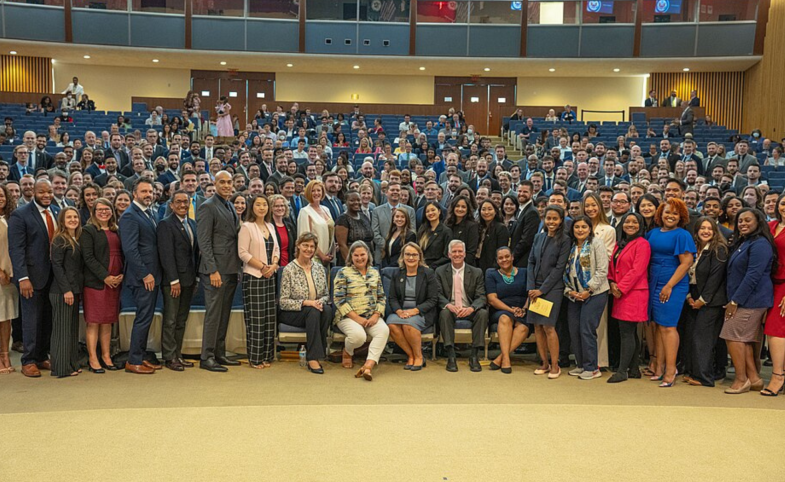
Featured photo: Former Acting Deputy Secretary of State Victoria Nuland swears in the Department’s newest Foreign Service Officers and Specialist during an A-100 graduation ceremony at the U.S. Department of State in Washington, D.C., on August 11, 2023.

Visit CPD's Online Library
Explore CPD's vast online database featuring the latest books, articles, speeches and information on international organizations dedicated to public diplomacy.
POPULAR ARTICLES
-
September 22
-
October 13
-
October 5
-
October 5
-
October 26
MORE FROM THIS AUTHOR
Join the Conversation
Interested in contributing to the CPD Blog? We welcome your posts. Read our guidelines and find out how you can submit blogs and photo essays >.