









The CPD Blog is intended to stimulate dialog among scholars and practitioners from around the world in the public diplomacy sphere. The opinions represented here are the authors' own and do not necessarily reflect CPD's views. For blogger guidelines, click here.
Q&A with Professor Nicholas Cull on Propaganda in the AI Age
Note from the CPD Blog Manager: This post was adapted from an interview between CPD Faculty Fellow Nicholas J. Cull and journalist and USIA veteran Rob Koenig. Read other Q&As about propaganda with Professor Cull, here, here, here and here.
Do you view AI and deep fakes to be essential tools for the future of propaganda? Or will people become so accustomed to AI-generated memes that they will end up ignoring or dismissing nearly everything they see on sites such as X? Does generative AI open the door to revolutionary advances in propaganda, or is it simply a new technique that is likely to have limited long-term impact?
As a historian, my take always seems to begin with the reminder that there is nothing new under the sun, but don’t take too much comfort from that. While the medium of AI is new, the experience of the sudden explosion in materials intended to stir audiences delivered via a new platform is not. Much the same destabilization happened when moveable type, popular newspapers, radio and other electronic media hit audiences. Unfortunately, the track record for human society coping with these new techniques is not good. I see the manipulation of publics at such moments as part of the origin of the Thirty Years War, World War One and World War Two, and can see how new media technologies made the Cold War worse than it needed to be. AI is breaking like a wave on publics already struggling to come to terms with social media. It is exponentially increasing the flow of political propaganda. As ever, we need to respond by drawing attention to manipulation and teaching media literacy and media-specific skepticism. You ask about the future. There are already interesting trends which may predict something of the future. I was struck by the argument over the AI generated images of a young flood victim during the flood disaster in North Carolina in September 2024. A widely seen image purported to show a child in an evacuation boat clinging to a puppy. Supporters of President Biden cried foul and pointed out the AI, but his detractors countered that the point of the image was not its origin but the veracity or otherwise of its claim. To focus on denunciation of an AI image may be as futile as pointing out that a newspaper cartoon is not a photograph or that the ceiling of the Sistine Chapel is pigment in plaster and not the actual face of God, which is to say that they miss the point. I expect that AI will be seen as a tool and debate will shift to the message rather than an unacceptable medium. AI is currently making it harder for ordinary people to evaluate the veracity of news which is a great argument to seek out the most reliable platforms like the BBC, and for diplomacy around limits and regulation. The regulation of AI is on the agenda in Europe which is exactly why big tech puts so much energy into demonizing the European Union.
How do you distinguish between propaganda aimed primarily at a foreign audience and propaganda that seeks to shore up support at home? Early in the Iran war, the White House -- rather than clearly defining the war's aims -- released media mashups that blended highlights from football tackles with footage of missile strikes in Iran. In contrast, given the internet blackout in Iran, the recent Iranian Lego propaganda videos seemed aimed mainly at international audiences. (I recall that when Russia annexed Crimea and sent "volunteer" paramilitary into Ukraine's Donbas region in 2014-15, the Kremlin's propaganda posts and videos, including the use of actors to enact false Ukrainian "atrocities," were in Russian, with a desired audience in Russia and Ukraine.)
I think it is always important to consider the audience for a piece of propaganda. One of the most effective techniques of counter-propaganda is to show a message intended for one audience to a different audience as the desire to please one will reveal artifice to another. USIA did this during the Cold War when it shared the Soviet messaging for the developing world about secret US ethnic bombs with audiences of European journalists in Paris. It made Moscow look bad. I find it revealing that early Iran war messages in the US were so obviously crafted as red meat for the MAGA base. This suggests that the Trump White House, like so many populist regimes before, is only too aware of the need to feed its own supporters as it "rides the tiger" or people craving action. Wartime culture belittling the enemy and glorying in destruction emerges in every war but one hasn’t previously seen the president himself sharing it. The Iranian Lego videos are in English which underlines that they are meant for foreigners. They are largely secular in tone and designed to challenge US claims and embarrass the Trump administration by keeping certain arguments in play: the alleged need to distract the country and the world from the Epstein story; the subservience of the US to Israeli policy; tragedies like the mistaken bombing of the girl’s school and the simple fact that Iran has survived the bombardment. This disrupts the US narrative but will probably not change how the world feels about Iran. The country consistently has the worst rating of any in Anholt’s nation brands index. I think we are looking at something we could call "frame spoiling" in which propaganda on social media so disrupts arguments over the rights and wrongs of a war that global publics see the whole things are toxic. The propaganda capital is there for the country that seems to mediate (like Pakistan) or the country that stands back and models good behavior (like China). Russia has always sought to "frame spoil" its war on Ukraine.
In the "Front Burner" interview for CBC, you compared some of the recent fabricated images from Iran to fakes from previous wars, such as fakes during the Boer War: "You know, there is nothing new. The basic position is we're innocent, you're a terrible bully. That continues across the ages." Were the British fabricating such images for home consumption during the Boer War? Can you recall a few similar instances in more recent wars? I recall that Russian propagandists in 2014 came up with the fake story of a "crucified boy" by Ukrainian soldiers. Is that the same sort of propaganda?
The Boer War case that has caught my attention is not specifically a fabrication but an example of a frame/re-framing. In 1901, a young Boer girl called Lizzie Van Zyl was photographed in the British army’s concentration camp at Bloemfontein in South Africa. She was clearly malnourished and sick with the typhus which soon took her life. A British anti-war campaigner named Emily Hobhouse published the picture as evidence of British government cruelty but the picture was effectively defused when the pro-war cabinet minister Austin Chamberlain falsely claimed that it was taken when Lizzie first entered the camp and that her mother had been prosecuted for child abuse. His claim was that Boers neglected their children and Britain’s war against them was just. This tactic of accepting an image but changing its frame happens often these days. I have found that public sympathy in war flows from three key drivers: perceived morality, perceived similarity and perceived strength or weakness. In the first flush of a crisis global audiences do not all rush to read the three most authoritative books on the background to the crisis, rather they ask 1) who is right and who is wrong? 2) who in this conflict is most similar to me? 3) who is weak and who is strong (with sympathy going to the weaker party in a David/Goliath stand-off). Propaganda battles devote as much energy to points arguments for similarity and noble weakness as to moral purity (perhaps because just causes are so easily muddied). Think how Russia has worked to tell the world how Ukraine is actually the leading edge of a NATO conspiracy or Israel has sought to locate its war on Hamas/Gaza within a wider picture of Iranian sponsorship of regional terrorism. I think that part of Ukraine’s success in communication – its journey from reputational insecurity in 2014 to reputational security in 2022 – lies in its transition from dissimilarity to Europe in 2014 to an acceptance of its essential similarity in 2022.

In that interview, you called propaganda "an enduring element in political history, something that is always there, something that we always have to be looking for, and we always have to be thinking, well, why are we being asked this question? Why are we being told this thing? What is the agenda behind this statement? Who tells us that the world is this way? And I believe this is a fundamental part of media literacy, and part of our citizenship should be to look at international images, to look at media stories, messages that come to us with political meanings and to ask, well, what's this, what's this really about?" My question: Now that AI fabrications are becoming common in social media and some television news, is it possible to better train viewers and readers on "media literacy," so that they are able to identify propaganda? What is the best approach to do so?
We need to respond by drawing attention to manipulation and teaching media literacy and media-specific skepticism. I think that it is a vital task of educators in any age to equip audiences to be on the alert for media manipulation. At some point in each age or media environment this becomes almost proverbial. I remember my grandmother cautioning ‘you can’t believe everything you read in the papers, dear.’ And yet we can’t expect that simply explaining the manipulative nature of medium will fix matters. Social scientists have long been aware of the so-called ‘third person effect’ whereby if you explain the power of a particular form of propaganda people become concerned about the gullibility of others rather than themselves. So calling out AI is not alone the answer. We need to keep talking about how messaging works as maybe remember that the most powerful propaganda is that which engages with what an audience already thinks. Hitler did not invent anti-Semitism and Putin did not invent a narrative of Russian exceptionalism and victimhood. Such people affirm these narratives within their audiences and tie their political fortunes to their supposed unique ability to resolve these problems. Propaganda research needs understand such dynamics and look for the points of contradiction and disruption. I see particular vulnerability flowing from simply remembering what has been said previously. The need for a war on Iran in 2026 surely suggests that the success of the war on Iran in 2025 was exaggerated. Could it be that the most helpful thing a citizen has in this age of AI is a memory?
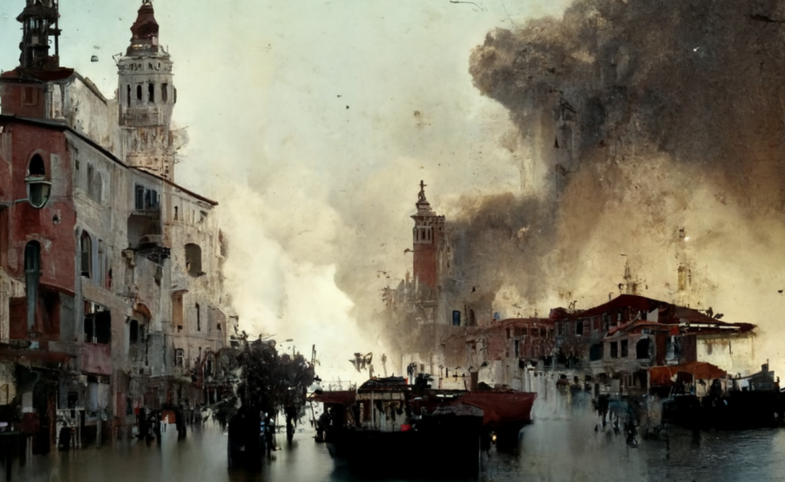
Featured Image: AI generated photograph of Venice under bombardment.

Visit CPD's Online Library
Explore CPD's vast online database featuring the latest books, articles, speeches and information on international organizations dedicated to public diplomacy.
POPULAR ARTICLES
-
September 22
-
October 13
-
October 5
-
October 5
-
October 26
MORE FROM THIS AUTHOR
Join the Conversation
Interested in contributing to the CPD Blog? We welcome your posts. Read our guidelines and find out how you can submit blogs and photo essays >.