









The CPD Blog is intended to stimulate dialog among scholars and practitioners from around the world in the public diplomacy sphere. The opinions represented here are the authors' own and do not necessarily reflect CPD's views. For blogger guidelines, click here.
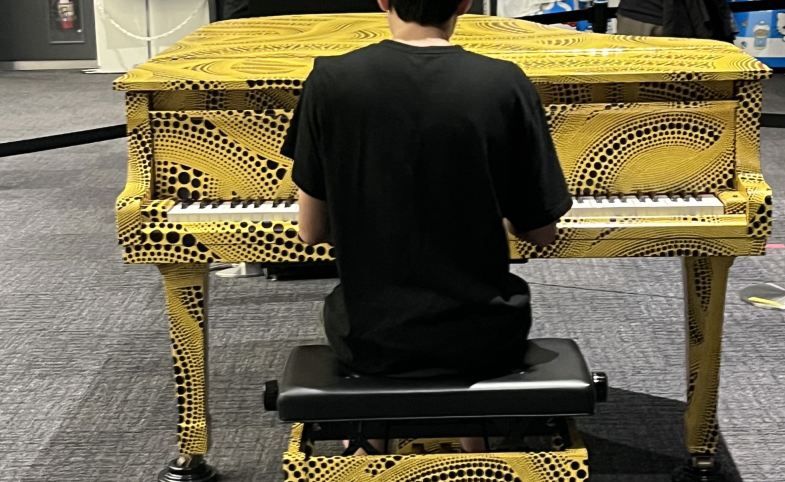
Tokyo’s Top-Floor Memory Piano is a Symbol for City-led Diplomacy
In the middle of a 35-million-person metro area, there is an unlikely place of calm in Tokyo; and it’s not on the foothills of Mount Fuji or in the quiet of Japan’s famed temples.
It is on the 45th floor of the Metropolitan Government Building, where the beauty of 360-degree city views is topped off by the simple sounds of a public piano – a centerpiece of the city’s cultural diplomacy.
For the past seven years, Tokyo, which hosts the World Cities Culture Summit this month, has married music to its free observatory experience. From the bustle and bureaucracy of the city below, two million visitors a year now go up the high-speed elevator for the top floor walk-about, accompanied by the music of the Tocho Omoide (memory) Piano.
“We believe music has the power to connect people across languages and national borders,” said Hibiki Tatesada, a spokesperson for Tokyo’s 50-person international affairs team. “It is important for each city to share the appeal of its unique culture with the world."
My teenage son has participated in global exchanges across three continents, but the piano music in Japan and the calm it brought the floor full of tourists on a recent visit struck him differently. As he commented on how the music itself provided a global language of connection, a young man of similar age stepped off the piano bench. A line of a dozen other visitors shuffled toward the keys. Each playing one song for a few minutes before giving the stage to another traveler.
Live music, like cultural diplomacy is a participatory effort. The shared enjoyment for the player and the listener creates a two-way connection one can’t get by simply streaming the next song or movie.
That’s why it is extra concerning to see cities cutting back their participation in these areas: budgets that curate meaningful itineraries, bring about high-level business and governmental meetings, and inspire new policies that improve local life with global ideas.
My home city of Portland, Oregon recently eliminated its one-person international affairs division. Portland State University also stopped its in-bound study program on sustainable cities—First Stop Portland—in 2023, after a 14-year run serving visiting delegations from around the world.
Such cutbacks parallel U.S. federal government cuts to international aid, and make the work of world affairs councils, universities, and businesses engaged in corporate diplomacy all the more essential to maintain positive global connections.
The US Global Leadership Coalition, a business-backed non-profit focused on American engagement in the world, in its report on effective international assistance has called exchange programs an essential civilian tool of national security. Such programs enhance host communities’ image and reputation, according to 80% of respondents in a recent survey of U.S. communities who participate in cultural diplomacy programs conducted by Global Ties.
"It’s the cultural diplomacy experiences, including regional food, music and entertainment, that often creates the most lasting moments in the mind—perhaps why the piano is called The Memory Piano in Tokyo."
Given these positive impacts, it should be no surprise that the cities that compete best on the global stage for the most high-profile events, the largest trade investments, and overall city-brand visibility, continue to invest in their own subnational diplomatic efforts.
In Tokyo, the city boasts a 50-person international affairs division, often seeking shared global solutions to increasingly complex urban problems. “That is why Tokyo places great importance on multilateral city-to-city cooperation, through which cities bring together their experiences and strengths and learn from one another,” Tatesada said.
Tokyo’s diplomacy aims to benefit visitors as much as locals. In 2023, Tokyo added a free, nightly public laser light and musical performance show, including projections of videos and animation on the government building. One this summer featured scenes from the Japan-invented videogame Pac-Man. (In a classic twist of public diplomacy connections, we learned about the Nights and Lights show from a businessman running a small taco shop featuring mini Japanese and Mexican flags in Tokyo’s Shimokitizawa neighborhood.)
Seoul, with its Guinness World Record-winning 7-story indoor vertical garden, has a whole floor of staff at city hall dedicated to international affairs.
Houston has a six-person international affairs team in a city that hosts over ninety foreign consulates.
In Los Angeles, Mayor Eric Garcetti elevated the role of international affairs to include a deputy mayor, which has been in place for nine years now.
More than 500 other US cities—with or without full-time staff—have established relations with sister cities around the world, creating bridges of cultural understanding and economic partnership.
In each of these cases, city programs and policies become launchpads from which city innovations get shared with peers around the world. Smart cities technology from Korea, alternative energy production from Denmark, or green roof innovations in the U.S. become points of connection to global benefit. But it’s the cultural diplomacy experiences, including regional food, music and entertainment, that often creates the most lasting moments in the mind—perhaps why the piano is called The Memory Piano in Tokyo.
When it was dedicated in 2019 with its black on yellow polka dots overseen by the late famed artist and Tokyo citizen, Yayoi Kusama, she said, “Together with this piano, I wish to speak of all human hope in the love of humanity.”
Governor Yuriko Koike said she hoped the melodies would be “sent throughout Tokyo, throughout Japan, and throughout the world.”
The piano and its roster of global players certainly have. More than 20 million people experienced the music last year.
“We hope that the sound of this piano, played here in Tokyo, will continue to connect people’s hearts, together with Ms. Kusama’s wishes,” Tatesada said.
Neil H. Simon is a Portland, Oregon-based principal of government affairs for global clients through his work at Porter Wright. He served as a diplomat in Washington and Copenhagen and is currently an advisory board member at World Oregon.

Visit CPD's Online Library
Explore CPD's vast online database featuring the latest books, articles, speeches and information on international organizations dedicated to public diplomacy.
POPULAR ARTICLES
-
September 22
-
October 5
-
October 13
-
October 5
-
October 26
MORE FROM THIS AUTHOR
Join the Conversation
Interested in contributing to the CPD Blog? We welcome your posts. Read our guidelines and find out how you can submit blogs and photo essays >.