









The CPD Blog is intended to stimulate dialog among scholars and practitioners from around the world in the public diplomacy sphere. The opinions represented here are the authors' own and do not necessarily reflect CPD's views. For blogger guidelines, click here.
When Mexico Takes the Screen: Loco México Mágico at the Hola México Film Festival in Hollywood
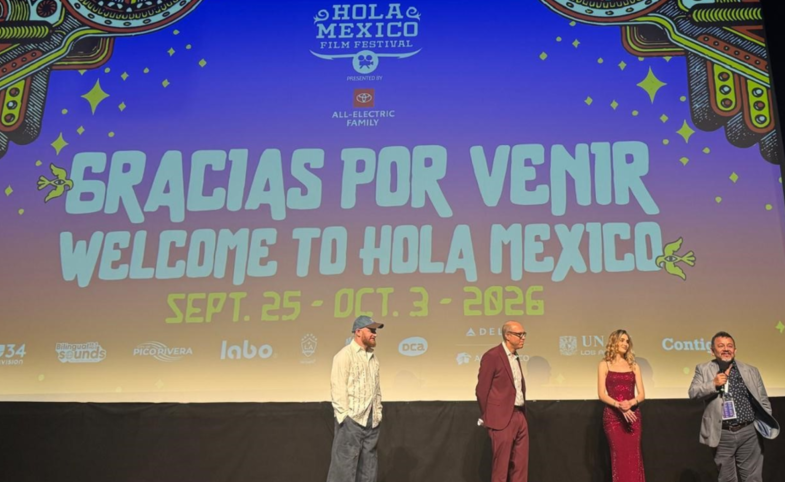
On September 25, I found myself quite literally in Hollywood, walking the red carpet at The Montalbán for the opening night of the 18th Hola México Film Festival. The location mattered. We were on Vine Street, in the symbolic center of an industry that has spent more than a century projecting American stories across the world. Yet that night, the screen belonged to Mexico.
The opening film was Carlos Santos’s Loco México Mágico, a comedy set in Alvarado, Veracruz, where an eccentric mayor decides that the way to turn his town into an international destination is to make a Hollywood-style movie. The plan is chaotic, proudly improvised and very funny. But beneath the comedy sits a serious question: who gets to tell Mexico’s story? The Hola México Film Festival, founded in 2008, describes itself as the largest Mexican film festival outside Mexico. Its 18th edition places more than twenty Mexican films before Los Angeles audiences during Hispanic Heritage Month.
That question became more personal after the screening, when I interviewed Santos about cinema, identity and Mexico’s international image. “Cinema is the most efficient tool to generate identity,” he told me in the our interview. He immediately turned to Hollywood as proof. The United States, he said, understood throughout the twentieth century how effectively film could export culture. His film, he explained, tries to perform that same exercise “in favor of Mexico,” particularly in the present political climate.
That is where a comedy becomes public diplomacy. Nicholas Cull’s classic taxonomy of public diplomacy includes cultural diplomacy alongside listening, advocacy, exchange and international broadcasting. Cinema can move through several of those functions at once. It communicates, but it also creates encounters. Audiences do not simply receive a message about a country; they spend time with its humor, anxieties, accents and contradictions.
Film scholars Stephanie Dennison and Rachel Dwyer have described cinema as a significant site through which soft power and geopolitics interact, while Song Hwee Lim emphasizes that the relationship between film and soft power is also affective: what matters is not only who produces an image, but how audiences feel and respond to it. Their work in Cinema and Soft Power helps explain why a screening can do something a policy statement cannot. It can create familiarity before it asks for agreement.
That possibility matters especially in Los Angeles. Mexico is not abstract here. It is embedded in the city’s history, language, food, neighborhoods and families. At the same time, Mexican identity in the United States is being discussed in an environment shaped by immigration enforcement, deportation fears and recurring debates over the border. The Consulate General of Mexico in Los Angeles has itself become a space where families seek help amid ICE enforcement and uncertainty. In that environment, giving Mexican characters emotional and narrative depth is not politically neutral: it widens the frame through which a community is seen.
Santos returned to this point repeatedly in our conversation. When I asked what he wanted an American audience to take from Mexican cinema, Carlos told me in the interview I conducted with him that one objective was simply to “give screen time to the Mexican.” He said that screen time allows Mexican characters to move away from stereotypes and reveal their “emotions, fears and hopes.” Then he offered the line that stayed with me for the rest of the evening: “Whoever has the microphone has the word and tells the story.”
"Cinema analysis belongs in conversations about international relations: images create familiarity, familiarity creates relationships, and relationships shape how countries are understood long before governments negotiate."
That sentence could almost serve as a theory of cultural power. Joseph Nye’s concept of soft power begins with attraction rather than coercion. Cinema is particularly suited to that logic because attraction is rarely produced by perfect national advertising. It emerges through characters and stories that audiences actually want to follow. A study of Parasite as cultural diplomacy makes a similar point in the South Korean context: a film can become an international image resource precisely because cultural impact travels beyond formal government messaging.
The opening night also made the institutional dimension visible. Carlos González Gutiérrez, Mexico’s Consul General in Los Angeles, was present and addressed the audience before the screening. Seeing the Consul General speak in a Hollywood theater, surrounded by filmmakers, cultural workers, members of the consular team and audiences, made Mexico’s diplomatic presence tangible rather than ceremonial. It was not an embassy reception detached from public life; it was diplomacy embedded in a cultural event.
González Gutiérrez has articulated this broader approach elsewhere in Los Angeles. In announcing Casa México Los Angeles 2026, he described the goal as showcasing Mexico’s “cultural richness, creativity, and hospitality” while strengthening friendship and highlighting the contributions of Mexicans and Mexican Americans to the city. That public statement and his presence at the film festival point to the same diplomatic logic: Mexico makes itself present through culture, community and repeated face-to-face encounters.
For Mexico, the reputational stakes are real. César Villanueva Rivas’s research on Mexico’s international image has examined how stereotypical identities and negative international narratives complicate the country’s image abroad. Cinema cannot erase violence, inequality or migration tensions, nor should it try. Its value lies elsewhere: it multiplies the stories through which Mexico can be understood. It resists the reduction of a country to the issues that dominate foreign headlines.
Film festivals themselves can become part of that infrastructure. Recent research in the International Journal of Cultural Policy describes film festivals as spaces where cultural relations, public diplomacy and professional exchange overlap. Hola México does this from a distinctly Mexican position in Los Angeles: filmmakers meet audiences, industry professionals meet emerging talent, and Mexican institutions share space with cultural producers rather than speaking for them.
Santos also reminded me that Mexico and the United States are inseparable. As he told me in our interview, political moments change, but a shared border and centuries of interaction make the relationship permanent. That may be the most important diplomatic lesson of the evening. Bilateral relations are not made only in presidential meetings, trade disputes or migration negotiations. They are also built in theaters, festivals, classrooms, kitchens and red carpets.
For Latin America, there is a wider lesson. The region has often been narrated internationally through crisis: migration, violence, instability or exoticism. Cultural diplomacy does not require denying those realities. It requires refusing to let them become the only realities visible abroad. When filmmakers control the microphone, they can add humor, contradiction, ordinary life and self-criticism to the picture.
I went to the Hola México Film Festival to watch a comedy. I left thinking about diplomatic power. I had interviewed the director, watched Mexican institutions make themselves present in Hollywood, and seen a Mexican audience laugh at a story that refused to explain itself through someone else’s stereotypes. This is why cinema analysis belongs in conversations about international relations: images create familiarity, familiarity creates relationships, and relationships shape how countries are understood long before governments negotiate.
For one night in Hollywood, Mexico was not merely the subject of somebody else’s political conversation. It held the microphone. And as Carlos Santos told me in our interview, whoever holds the microphone gets to tell the story.

Visit CPD's Online Library
Explore CPD's vast online database featuring the latest books, articles, speeches and information on international organizations dedicated to public diplomacy.
POPULAR ARTICLES
-
September 22
-
October 13
-
October 5
-
October 5
-
October 26
MORE FROM THIS AUTHOR
Join the Conversation
Interested in contributing to the CPD Blog? We welcome your posts. Read our guidelines and find out how you can submit blogs and photo essays >.