









The CPD Blog is intended to stimulate dialog among scholars and practitioners from around the world in the public diplomacy sphere. The opinions represented here are the authors' own and do not necessarily reflect CPD's views. For blogger guidelines, click here.
Whose America Does Mexico See? Elections, Latino Voices and Public Diplomacy
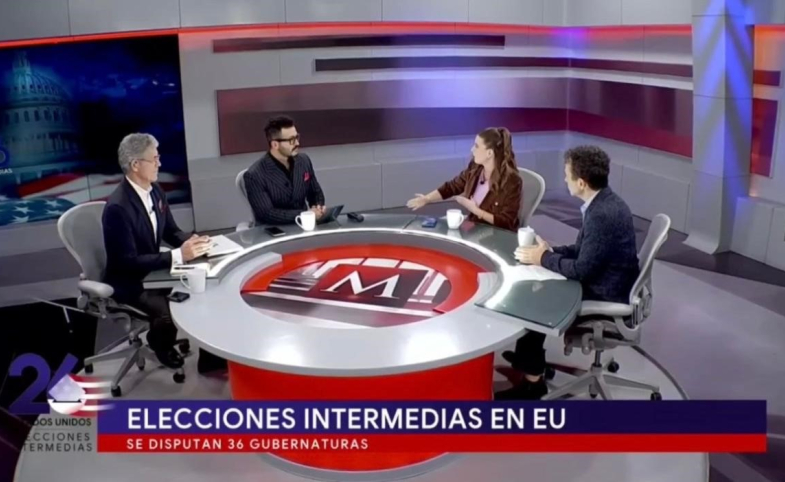
On the day of the U.S. midterm elections, I gave more than ten interviews. Moving between conversations on national television and other media in Mexico, I analyzed the election alongside journalists and fellow specialists. Since returning from my research stay in the United States, I had been receiving requests to discuss American politics. The intensity of that day made me pause: Why did an election across the border feel so close?
As a political commentator, I was there to explain an electoral process. As a scholar of public diplomacy, I began thinking about the relationships that made the explanation matter. The interviews brought me back to a question: Whose America does Mexico see? The answer depends partly on which people our coverage allows audiences to recognize as political actors.

My own position makes this question personal. As a Turkish-Mexican scholar working between languages and national contexts, I am accustomed to explaining one political setting through another. That experience does not erase distance. It makes me more attentive to what gets lost when a complicated society becomes a familiar label. During electoral coverage, the pressure to offer a clear answer is necessary, but clarity can become a problem if it leaves no space for uncertainty. The responsibility is to make complexity intelligible while acknowledging the limits of our vantage point.
There are material reasons for Mexican attention. The U.S. Trade Representative estimates bilateral goods and services trade at $964.1 billion in 2025. Changes in Washington have implications for an economic relationship embedded in workplaces and households. Congress also matters through legislation, spending and oversight, even when the president remains the most recognizable face of U.S. politics. Explaining the midterms requires making those institutions visible.
Yet trade figures cannot fully account for the closeness I felt during the coverage. For families with relationships across the border, American politics can raise intimate questions about security, belonging and the possibility of remaining together. Mexico is a particularly immediate vantage point on a wider Latin American question: how do people understand a powerful country in which relatives, friends and communities of shared origin have built their lives?
This is where public diplomacy becomes useful. Nicholas J. Cull’s account identifies listening, advocacy, cultural diplomacy, exchange and international broadcasting as distinct practices. My interviews were independent journalism and commentary, not an official diplomatic initiative. Their relevance to public diplomacy lies in the space they opened for interpreting another society, beyond the messages its government chooses to project.
That distinction matters. Journalists should retain their independence from diplomatic objectives. Precisely because they do, their choices about sources and context can complicate official representations. An election offers foreign audiences a view of a country arguing with itself. Responsible coverage can help explain those disagreements without treating a president, a party or a television confrontation as the whole society.
Latino political participation makes that interpretive task especially important. Pew Research Center projected approximately 39 million Hispanic eligible voters in 2026, an increase of roughly 5.2 million since 2022. These are estimates of eligibility, not turnout. The distinction is essential: demographic presence creates potential political influence, while participation and the geography of individual contests determine how that potential is exercised.
We should also resist turning “the Latino vote” into a personality. Pew’s demographic research describes a population with diverse national origins that is mostly U.S.-born. Latino identity does not establish a single relationship with migration, language or an ancestral homeland. Nor does it give Mexican observers grounds to expect a particular partisan loyalty. Recognizing political agency means accepting choices that may unsettle our own expectations.
Issue priorities further complicate familiar narratives. Pew’s October 2026 survey identified the economy as Latino voters’ leading issue. Coverage organized exclusively around immigration risks missing how people understand their everyday circumstances. Inviting Latino voices to explain their priorities would help Mexican audiences encounter them as citizens participating in a political society, with concerns that extend beyond their usefulness to a campaign.
Diaspora diplomacy offers another way to understand that encounter. I use the term carefully: Latino populations are not a single diaspora, and not everyone with Latin American ancestry identifies through a homeland connection. Where such connections are active, however, community organizations, journalists and everyday exchanges can carry interpretations between societies. They can challenge representations produced on either side of the border.
Alina Dolea’s work on diaspora diplomacy and emotions explains why these relationships cannot be understood apart from their emotional foundations. Attachment and disruption belong in the analysis. Her framework helped me articulate what my interview schedule alone could not explain: electoral attention may arise from relationships in which political developments acquire deeply personal meaning.
"Mexico is a particularly immediate vantage point on a wider Latin American question: how do people understand a powerful country in which relatives, friends and communities of shared origin have built their lives?"
This also changes what listening requires of institutions. A diaspora cannot be approached only when its members can improve a national image or influence an election. Its disagreements deserve attention, including criticism of Mexico itself. Otherwise, the language of connection becomes selective: people are celebrated as representatives of a homeland while their demands are treated as inconvenient. A relationship capable of sustaining trust must leave room for that discomfort.
This is also why emotion deserves a place in political analysis. Concern for relatives abroad, identification with a candidate or disappointment with a political institution can bring people into an international conversation. Those attachments do not automatically produce understanding. They create an opening that journalists and commentators can either deepen or close. When we explain a Latino voter's choices through a stereotype, we close it. When we ask how that person understands work, rights and belonging, we make a relationship available for interpretation. For public diplomacy, the opportunity is to recognize that connection and learn from it without claiming ownership of its meaning across the different communities involved in it.
The emotional dimension calls for editorial care. Familiar accents and family histories can create recognition, but recognition should invite questions rather than substitute for them. Fear can make a story urgent while narrowing its range of voices. My experience does not establish what Mexican audiences collectively felt; it prompted me to ask how we, as commentators, can acknowledge emotional proximity while preserving complexity.
For me, that means explaining institutions alongside personalities and making room for Latino journalists, researchers and community members throughout the electoral cycle. Public diplomacy practitioners could learn from those conversations by listening to concerns expressed through independent media, without attempting to direct them. Diaspora engagement becomes more meaningful when communities can set questions and disagree with the institutions seeking their participation.
I would like our coverage to keep those conversations alive after the cameras move elsewhere. Following a community reporter or returning to a local organization could reveal how electoral promises meet experience. Such continuity would give the public a fuller account of political life across the border and offer public diplomacy a more grounded understanding of the relationships already connecting our societies.

After more than ten interviews, I was left thinking about the responsibility of interpretation. Returning from the United States gave me experiences to draw on, not authority to speak for its many communities. Mexico’s view of America will always be partial. Public diplomacy can help widen that view when it takes media connections, diasporic agency and emotional attachments seriously enough to listen beyond election day.

Visit CPD's Online Library
Explore CPD's vast online database featuring the latest books, articles, speeches and information on international organizations dedicated to public diplomacy.
POPULAR ARTICLES
-
September 22
-
October 13
-
October 5
-
October 26
-
October 5
MORE FROM THIS AUTHOR
Join the Conversation
Interested in contributing to the CPD Blog? We welcome your posts. Read our guidelines and find out how you can submit blogs and photo essays >.