









The CPD Blog is intended to stimulate dialog among scholars and practitioners from around the world in the public diplomacy sphere. The opinions represented here are the authors' own and do not necessarily reflect CPD's views. For blogger guidelines, click here.
Craft Diplomacy: The Subtle Soft Power of Craft
Craft diplomacy is a form of cultural diplomacy that refers to the promotion and use of craft as a means of fostering cross-cultural understanding and dialogue. By engaging cultural heritage and collective memory, craft offers an accessible means of connection, one that is continually shaped and reshaped through use and exchange.
In an era dominated by rapid digital consumption, craft invites us to slow down. It adds a sensory dimension that goes beyond the merely decorative to encourage a deeper appreciation for how objects are made and valued. The soft power of craft lies in its relational nature, being shaped through ongoing exchanges between maker, material, and the communities that support and situate the work within a broader social context. These qualities are especially evident within the context of craft diplomacy. Within this framework, craft is reimagined as a potent cultural tool of soft power, capable of addressing global concerns such as sustainability, inclusivity, and heritage preservation, while embodying culture as a shared and evolving experience expressed through material practice.
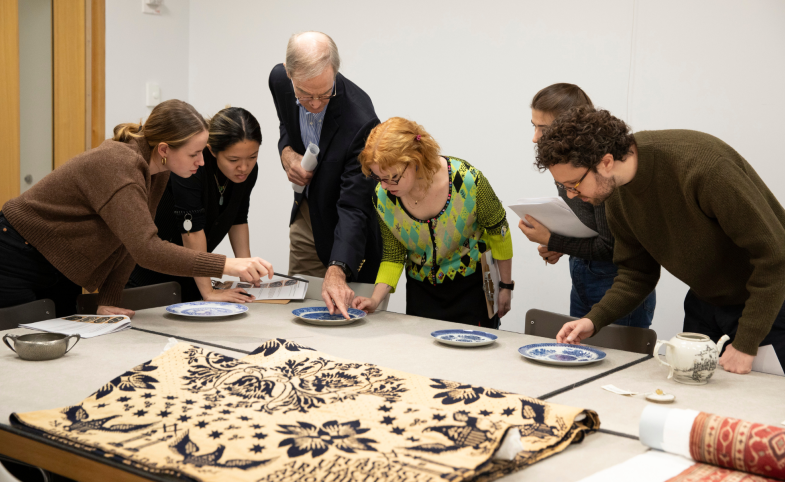
Edward S. Cooke Jr., a leading craft scholar, author of Global Objects: Toward a Connected Art History, and the Charles F. Montgomery Professor of the History of Art at Yale University, offers an expansive and inclusive perspective that situates craft within a global and interconnected context. His work is grounded in an object-driven inquiry, a research practice that begins with the object and works outward from there, attending closely to histories, questions, and relationships embedded within it. From this starting point, broader cultural questions emerge: how craft objects are produced, used, and endowed with meaning, and how those meanings shift as cultures evolve or interact with each other. In this sense, the object actively drives the inquiry, serving as an entry point into the larger cultural systems that generate, sustain and experience it.

Edward S. Cooke
Cooke’s methodology iterates, continually moving between the making, movement, and meaning of objects, with each dimension generating new questions and reshaping interpretation through ongoing engagement. Through this sustained engagement, Cooke encourages a form of material literacy that is informed by cultural curiosity, that asks not only how objects were made, but what forms of knowledge, worldview, and human experience they embody and transmit. Using this framework, the practice of craft diplomacy begins with careful attunement to the processes and practices by which objects come into being, and are used and experienced as meaningful by people in their everyday lives. With this as its focus, the sharing of one culture’s crafts with another serves the kind of human connection through which craft diplomacy seeks to cultivate greater understanding between cultures. Working in this way matters. As Cooke observes, “Studying and teaching about objects, makers, and processes from around the world is crucial for us as responsible citizens of the world.”
Cooke identifies three foundational lessons that emerge from this approach:
“First, it inculcates habits of slow engagement with all senses: sight, touch, smell, and embodiment. In a time of screen-mediated experiences of short duration controlled by swiping and clicking, this sort of slow thoughtful engagement is crucial. We need to take our time when understanding objects, both familiar and unfamiliar. Second, it encourages curiosity since not all parts of an object and its processes are immediately visible. Objects can be like puzzles that need to be solved through rigorous and systematic study. You can only do this when you have cumulative knowledge. Finally, it builds in a tolerance for different solutions to the same problem or different technologies used for making. We tend to believe that our current solutions are the best and most advanced, but that is not always the case. Historical and contextual knowledge reveals a more complex terrain.”
"By approaching craft as a dynamic and critical practice, artists invite engagement that moves beyond historical categorization to position craft as a contemporary vehicle for cultural diplomacy."
Building on Cooke’s object-driven inquiry, leaders in the craft field demonstrate how the principles of craft diplomacy are applied in practice. Rody N. Lopez, the Executive Director of Craft Contemporary, a nonprofit museum in Los Angeles dedicated to contemporary craft, describes how institutions can employ craft to foster cross-cultural understanding and connection:
“As a museum director, I see firsthand how craft serves as a powerful tool for cultural diplomacy. Craft Contemporary has long recognized that handmade art is more than an object, it is a way of life, a vessel of memory, resilience, hope for the future, and a dialogue across cultures. In a world increasingly shaped by rapid digital interaction, the act of making by hand offers a slow, deliberate form of engagement that nurtures empathy, curiosity, and cross-cultural understanding.

Ether: Aromatic Mythologies, installation view featuring espíritu y tierra by Andrés Cortes, 2025. Photo courtesy of Craft Contemporary, Los Angeles. Exhibition installation. (Image: Marc Walker)
“Through exhibitions, multigenerational public programs, and community collaborations, we have witnessed how craft transcends barriers of language, politics, and geography. It offers a shared space where histories are honored, contemporary voices are amplified, and collective healing can begin. By centering diverse makers and their stories, museums like ours become active participants in building a more inclusive and interconnected global community. Craft diplomacy, in this sense, is not simply about preserving tradition, it is about nurturing vibrant, evolving conversations that sustain cultural memory and inspire future generations.”
Natalie Melton, Executive Director of the Craft Council in the United Kingdom, emphasizes the human value embedded in craft:
“We have witnessed an enormous increase in interest in craft in the last two decades, and a renewed appreciation for the values that craft holds — care, authenticity, provenance, sustainability, and deep focus and flow. It is no wonder that this has been matched by an increase in the role of craft diplomacy as a key strategy for developing soft power. The value of craft lies in its humanity. Each crafted object carries with it stories of culture, skill, and community. In sharing these objects and stories, nations extend not power over others, but connection with others. Craft diplomacy provides a vital counterpoint to the international politics of rising tension, adversarial views and military grandstanding that feels far too prevalent right now. The countries that recognize its power, and invest in this, are crafting valuable cultural capital.”

The stand of the Craft Alliance Atlantic Association. (Image: Iona Wolff)
As artists around the world continue to reimagine craft conceptually, renewed attention is drawn to material practices once dismissed as merely prosaic. By approaching craft as a dynamic and critical practice, artists invite engagement that moves beyond historical categorization to position craft as a contemporary vehicle for cultural diplomacy. This shift challenges long-standing hierarchies that have subordinated craft to fine art, and instead reframes it as a medium of exchange that links communities through intertwined histories and shared practices.
With this expanded framework, museums and other cultural institutions play a vital role as cultural mediators, broadening the definition of craft. Adopting curatorial strategies that encourage cross-cultural curiosity and reflective engagement, they enable audiences to uncover the layered meanings embedded in craft as an evolving discourse shaped by movement, context and function. These transformations can be recognized by acquiring the material literacy that brings with it the analytical tools for understanding them, while craft diplomacy reveals their interconnections and contemporary relevance. Together, they model a form of cultural diplomacy that is grounded not in spectacle or persuasion, but in attentiveness, reciprocity, and a recognition of our shared humanity. This is the essence of cultural diplomacy.

Visit CPD's Online Library
Explore CPD's vast online database featuring the latest books, articles, speeches and information on international organizations dedicated to public diplomacy.
POPULAR ARTICLES
-
September 22
-
October 5
-
October 5
-
October 13
-
October 15
MORE FROM THIS AUTHOR
Join the Conversation
Interested in contributing to the CPD Blog? We welcome your posts. Read our guidelines and find out how you can submit blogs and photo essays >.