









The CPD Blog is intended to stimulate dialog among scholars and practitioners from around the world in the public diplomacy sphere. The opinions represented here are the authors' own and do not necessarily reflect CPD's views. For blogger guidelines, click here.
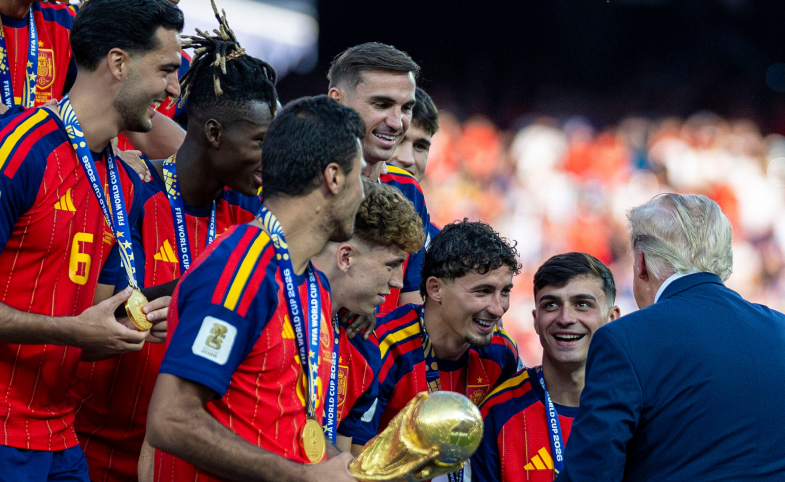
The World Cup’s Bigger Story: Public Diplomacy Beyond the Game
This is the fourth in a series of blogs by Professor Jay Wang, Director of the Master of Public Diplomacy Program at USC Annenberg, focusing on how the eleven U.S. host cities for the FIFA World Cup are represented and discussed across digital and social media environments during the FIFA tournament. Read Part One, Part Two, and Part Three.
The curtain has come down on the biggest FIFA World Cup in history. Having attended several matches and organized a roundtable on mega-events and public diplomacy during the tournament, I have been reflecting on what this World Cup ultimately tells us, not simply about soccer, but about culture, international engagement, and the evolving nature of global mega-events. Beyond the excitement on the pitch, several broader observations stand out.
The first is the continuing fusion of sport and entertainment, which has become a defining characteristic of contemporary global mega-events. The World Cup experience now extends far beyond the ninety minutes of play. Music, elaborate stadium production, fan festivals, and watch parties have become integral components of the event itself. Shared sing-alongs and popular music created moments of collective enjoyment that transcended national and linguistic differences. The extended halftime entertainment during the final closely resembled the Super Bowl halftime show. Some fans understandably lament this development, arguing that it shifts attention away from the sport itself and interrupts the rhythm of the game.
Yet the trend seems unmistakable. Contemporary mega-events are increasingly designed as immersive live experiences rather than sporting competitions alone. They satisfy a deep human desire for conviviality and celebration, one that is both primordial and amplified by digital media, which connect dispersed audiences in shared physical and online spaces.
A second observation concerns the image of the United States. International surveys in recent years, such as those by Pew Research Center, have documented declining global perceptions of the U.S. amid the contentious policies of the Trump era. But the lived experience of the World Cup presented a different America to international fans. Rather than encountering the country primarily through the lens of friction and conflict, international visitors experienced genuine hospitality and competent organization. Across the host cities, fan festivals, bars and restaurants, transit systems, and public squares became spaces where international visitors encountered an America through glimpses of everyday life that felt welcoming and ordinary, a far cry from the headlines and narratives of division and dysfunction that have shaped international perceptions of the U.S. in recent years.
"In the end, the 2026 World Cup demonstrated that contemporary public diplomacy is often most effective not when countries attempt to tell their own stories, but when they create the conditions for others to experience them firsthand."
Perhaps the tournament’s most distinctive feature, however, lay in something uniquely American—its demographic diversity. The country’s vast immigrant and diaspora communities transformed what might otherwise have been a conventional host-country experience into something exceptional. Regardless of whether a participating nation was large or small, supporters often created atmospheres resembling home matches because those communities already existed within American cities. Host cities became temporary transnational spaces filled with flags, chants, and celebrations, blurring the distinction between “host country” and “visiting country.”
As Barbara Keys has observed, sport possesses a special capacity to mediate between national and international identities. This World Cup vividly illustrated that dynamic. Multiple identities coexisted, sometimes comfortably and sometimes with ambiguity and tension when diaspora communities found themselves choosing between their ancestral homeland and their adopted home.
Another notable feature of this World Cup was what did not dominate the conversation: geopolitics. Despite a handful of political controversies that briefly entered the news cycle, the tournament largely escaped being consumed by geopolitical rivalry. For several weeks, the world’s attention centered not on great-power competition or the stalemate of international politics but on the achievements and stories of teams from around the globe. There was something refreshing about allowing other countries to occupy the international spotlight. It may have helped that the U.S., while serving as host, remains outside soccer’s traditional elite, and China did not qualify for the tournament.
Yet one missed opportunity also deserves mention. From a public diplomacy perspective, surprisingly little attention was devoted to the fact that this was a tournament jointly hosted by the United States, Canada, and Mexico. One might have expected a compelling North American narrative emphasizing partnership, regional cooperation, and shared hospitality. Instead, such a trilateral story remained conspicuously absent. Given recent political tensions among the three countries, perhaps this should not be surprising. Still, it represents a missed opportunity, particularly at a moment when renewed attention to the Americas might have aligned well with broader foreign policy priorities.
In the end, the 2026 World Cup demonstrated that contemporary public diplomacy is often most effective not when countries attempt to tell their own stories, but when they create the conditions for others to experience them firsthand. But how significant are these experiences in the larger scheme of global relations? Some may argue that they are transient, superficial, or even trivial. How durable are the memories and impressions created over a few weeks of spectacle and celebration? Cities often promise transformative economic and reputational benefits when bidding to host mega-events. However, the evidence has always been mixed. Did all eleven U.S. host cities benefit equally this time? If not, why did some succeed more than others in translating the tournament into lasting international visibility and reputation? These are questions we will continue to explore as part of a project examining the international impact of the 2026 World Cup on host-city image and reputation.
The Peruvian novelist Mario Vargas Llosa once remarked that soccer is simultaneously “exciting and empty.” Perhaps that is precisely why it matters. For a few weeks, the world’s attention shifted from conflict to competition and from division to shared experience. The tournament’s enduring value lay not in carefully crafted messages but in the countless everyday encounters through which visitors formed their own impressions of places and people. And mega-events compress into a few short weeks the kinds of international encounters that might otherwise take years to unfold.
Note:
The analysis in this series draws on data collected through Brandwatch, a digital media monitoring and social listening platform, using a tailored set of search terms designed to capture conversations related to each host city and the World Cup. The objective is not to provide a comprehensive analysis of all online discussions, but rather to offer a snapshot of prominent narratives, recurring topics, and notable points of attention during the period examined.

Visit CPD's Online Library
Explore CPD's vast online database featuring the latest books, articles, speeches and information on international organizations dedicated to public diplomacy.
POPULAR ARTICLES
-
September 22
-
October 5
-
October 13
-
October 5
-
September 9
MORE FROM THIS AUTHOR
Join the Conversation
Interested in contributing to the CPD Blog? We welcome your posts. Read our guidelines and find out how you can submit blogs and photo essays >.