









The CPD Blog is intended to stimulate dialog among scholars and practitioners from around the world in the public diplomacy sphere. The opinions represented here are the authors' own and do not necessarily reflect CPD's views. For blogger guidelines, click here.
How Two Rescue Dogs Became Symbols of Disaster Solidarity and Public Diplomacy
Public diplomacy is often discussed in terms of messages, exchanges and institutions. In disasters, however, relationships can be built in a more immediate way: through who shows up, who helps and what publics remember afterward. I use the phrase "disaster solidarity diplomacy" to describe the moment when emergency assistance produces a durable relationship in public memory. The communication matters, but the credibility comes foremost from the action.
On February 6, 2023, two powerful earthquakes struck Türkiye. Türkiye’s disaster agency later reported 53,537 deaths and more than 107,000 injuries. The next day, Mexico dispatched a 150-person urban search-and-rescue team coordinated by the Defense, Navy and Foreign Affairs ministries, Civil Protection and the Mexican Red Cross, including canine teams. One of those dogs, Proteo, became the mission’s most visible figure.
Proteo died while deployed in Adıyaman after working in the rubble to locate survivors. Türkiye later publicly thanked Mexico for its assistance and specifically remembered Proteo and the Mexican rescue dogs. His story traveled far beyond the operational details of the mission. It gave Mexico’s solidarity a face—and, unusually, four paws.
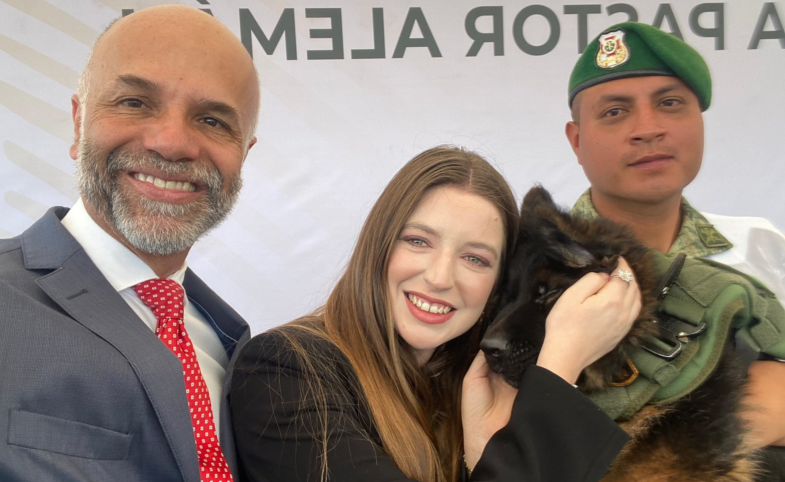
That could have remained a story of emergency assistance. Instead, it acquired a diplomatic afterlife. In May 2023, Türkiye sent Mexico a German shepherd puppy in Proteo’s memory. Mexico invited the public to choose among three names, and Arkadaş — “friend” in Turkish — was selected. The puppy joined the Mexican Army’s canine unit and continued training for search-and-rescue work.
I experienced part of this process from unusually close range. At the time of the earthquakes, I was working with the diplomatic staff of the Embassy of Türkiye in Mexico. I later attended Arkadaş’s welcome and naming ceremony in Mexico City and watched the story circulate across Mexican and Turkish media. What struck me was how quickly an official gesture became a public relationship. People did not need a briefing paper to understand the message: Mexico had come to help Türkiye, Proteo had died in that mission, and Türkiye answered with a living symbol of friendship.
Nicholas J. Cull’s framework helps explain why this matters. Cull treats public diplomacy as a set of practices that includes listening, advocacy, cultural diplomacy, exchange and international broadcasting, with partnership increasingly central to the field. Disaster response is not a conventional exchange program, but it can create the same essential condition: a credible relationship with foreign publics built through participation rather than coercion.
"A rescue mission became shared memory, and shared memory became a symbol of bilateral friendship."
César Villanueva Rivas’s work on Mexico’s country image adds another layer. International images are not produced only by official campaigns; they are shaped by events, narratives and the ways foreign publics encounter a country. Proteo projected an image of Mexico that no tourism slogan could manufacture: competence, sacrifice and solidarity. Arkadaş made that image reciprocal by turning remembrance into a continuing Mexico–Türkiye relationship.
In my recent CPD essay on Mexico’s public diplomacy, I argued that public diplomacy works at human scale when an encounter becomes a relationship. Proteo and Arkadaş show the disaster-response version of that idea. A rescue mission became shared memory, and shared memory became a symbol of bilateral friendship.
Writing this from USC in Los Angeles gives the argument another resonance. California also knows how disasters reshape public memory. The 2025 Eaton Fire killed 17 civilians and destroyed 9,418 structures, while the Palisades Fire killed 12 and destroyed 6,845 structures. In crises of this scale, communities notice who arrives, who stays, what help is useful and whether solidarity continues after the cameras leave. That is why disaster response can have consequences for trust and international perception long after the emergency itself.
There is an ethical limit here. Disaster solidarity diplomacy should never turn suffering into branding. Assistance has to be needed, competent and centered on affected communities. Public diplomacy is strongest when it emerges as a consequence of meaningful action rather than as the reason for it.
Proteo went to Türkiye to search for survivors. Arkadaş came to Mexico as a friend and future rescuer. Together, their story shows how solidarity can cross borders twice: first as assistance, then as memory. That is public diplomacy at its most credible — when the relationship is carried not by a slogan, but by an act people choose to remember.
Featured photo: Talya İşcan with Arkadaş and members of the Mexican Army during Arkadaş’s 2023 welcome ceremony in Mexico City.

Visit CPD's Online Library
Explore CPD's vast online database featuring the latest books, articles, speeches and information on international organizations dedicated to public diplomacy.
POPULAR ARTICLES
-
September 22
-
October 5
-
September 9
-
September 22
-
October 5
MORE FROM THIS AUTHOR
Join the Conversation
Interested in contributing to the CPD Blog? We welcome your posts. Read our guidelines and find out how you can submit blogs and photo essays >.