









The CPD Blog is intended to stimulate dialog among scholars and practitioners from around the world in the public diplomacy sphere. The opinions represented here are the authors' own and do not necessarily reflect CPD's views. For blogger guidelines, click here.
Public Diplomacy in the News: Trump's World Cup Intervention, MMA Diplomacy, & More

Jul 13, 2026

by

“Public Diplomacy in the News” is a CPD Blog series by Andrew Dubbins that spotlights noteworthy stories on public diplomacy topics such as cultural diplomacy, nation branding, exchange programs, international events and conferences, digital diplomacy, and strategic global communications.

Soft power backfire on the world stage. Artis Curiskis of Mother Jones argues that President Trump's reported intervention to overturn a U.S. player's World Cup suspension—and the international backlash that followed—illustrates the erosion of his global soft power. After FIFA reinstated U.S. striker Folarin Balogun following lobbying by U.S. officials, critics across the soccer world accused the organization of political favoritism, prompting outrage from Belgium and UEFA. Belgium's subsequent 4–1 victory over the United States, punctuated by players mockingly performing Trump's signature dance and singing "YMCA," is presented as a symbolic rejection of the president's influence, with Curiskis contending that while Trump may still wield political power, his cultural appeal abroad has become a source of ridicule rather than admiration.

Artis Curiskis / Mother Jones

Sports diplomacy through Mixed Martial Arts. The UFC and the U.S. Department of State have launched a public-private sports diplomacy partnership that seeks to use mixed martial arts as a vehicle for international engagement, cultural exchange, and youth development. Announced during UFC Freedom 250, the agreement positions UFC athletes and coaches as sports ambassadors through the State Department's Sports Envoy Program, where they will lead training clinics and mentorship initiatives around the world. UFC executives and Secretary of State Marco Rubio said the partnership aims to promote values such as discipline, perseverance, excellence, and sportsmanship while leveraging the organization's global reach—its athletes represent 75 countries—to strengthen U.S. public diplomacy during the Decade of Sport in America.

UFC Foundation

Sports Diplomacy or Spectacle? The New York Times’ Frank Bruni argues that the Trump administration’s partnership with the UFC as a form of “sports diplomacy” represents a troubling shift in how the United States projects its values abroad, replacing humanitarian leadership and cultural influence with an embrace of violence, spectacle, and celebrity. He contrasts initiatives such as the Marshall Plan and global health programs with the administration’s promotion of mixed martial arts, contending that the move reflects a broader preference for displays of dominance over compassion, diplomacy, and the arts while also raising concerns about conflicts of interest and America’s international image. Bruni concludes that exporting cage fighting is a revealing symbol of the administration’s priorities and its vision of American power.

Frank Bruni / New York Times

America through World Cup eyes. International visitors attending the 2026 FIFA World Cup are using social media to spotlight the quirks of everyday American life, turning ordinary experiences into viral cultural observations that are resonating worldwide. Patrick Ryan writes that fans have been captivated by everything from Southern hospitality, free drink refills, and massive retail stores to ranch dressing, Taco Bell, school buses, Texas Roadhouse, Dunkin', and even John Denver's “Take Me Home, Country Roads,” illustrating how digital platforms have transformed tourists into global storytellers. Tourism expert Rachel J.C. Fu argues that these viral moments highlight aspects of American culture that residents often overlook, while fostering curiosity, cultural exchange, and a renewed appreciation for the country's everyday customs during the World Cup.

Patrick Ryan / USA Today

America's soft power at a crossroads. Alec del Pino Gil-Casares of the Harvard Political Review argues that the United States built its global influence not through coercion but through the appeal of its culture, institutions, humanitarian leadership, and economic model, yet risks squandering that legacy under President Trump's "America First" policies. Tracing the historical foundations of American soft power—from the Marshall Plan, USAID, and the U.S. Information Agency to Hollywood, Coca-Cola, and international educational exchanges—the essay contends that recent withdrawals from multilateral institutions, cuts to foreign aid, immigration restrictions, and diminished global cooperation have weakened America's international standing. As U.S. favorability declines, the author argues, China has been able to improve its own image less by becoming more attractive than by presenting itself as a more reliable global partner, underscoring the need for the United States to recommit to international engagement if it hopes to preserve its leadership.

Alec del Pino Gil-Casares / Harvard Political Review

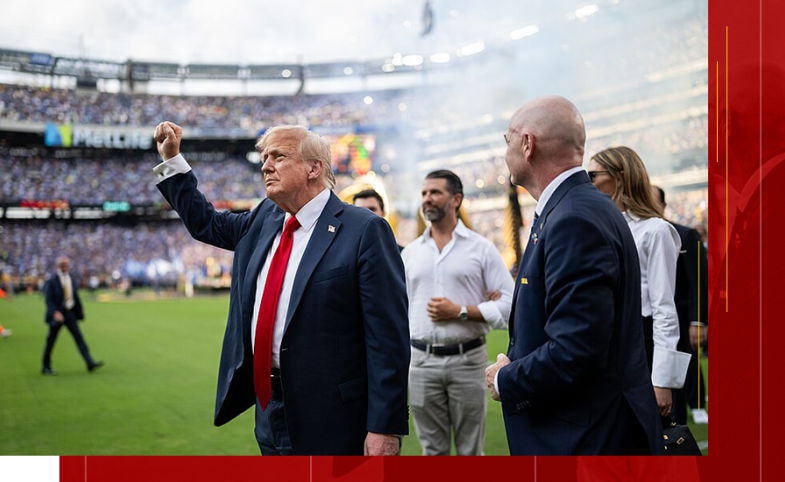
Featured imagePresident Donald Trump and family attend the FIFA Club World Cup Final soccer match, July 2025.

STAY IN THE KNOW

Visit CPD's Online Library

Explore CPD's vast online database featuring the latest books, articles, speeches and information on international organizations dedicated to public diplomacy. 

Join the Conversation

Interested in contributing to the CPD Blog? We welcome your posts. Read our guidelines and find out how you can submit blogs and photo essays >