









The CPD Blog is intended to stimulate dialog among scholars and practitioners from around the world in the public diplomacy sphere. The opinions represented here are the authors' own and do not necessarily reflect CPD's views. For blogger guidelines, click here.
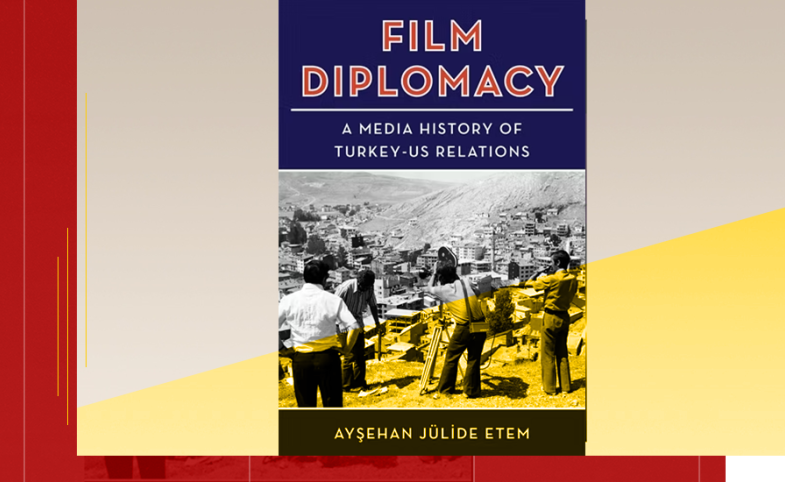
A Review of 'Film Diplomacy': A Media History of Turkey-US Relations
At a time when this public diplomacy scholar is examining the tools and terrains of influence and meme trafficking, Ayşehan Jülide Etem’s Film Diplomacy: A Media History of Turkey–US Relations arrives as a timely intervention and a conceptual expansion of the field. Her book asks us to reconsider the very familiar medium of film not as a passive vehicle of messaging, but as an active, multilayered infrastructure through which diplomacy is enacted, negotiated, and sustained.
Etem’s central contribution is to redefine “film diplomacy” as a process rather than a product. Instead of focusing solely on film content or intent, she foregrounds the entire lifecycle of film: production, distribution, exhibition, and reception. Film, in her account, does not simply transmit meaning; it generates meaning through interaction with audiences, institutions, and contexts. Who addresses that audience, and how, is crucial.
This process-oriented approach also resonates with Nicholas Cull’s well-known taxonomy of public diplomacy activities—listening, advocacy, cultural diplomacy, exchange, and international broadcasting—while complicating it in productive ways. Film, as Etem demonstrates, resists easy categorization. It can operate simultaneously across all five dimensions, blurring the lines between persuasion and mutual understanding. In this sense, Film Diplomacy contributes not only a new term to the lexicon, but a more integrated way of thinking about how public diplomacy actually functions in practice.
The book’s empirical focus on U.S.–Turkey relations is significant. While much of the public diplomacy literature has centered on great power competition or global media industries, Etem turns our attention to a bilateral relationship that has long been strategically important yet understudied in media history. By excavating archival materials from multiple countries and institutions, she reconstructs a dense network of educational film and proselytizing programs that operated from the early years of the Turkish Republic in the 1920s through the Cold War.
What emerges is a fascinating portrait of diplomacy at work far from the formal spaces of embassies and summits. Educational films circulated through schools, community centers, and mobile cinema units, reaching audiences in both urban and rural settings. These films addressed topics ranging from agriculture and health to governance and national identity, embedding diplomatic messages within everyday life. As Etem shows, such films were not peripheral to diplomacy but central to it, functioning as tools for shaping public opinion, aligning policy goals, and fostering bilateral relationships.
One of the book’s most compelling contributions is its attention to institutional actors and infrastructures. Etem highlights the roles of government agencies, international organizations, missionaries, educators, and media professionals in producing and circulating films. This networked perspective challenges the state-centric bias that still characterizes much of the public diplomacy literature. It reminds us that influence is rarely the product of a single actor; rather, it emerges from complex collaborations and sometimes competing agendas.
"For scholars and practitioners alike, Etem’s book offers both a valuable historical account and a conceptual toolkit for understanding the evolving nature of public diplomacy."
Etem does not shy away from the ideological dimensions of film diplomacy. Her analysis of modernization narratives is particularly insightful. Educational films, she argues, promoted a vision of development aligned with Western models, positioning the United States as a benevolent partner and Turkey as a nation on a path toward modernity. These narratives were not merely descriptive; they were prescriptive, shaping how audiences understood progress, identity, and their place in the global order.
Importantly, Etem situates these narratives within broader frameworks of race and power. By engaging with concepts such as whiteness and racialized modernization, she adds a critical layer to the analysis that deepens our understanding of how diplomacy operates. The films she examines do more than promote policies. They are encoders of assumptions about civilization, hierarchy, and belonging. They reveal the subtle ways in which public diplomacy can reinforce, as well as challenge, existing power structures.
Another notable aspect of the book is its focus on audience reception. Too often, studies of media and diplomacy stop at production or intent. Etem goes further by examining how audiences responded to educational films, drawing on surveys, reports, and other archival sources. This emphasis on reception reinforces a key principle of public diplomacy: communication is not complete until it is received, interpreted, and, ideally, acted upon.
Film Diplomacy aligns with a more relational understanding of diplomacy, one that views influence as a two-way process rather than a one-directional flow. The films discussed in the book were not simply imposed on Turkish audiences; they were adapted, interpreted, and sometimes resisted. This dynamic interplay adds nuance to our understanding of how media functions in international contexts.
Ultimately, Film Diplomacy invites us to expand our analytical lens. It challenges us to look beyond messages and narratives to the systems that produce and circulate them. It encourages us to think of diplomacy not only as a matter of policy or rhetoric, but as a set of practices embedded in everyday media experiences.
For scholars and practitioners alike, Etem’s book offers both a valuable historical account and a conceptual toolkit for understanding the evolving nature of public diplomacy. It is a reminder that influence is rarely straightforward, that media are never neutral, and that the most effective forms of diplomacy often operate in spaces we might otherwise overlook.
In bringing film to the center of the conversation, Etem has opened up new avenues for research and reflection. Her work will be of interest not only to those studying U.S.–Turkey relations, but to anyone seeking to understand how culture, communication, and power intersect on the global stage.
A broader takeaway is this: film diplomacy complicates the neat boundaries we often draw in public diplomacy theory. It is simultaneously advocacy, exchange, broadcasting, and listening, at once state-driven and networked, persuasive and pedagogical.
In the end, Etem reminds us of a simple truth: diplomacy doesn’t just speak, listen, or advocate; it screens, circulates, and settles into how people see the world.

Visit CPD's Online Library
Explore CPD's vast online database featuring the latest books, articles, speeches and information on international organizations dedicated to public diplomacy.
POPULAR ARTICLES
-
September 22
-
October 5
-
October 5
-
September 9
-
September 22
MORE FROM THIS AUTHOR
Join the Conversation
Interested in contributing to the CPD Blog? We welcome your posts. Read our guidelines and find out how you can submit blogs and photo essays >.