








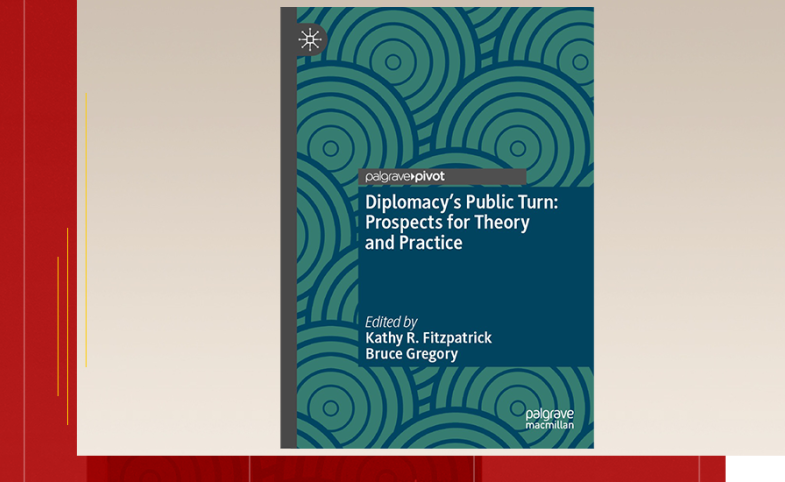
Kathy Fitzpatrick and Bruce Gregory on Diplomacy’s Public Turn
CPD’s Andrew Dubbins sat down with Kathy R. Fitzpatrick and Bruce Gregory, co-editors of the new book Diplomacy’s Public Turn: Prospects for Theory and Practice (Palgrave Pivot, 2026)
Throughout the book, you describe diplomacy’s “public turn” as a major transformation in both theory and practice. What do you see as the single most important shift public diplomacy practitioners need to make in order to remain effective in today’s fragmented and hyperconnected environment?
The book is about a transformative “public turn” in diplomacy’s mid-21st century operational landscape. Diplomats engage more in societies at home and abroad. Citizens and societal groups increasingly operate as diplomatic actors in complex state-society relations. Governments accept public diplomacy as a core component of diplomatic practice. These changes are occurring in an environment shaped by interdependence and fragmentation, urgent geopolitical conflicts, societal polarization, rampant disinformation, declining trust in government, and the disruptive power of artificial intelligence (AI).
Next generation diplomacy practitioners need, first and foremost, to recognize the profound nature of these trends and display a willingness to adopt new strategies, structures, tools, and methods — integrating new and innovative practices with what is enduring and still relevant.
The insights and diverse perspectives featured in this volume point to a variety of ways forward. Reconceptualize diplomacy as a practice where deeply connected states and societies collaborate and negotiate interests, policies, and global responsibilities. Align diplomatic aims with humanity-focused approaches to global challenges. Research and advocate ways in which citizens and societal groups can acquire diplomatic understandings, priorities, and dispositions. Elevate the concept of reputation and the importance of integrity and goodwill in state-society relations. Bridge theoretical and practical gaps through multidisciplinary research and understanding. Build connections with relevant knowledge communities and expertise to enhance diplomatic performance and respond to the challenges of artificial intelligence. Expand awareness among practitioners and policy makers of digital culture and digital sociability and their impacts on practice. Overall, reimagine diplomatic institutions and practices to effectively address complex global issues and integrate new technologies in productive ways.
Several contributors argue that diplomacy is no longer confined to governments and foreign ministries alone. How should diplomats engage with increasingly influential non-state actors, online publics, and civil society organizations without losing diplomacy’s core professional identity?
The book highlights multiple views on the extent to which groups in civil society (corporate, educational, humanitarian, faith-based, diasporas) have standing as independent governance and diplomatic actors, the existence and diversity of plural diplomatic cultures (regional, state, and sub-state), and the diplomatic culture of the international state system.
Contributors generally recognize that without analytical and practice boundaries between diplomacy and other forms of human relations, diplomacy and its public dimension lack content and meaning. At the same time, a “societized” diplomacy means practitioners must embrace a more socially conscious mission that advances shared interests and goals. They must acknowledge that many of today’s problems can only be solved through collaborative networks and partnerships among government, business, NGOs, universities, and other influential groups and organizations.
The authors emphasize the need for practitioners to understand citizens’ expectations and the contributions of non-state diplomatic actors in advancing shared objectives. They must recognize the diverse characteristics of publics and how relationships — online and offline — are formed. Practitioners are challenged to combat disinformation and create shared realities in their engagement with online actors and civil society organizations. In all this, they must prioritize the importance of transparency, integrity, dialogue, and goodwill as they pursue deeper connections with societies both at home and abroad.
The volume explores how AI, digital culture, and disinformation are reshaping diplomacy. Looking ahead five or ten years, what developments in artificial intelligence most concern you, and which offer the greatest opportunity for public diplomacy?
We hesitate to look too far ahead on developments in AI —an exceptionally complex and transformative technology that is changing faster than attitudes and shared knowledge within diplomacy organizations.
Contributors identify opportunities that include AI’s integration into public diplomacy’s tools and methods: data analytics, sentiment analysis, media research, identification of diverse online publics, content creation, program implementation and evaluation. Its demonstrable cost/benefit advantages in knowledge management give practitioners more time for human oversight, strategic planning, creative adaptation, and relationship building — tasks that cannot be delegated to AI’s algorithms. Areas of concern are its use by malign actors to undermine trust and credibility and AI’s creation of plural plausible realities that disrupt efforts to establish shared realities between diplomacy practitioners and publics.
The book’s contributors point to ways practitioners can embrace AI’s promises and mitigate its risks through development of AI-literacy skills, facilitating the epistemic authority of non-state actors, finding credible voices in society that resonate with different online networks, and leveraging the expertise of public-private research institutes.
One of the book’s most compelling themes is the tension between polarization and connectivity. In an era when societies are deeply connected yet increasingly divided, what role can public diplomacy realistically play in fostering dialogue, mutual understanding, or even social cohesion?
A premise of the book, shared by contributors, is that public diplomacy is not only central to everyday diplomatic practice but vital in finding solutions to shared problems and in responding to crises that cross borders. Public diplomats have a long history of adapting tools and methods in radically altered circumstances. So the question is how might they do so again.
Contributors answer with ideas that have global relevance. They include placing greater emphasis on solving problems (climate change, pandemics, conflict resolution), less through messaging and more through collaborative means. Developing expertise and improved patterns of practice by embracing operationally relevant insights in the humanities, social sciences, and sciences. Devoting more attention to disintermediated (“last three feet”) home engagement with citizens on their expectations, political expressions, and diplomatic agency in contested policy issues. Creating and maintaining shared realities in a post-truth world. Encouraging citizens, cities, and NGOs to engage more in public diplomacy when authoritarian national governments undermine diplomacy’s institutions, tools and methods.
This collection brings together scholars and practitioners from multiple disciplines and regions. What do you hope the next generation of public diplomacy students and professionals takes away from this volume as they prepare to navigate diplomacy in an age of societal disruption and technological change?
The book argues that diplomacy and its public dimension are at an inflection point. For students and scholars, diplomacy’s public turn calls for investigation in a broad range of disciplines beyond IR, communications, and diplomacy studies. More research is needed on relations between states and society, on politics and governance within states, on new technologies, on unconventional forms of political and diplomatic participation, and on diplomatic practices in liberal and illiberal societies worldwide.
For next generation practitioners, diplomacy’s public turn means deeper engagement with domestic citizens and groups beyond traditional stakeholders. Recognition that diplomacy increasingly is co-constructed by states and societal actors. An understanding that changes in training and mid-career professional education are essential to improving tools, methods, and patterns of practice and successful whole of government and whole of society diplomacy. The courage to reimagine and achieve change in the face of leaders who undermine diplomacy and professionals resistant to new directions in diplomatic practice. Building capacity to seek out and leverage society’s expertise, norms, and technical skills to diplomatic advantage. And willingness to view diplomacy as a socially conscious instrument that is both interest-based and concerned with problem solving and collaborative effort.
What surprised you in editing this book?
We were a bit surprised that all contributors enthusiastically agreed with the book’s premise that diplomacy is more societized and that public diplomacy is now a central element of diplomacy. Their chapters brought a wealth of knowledge and new insights to what future scholars and practitioners should understand about diplomacy’s public turn in today’s turbulent geopolitical and technological environment. We are grateful for their contributions.
- Kathy R. Fitzpatrick and Bruce Gregory, “Introduction”
- Jan Melissen and Lavinia Pacifici (Leiden University), “The Societization of Diplomacy: Transitioning Operational Landscapes, Shifting Lenses.”
- Paul Sharp (University of Minnesota, Duluth), “Societizing Diplomacy or Diplomatizing Society,”
- R. S. Zaharna (American University), “Pathways to Humanity-centric Approaches to Public Diplomacy as an Instrument of Progress, Prosperity, and Peace.”
- Geoffrey Wiseman (DePaul University), “Regional Diplomatic Cultures and Diplomacy’s Public Turn.”
- Kadir Jun Ayhan (James Madison University), “The Boundaries of Public Diplomacy: Public Turn While Maintaining the Diplomatic Ground.”
- Jian Wang (University of Southern California), “Rethinking the Public in Public Diplomacy.”
- Nicholas J. Cull (University of Southern California), “Reputational Security on the Edge: Diplomacy’s Public Turn.”
- Eytan Gilboa (Reichman University), “Bridging Gaps in Diplomacy Research.”
- James Pamment (Lund University), “Mediatization, Logics of Diplomacy, and the Crisis of Epistemic Security in the Digital Age.”
- Ilan Manor (Ben Gurion University of the Negev), “Towards AI-Enhanced Public Diplomacy? A Quantum Reflection.”
- Elsa Hedling (Lund University), “Digital Public Diplomacy and the Illusion of the Online/Offline Divide.”
- Dan Spokojny (fp21), “What is an Expert? Public Diplomacy in a Complex and Uncertain World.”
- Vivian Walker (Georgetown University), “Reimagining U.S. Diplomatic Practice: The Case for Public Diplomacy.”
- Bruce Gregory and Kathy R. Fitzpatrick, “Conclusion.”
Visit CPD's Online Library
Explore CPD's vast online database featuring the latest books, articles, speeches and information on international organizations dedicated to public diplomacy.
Popular Blogs
-
September 22
-
October 5
-
October 5
-
October 13
-
October 15